Unklian's G3 workbench .

unklian

Western Thunderer
Ian
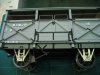
How did you go about painting the ironwork on the Gloucester? I have problems with the paint drying out on the brush too quickly together with an inconsistency in paint finish.

Jon

Jon,
The ironwork was done with a 2/0 Humbrol brush, with Precision dull black enamel well stirred and straight from the tin. I painted each strap as thickly as I dared without the paint flowing over the edges . For the corner plates I went round the edges with the 2/0 and then filled in with a #8 flatie quickly before the edges dried. The photo is fairly flattering as to the final finish mind. I find with hand painting like this speed is of the essence to get each area covered while still wet, so each bit blends wet into wet like in water colouring. However if at the end things are a bit patchy from dull to shiny, a quick blow over with some satin or matt varnish/lacquer will soon even it all out. Took about two hours of a rainy Bank holiday afternoon with nothing else to do ........

Cheers HTH Ian
 

Ian@StEnochs

Western Thunderer
Jon,
The ironwork was done with a 2/0 Humbrol brush, with Precision dull black enamel well stirred and straight from the tin. I painted each strap as thickly as I dared without the paint flowing over the edges . For the corner plates I went round the edges with the 2/0 and then filled in with a #8 flatie quickly before the edges dried. The photo is fairly flattering as to the final finish mind. I find with hand painting like this speed is of the essence to get each area covered while still wet, so each bit blends wet into wet like in water colouring. However if at the end things are a bit patchy from dull to shiny, a quick blow over with some satin or matt varnish/lacquer will soon even it all out. Took about two hours of a rainy Bank holiday afternoon with nothing else to do ........

Cheers HTH Ian


Hi,

Painting straps is a pain and difficult to get the paint on them, without straying onto the body, with a brush. I have found that using a cheap bow pen, on its side, gets the paint right up to the edge without straying, A brush then spreads it and gets it round and over the bolts. Still takes time and patience!

Ian.
 

Jon Nazareth

Western Thunderer
Ian, thanks for explaining your method and,

Ian, thanks for yours. The idea of using a bow pen first and then a brush sounds very interesting. I've never painted straps because of the difficulty in getting up to the edge/going over the and making a pig's ear of the whole thing. What sort of a pen do you have?

Jon
 

jamiepage

Western Thunderer
Jon,
FWIW, when I painted this G1 wagon,
IMG_0008.JPG
I used straight from the pot enamel, applied with a small brush.
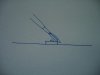
I first went round the edges like so
IMG_0008.JPG
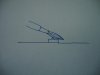
Actually, probably a flatter angle,
IMG_0009.JPG
which defined the edges rather like Ian's bow pen, and then filled in between.
I made no attempt to paint the edges themselves because all the strapping was thin enough for it not to notice. So far, I've only felt it necessary to paint the edges on a wagon with very thick (G3, scale 3in.) outside knees and that wasn't so easy! For most strapping however, I don't think it is necessary.
An overspray of varnish does pull it all together.
Jamie
 

Ian@StEnochs

Western Thunderer
Ian, thanks for explaining your method and,

Ian, thanks for yours. The idea of using a bow pen first and then a brush sounds very interesting. I've never painted straps because of the difficulty in getting up to the edge/going over the and making a pig's ear of the whole thing. What sort of a pen do you have?

Jon


Hi Jon,

Nothing special. I use a Riefler pen from my very old draughtsmans set of instruments which I bought as a student xx years ago. It does draw nice lines but a bit too wide for most lining. However it is great for doing strapping.

Ian.
 

unklian

Western Thunderer
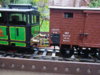
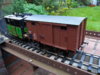
Been a bit quiet in the works as far as home jobs are concerned, but I did get back to the tram engine and replaced the one wheel with a traction tyre with a normal one. It now has three black wheels and one red, which hopefully will get sorted when(ever) it gets painted. Need to get rid of the number thirteen :eek: It does run better, but only when the track is clean, which led to another job. Some sort of track cleaning vehicle. Well after looking at various proprietry solutions I decided the simplest was worth a try and an LGB track cleaning attachment was purchased. This is intended to be fixed under a standard LGB wagon. Looking round for a suitable G3 vehicle I found most of my wagons had brake gear in the way of fitting the device. I then remembered that the first G3 wagon I had built/converted was an LGB van which never got fitted with brakes. That would do .....
RIMG0428.JPG

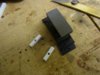
The LGB attachment was hacked into three bits in order to make it wider....

RIMG0418.JPG

Spacers added to make it taller....

RIMG0419.JPG

And then everything screwed to the bottom of the wagon...

RIMG0420.JPG

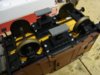
Finally a bit more weight was needed to compress the springs that held the abrasive pads down on the track. A rummage in the workshop for something suitable that wasn't useful for something else turned up this old casting, which was promptly strapped in .

RIMG0426.JPG

And off they went polishing the rails nicely too after a couple of circuits of the garden ......

RIMG0427.JPG

Oh and the strange hieroglyphics on the van. Well you see when I started doing G3 it was all going to be Danish railways, that was before it became French, err and then British :rolleyes:
 

unklian

Western Thunderer
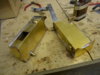
Did some work on a job for a friend today, and although I followed the recommended procedure and it worked out OK, I still feel there must be a better way to make a pair of tanks. They are for a DJB Engineering 16mm narrow gauge side tank and have to be functional . A previous owner of the bits had pressed all the rivets out and done the folding, so for the most part it was a soldering job. I fitted all the add ons first so I could a least solder them from the inside .

RIMG0463.JPG

Then ( don't look Mickoo ) I soldered the halves together from the outside. Bit of a mess !

RIMG0464.JPG

I managed to keep the solder off the outside faces of the tanks so no rivets were harmed . But the join in the top corner of the tanks upstand took some doing. The longest part of the job was then the clean up process.

RIMG0465.JPG

After a fair bit of filing, scraping and sanding I got most of the excess solder off. Fortunately they turned out to be water tight without any further soldering . I have been mulling over for some time how to make a functional water tight saddle tank for my Trojan project, I wonder if anyone else has tried anything similar ?
 

Steve Cook

Flying Squad
Nice job Ian, they look like the tanks for a 'Robert' to me.

I have one of DJB's conversion kits for my Accucraft Ragleth which uses functional tanks (folded up and soldered from etches) to sit within the existing cosmetic tanks of the standard body. I'm debating whether to do something 7/8ths based on the parts and have been pondering the tank issue like yourself. The obvious change is to have both sides and the base as one unit so that folds up into a U shape, perhaps with the ends on as well, but that only saves one long soldered joint at the base of the tank. A removable tank top makes filling and cleaning an easy aspect, as it stands it looks like it will be difficult to clean out the tank which directly feeds the axle / hand pump - did you get any gauze to solder over the feed pipe?

As for the saddle tank, it may be worth while make enough room for some insulation to sit between that and the boiler - I've heard instances where the water in the tank starts to boil as the boiler water level drops.

Steve
 

unklian

Western Thunderer
Thanks Steve,
I must admit I don't like how closed up the one tank is. Gauze ? what gauze ? Hmm I will have to mention that to the fella building the rest of the loco ! I wouldn't have soldered on the pretty 'tank fillers' if it was mine. I like to be able to see inside things .
Thanks too for the tip about insulating the saddle tank, would never have thought that a problem . I think I will have to find a way to join the top and ends together first and then add the bottom curved panel next to the boiler last . I was also wondering how thick and therefore strong the tank should be , given that it is the bit the model is most likely to get picked up by. Mind if it gets that hot perhaps that won't be such a problem :D
 

Steve Cook

Flying Squad
I'm not sure any gauze comes in the kit, but with a hidden pump feed pipe I'd be tempted to try and filter anything out of the water - bits of bugs and grit (given its a coal fired engine, there will be plenty of that about) are a right pain in pumps and clack valves. I suppose that given the feed pipe is on one tank, some kind of gauze could be applied to the inlet of the balance pipe on the 'fill' tank - that would stop things moving between tanks and give an option to spot things clogging up the gauze.

In terms of tank material thickness, Roundhouse use 0.7mm stuff on their Katie loco, but theirs is cosmetic only. I'd probably up the ante a bit for G3, and make sure it has at least two fixings to the boiler so it can be lifted that way.
 

geoff_nicholls

Western Thunderer
Clever move producing a wagon that only comes in pairs, so I'll have to buy two!
what diagram is it? and is there any evidence of them carrying anything other than wood?
 

unklian

Western Thunderer
Well maybe Geoff, I am seriously thinking of selling them in pairs for a price less than two normal size wagons. Trouble is a major part of the cost is the running gear and despite a shorter wheelbase that is all the same as two normal size wagons. The original reason for choosing these wagons was the possibility of casting the chassis/bodies myself, and so keeping the cost down . As it is a friend of mine cast them for a very reasonable sum using better equipment and better material than I could. As I said I will cast the bolsters and the buffers. There will also be the thorny question of instructions and maybe even transfers .
The Diagram is the D1616 . And yes wood was their main raison d'etre, but I have seen them coupled in threes carrying bridge girders, and used as runners under the overhanging loads of bigger wagons . You still need a pair though !
 

geoff_nicholls

Western Thunderer
As my layout terminates at a harbour, I was wondering about a boat.
If your kit is anything like one of Mike's you don't need detailed instructions, tell people to chuck it in the air, it'll land made up.
Could we get away with transfers from the smaller scales?
 

unklian

Western Thunderer
I am not sure you could load a boat like that, the only boat loads I have seen are on a long enough wagon to support the length of the keel . You need a picture I think to be sure .
 

David Taylor

Western Thunderer
I'd be tempted to try and filter anything out of the water - bits of bugs and grit (given its a coal fired engine, there will be plenty of that about) are a right pain in pumps and clack valves.

I agree some sort of filter is a really good idea to avoid bits of stuff ruining ball seats.
 
Top