4mm Correct Lubrication for steel gears

lag503

Member
Hello,

I have a question. I have that Slater's SG4, got ages ago.
Basically an RG4 replacement but with 1:1 steel helical gears as first stage.

Problem is, running it, even without load, those helical gears produce such an amount of friction, the gearbox heats up like crazy, even though the motor still keeps cool.
I tried "turbine oil", plastic compatible PTFE grease, etc, nothing really worked on this.

So, what is considered correct lubrication for such gears? What is everybody else doing in such a case?

Any idea is most welcome.

Thanks already.

Cheers,-w
 

simond

Western Thunderer
I wonder if asking David at Slaters, as something sounds awry here.

In general any normal light “sewing machine” or “clock” oil should be fine, but they’re expensive and typically sold in tiny bottles.

Wahl shaver oil is my go to, about four quid online, used it for years for models, household and my beard trimmer.
 

NickK

Active Member
I wonder if asking David at Slaters, as something sounds awry here.

In general any normal light “sewing machine” or “clock” oil should be fine, but they’re expensive and typically sold in tiny bottles.

Wahl shaver oil is my go to, about four quid online, used it for years for models, household and my beard trimmer.
I'm a Braun man myself. Wouldn't use anything else on my gearboxes.

Nick
 

lag503

Member
Thanks for all the replies, yes i did write to Slaters about that back then right after i experienced this the first time, but did not get a response.

The mesh seems good, not tight and not loose, the gears nicely fold a fagpaper been them without ripping.

The Singer oil i never tried, though. It's heavier, so might do the trick. I'll try this next.

Thank you!
C,-w

The gears shouldn't get too hot, sounds as if it's too tightly meshed. As Simon says ask David White .
'Singer' sowing machine oil on Ebay is fairly cheap.
Beard trimmer oil is good but I've not shaved a Wahl before . :D

I wonder if asking David at Slaters, as something sounds awry here.

In general any normal light “sewing machine” or “clock” oil should be fine, but they’re expensive and typically sold in tiny bottles.

Wahl shaver oil is my go to, about four quid online, used it for years for models, household and my beard trimmer.
 

simond

Western Thunderer
If the gear mesh is not tight, then something else must be.

As you said the motor doesn’t get too hot, my conclusion is that the first countershaft bearings must be the issue. Might be worth dismantling the gearbox and checking each of the shafts run sweetly.

I'm sure if you ring Slaters, David will speak to you if he can, he is very knowledgeable, and I have always found him helpful.
 

Matt Rogers

Member
Can you post pictures? specifically of the gear mesh. Have you looked to determine which gear is getting hot first?

From the image on the Slaters website, the design looks to have a worm gear driven directly from the motor, which would in theory be the biggest source of friction in the gearbox. In my experience of working with industrial gearboxes, that worm has to be shimmed carefully to maintain position, as if the pressure angle changes in the mesh of gears, you can get extreme amounts of additional friction and this heat. Had a couple of worm drive gearboxes run to failure by production in a previous role, which is all well and good, but management (summoned by the stench of burnt oil) tend to be alarmed when they see gearbox casing is glowing...

Might be an idea to remove one gear at a time, starting with the final drive gear, and see where the problem is as a systematic approach.

Regards
 
Last edited:

Tim V

Western Thunderer
When I used to use RG4s (all long gone, replaced with better machines), the grease/oil in them used to coagulate and make them very stiff.

Perhaps something similar has happened to yours? Remove the motor and try moving the gearset by hand. If stiff, try de-greasing the gearset using your favourite degreaser.
 

Fitzroy

Western Thunderer
When I'm designing small geartrains for various things (not just trains) I often reach for two products by Molykote.
Firstly, DX Paste. This is a very light mineral oil/lithium grease. In fact the correct designation for super light greases is "pastes". The idea being the grease is heavy enough to stay stuck to the gears and won't fly off with centripetal force, but light enough to be suitable for very small gears. Rolex recommend it for parts of their watches, and various people resell it under fancy names etc. Kenwood, etc use it for pre-lubrication of their geartrains when new. Its approved for food line use etc.

As a curio, Bassett-Lowke used to recommend in their instructions to use vaseline as a light gear lubricant for similar reasons, but I wouldn't recommend it.

The other product is G-Rapid Plus, which is a light paste but with moly disulphide. Probably exactly the same stuff Meccano used to sell in little tubes. The advantage with this is despite being messy, it has a very low friction coefficient and is recommended to be used for harmlessly running in geartrains and has no ill-effects.

I tend to use DX unless it is very tight and needs serious running-in and I can accept the mess, in which case I turn to the G-Rapid.
I recommend these not from any vested interest, only as a satisfied user on things ranging over the years from model trains to mining equipment and missile subsystems.

Cheers

Pieter
 

lag503

Member
Thank you so much! I will try to find some DX.

Now, I did spend some time with it (again) over the weekend, and my conclusion is, it is the 2 helical steel worms producing immense friction.
Which makes sense. Steel on steel, chafing at each other over quite some surface at high speeds.

It kind of seems like having a 1:1 worm transmission is a bad idea for a fast first stage in a gearbox. (Now is it technically a helical gear or worm?)

I first cleaned it thoroughly, degreaser and all, then checked mesh gear by gear.

No problem there.

Generous mesh everywhere. (No adjustment for mesh between the worms possible in this gearbox. (The sides are screwed and pinned - the block attaching to the motor is drilled precisely for the screw threads - no wobble adjust possible. Very nicely done!)

Also no stuck-bearing problems, as all but the final drive are on fixed axles which are a tight interference fit in the sides.

This is a very nicely machined unit!

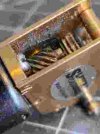
Reassembled fully, then greased it with Labelle 106 (PTFE plastic safe), and let it run for about 5min giving light to no load (when it got so hot I couldn't hold it any more). Yes, the motor got warm, too.

This is what that looked like:

IMG_1.jpg
The grease was originally white, so basically the grease left the worms and those worms are grinding each other down.

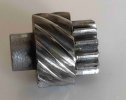
After another thorough clean, this is the second worm up close: I hope the picture is clear enough (never posted a picture here so I'm not sure of the correct procedure) one can see the "polishing" by the driving worm. It really shows where the friction happens: (see the second tooth from the bottom)

gear.SMALL.jpg

I reassembled it, gave it a light coat with light machine oil to prevent rust, and put it away for now. Until I can try the DX.

Thanks again for all the responses and advise.

C,-w
 

Matt Rogers

Member
Now, I did spend some time with it (again) over the weekend, and my conclusion is, it is the 2 helical steel worms producing immense friction.
Which makes sense. Steel on steel, chafing at each other over quite some surface at high speeds.

It kind of seems like having a 1:1 worm transmission is a bad idea for a fast first stage in a gearbox. (Now is it technically a helical gear or worm?)

<snip>

View attachment 246982

This is where it should be, as the sliding action of the gears will produce more fiction than the rolling action of spur gears.

The definition I've always used is based on the input shaft being at 90 degrees to the output output shaft, i.e. where the rolling action of the gears becomes a sliding action, Worm wheels are generally made out of softer material, Phosphor bronze etc, than the worm itself. With the worm wheel being the sacrificial component. Alas the worm is often easier to replace.

The shine on the edge of the gear tells me all is not well, the gear mesh should be on the flank of the tooth, not the tip. Suggestive of the gear being subject to incorrect alignment/ poor lubrication/ overheating.

I'm doubtful any magic lubricant will work now, I suspect the damage has already been done. Might be best to talk to Slaters and replace both gears for new.

Apologies for being the bearer of bad news.

Regards
 

lag503

Member
Thank you, at least now i know where I am with this.
I'll contact Slaters again.
Although I'm not really hopeful that replacing both worms helps, as there is no way to adjust the mesh between the two.

Thanks again.
C,-w
 

Brian McKenzie

Western Thunderer
The shine on the edge of the gear tells me all is not well, the gear mesh should be on the flank of the tooth, not the tip.
Yes, the exceptional photo in post #12, shows there is something seriously wrong with that gear. David White should see that. I suspect the teeth have not been cut deep enough - and this gear has "escaped" when adjusting the machinery for a new production run.

Slater's gearbox casings are machined with 'Swiss' precision, so any issues there are most unlikely.

-Brian McK.
 

Fitzroy

Western Thunderer
Hopefully you can organise a replacement- but my thoughts- if that is not an option, and if the tip is touching the root of the opposing gear and vice versa you could potentially fix the problem by very lightly skimming a thou or so off the tips of the offending gear(s) in a lathe. Given it normally should not contact there, removing material will only improve things- but a last resort! Or you could try G-rapid rather than DX to allow it to run itself in. I don't believe the surfaces that normally should be operating against each other will see load except as a secondary effect of high applied torque due to the tips rubbing in the mating roots.
 

lag503

Member
Thank you for the advise. I did write to Slater's. Let see if i can get a set of replacement worms.
These gearboxes are still offered after all.
 
Top