BR(S) Smokebox Number Plates

Stevers

Western Thunderer
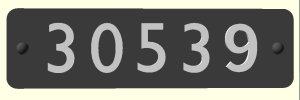
For Q and U Class locos that I'm building, I'm going to need some BR(S) smokebox number plates. Both are examples that worked the Salisbury & Dorset, and as luck would have it, both contain 6 or 9. On the ex-Southern engines these had curled over and under tails. Neither of the numbers needed are available off the shelf and the current suppliers of custom plates only offer the plain Gill Sans 6 and 9. As an aside I have found examples of curled tail 6s and 9s on ex-LNER engines, but it appears to be only on a small proportion of engines. Ex-LMS engines also had the curly tail 6s and 9s, but on plates with a totally different font.

Nobody I have contacted is interested in etching from my own artwork, and I am reluctant to commission my own etches particularly for something that doesn't need to be metallic, so I wondered how feasible it would be to 3D resin print the plates that I would need.
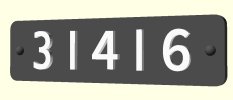
31416 -angled.jpg
A QCAD drawing for the plate outline, and 32 lines of OpenSCAD script later I had something that looked really quite promisingly 'Southern'. I sourced the Gill Sans MT font for all but 4s, 6s and 9s for which I have substituted the Source Sans Pro SemiBold font. 'I' has been used instead of '1' for obvious reasons. In 4mm scale the plates are 2.5mm x 9mm, the corners have a 0.333mm radius and the text height is 1.6mm. These things are tiny and my printer only 4K, though as the bed is small the quoted pixel size is 35 microns. As a sanity check, to visualise the pixel size in relation to the text size a 0.035mm grid was placed over some sample numbers:
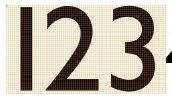
0.035 Pixel Grid.jpg
Given that I can read the smaller 'STEVENS & SONS' on the end of my lever frames this approach looks to be viable. In terms of practicality I shall invest in a bottle of white resin, spray the plates black and rub the paint off the numbers. Whether I print them straight onto the plate or if there is scope for adding the mounting feet on the back is something to be determined.

As examples, two of the engine numbers that I need plus a random T9 to provide an example of all numerals:

31416.jpg 30539.jpg 30728.jpg

I had wondered if I'd have to develop my own font for these, but given how small these actually are, mixing two suitable fonts is probably going to be good enough!

[Edit] While the proportions of the plates look fine and perfectly match photos, further analysis suggests that the plates were the normal size for BR (21"x6") which must mean that the numbers were smaller than the BR Standard - if someone has access to a real plate actual measurements would be much appreciated!
 
Last edited:

Dan Randall

Western Thunderer
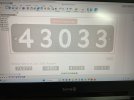
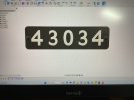
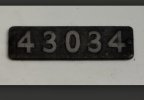
I produced a 3D printed a smokebox plate for my MOK Ivatt 4MT 2-6-0, so it’s certainly doable, at least in 7mm scale.

I found a photo of a plate with suitable digits in an online auction listing, imported it into Fusion 360, traced the digits and copied/positioned them accordingly, to get the number I wanted.…
IMG_1603.jpeg

IMG_1598.jpeg

IMG_1599.jpeg


Excuse the rubbish paint job - it was just to prove the concept….
IMG_1770.jpeg

Because thin resin is prone to go banana-shaped, I Araldited a small piece of nickel silver to the back of it, to keep it flat and give it some strength….
IMG_1845.jpeg

As a possible alternative to etching or 3D printing your own plates, you could always ask Steve Bell at Railtec Transfers to produce some 3D smokebox plate transfers for you. :)


Regards

Dan
 

Attachments

  • IMG_1602.jpeg
    IMG_1602.jpeg
    237.7 KB · Views: 5
Last edited:

Pete_S

Western Thunderer
They do look good - what material are you using - is it thin ply or card?
Neither - it's self-adhesive LaserFoil from Hobarts. 0.1mm white vinyl on a substrate of black acrylic. Very limited colour range which is a pity.

Capable of taking quite a fine cut:

1909_02.jpg
(Full size = 11.75"x7.5" - 7mm ≅ 7mm x 4.5mm)

Larger/post-mounted signs benefit from a thin card backing

Midland_Bathing_01.jpg
(Full size = 26.75"x20" - 7mm ≅ 16mm x 12mm))

Pete
 
Last edited:

Stevers

Western Thunderer
They laser up quite well:
Those are lovely - and self coloured too!
Have done a fair bit of laser cutting/engraving design, and I've found it impossible to get consistent results from multiple suppliers who all seem to have their own way of doing everything. are these raster or vector engraved? Would you be happy to share what software, file formats and hardware you use?
 

Pete_S

Western Thunderer
Those are lovely - and self coloured too!
Have done a fair bit of laser cutting/engraving design, and I've found it impossible to get consistent results from multiple suppliers who all seem to have their own way of doing everything. are these raster or vector engraved? Would you be happy to share what software, file formats and hardware you use?

All vector.
Masters drawn full-size in Illustrator CS6 then scaled 2.298850575% (at least, that's what I copy & paste from Excel into Illustrator :)) to bring it down to 7mm.
That gets imported into Lightburn (v.1.7.03) & the settings adjusted with until I stop swearing.
Machine is a hacked-about Mostics 3018 (Y-axis extension & 10W LaserTree LED head).

For the white/black foil I find 1000mm/min @ 8% engraves well although I've yet to find a line interval that doesn't cause 'ridging' in the black.
In Hobarts last sale I bought a sheet of red/white & was a bit surprised to find that 1000mm/min @1-1.5% gave good results with no ridging:—

LSW_BridgeSub.jpg

Pete.
 

Stevers

Western Thunderer
Suitably chastened in the matter of BR(S) smokebox plate size (6"x21"), I have revisited my numeral sizing to restore proportion, and have concluded that they must have been around 4" high.
30310 at Verwood.jpeg
As a sanity check this is T9 30310 at Verwood with smokebox scaled at 5'4" and wearing one of my revised plates - in this case of course pure 'Gill Sans MT'.

31416.jpg
After looking at hundreds of 'Sans' fonts I have also concluded that 'Yu Gothic UI Semibold' is the least worst compromise for 6s and 9s having that very rare thing - a vertical end to the tail stroke.

Laser engraving of laserfoil stock seems to be the way forward, and if 'gold' foil is used might also work for the curved Adams' nameplates for my LSWR Lion Class Stour.
 

Pete_S

Western Thunderer
I'll nearly agree - I get 22"± a tad based on a selection of BR(S) plates that have been auctioned by GW Railwayana :—

AI_Southern Plates.jpg

There seem to be slight variations in the type height (~4") & plate (~6") too - presumably as a 'feature' of the casting process. I'd guess that each plate had a bespoke pattern (unlike wagon plates) & the workforce (apprentices?) were on piece rates, so even if one was a bit off it got cast anyway.

8441.jpg
41835.jpg

Pete.
 

adrian

Flying Squad
Neither - it's self-adhesive LaserFoil from Hobarts. 0.1mm white vinyl on a substrate of black acrylic. Very limited colour range which is a pity.

Capable of taking quite a fine cut:
Thanks for that - looks very useful. Would I be right in guessing from the original image that you are holding it down with some double sided sticky tape to a baseplate to hold it in position.
 

Stevers

Western Thunderer
I'll nearly agree - I get 22"± a tad based on a selection of BR(S) plates
30776 GWRA.jpg
This is another good straight on view of a GWRA BR(S) plate and from the trace is heading for 22.5" - it looks longer too.

My caveat is that I needed a hanger for a pendulum clock and managed to find a photo of the part I needed. I knew the width of the part so scaled the image from that and then traced it in CAD. The problem being that the length turned out to be 10% short (no obvious parallax error) and the clock of course ran far too fast, until fully regulated.

[Edit] It has just occured to me that the numbers are larger on this one (1.42mm). If I scale the plate so that the numbers are 1.333mm/4", then the plate is 7mm x 1.88mm, so back to 21"!
 
Last edited:

Stevers

Western Thunderer
All vector.
Masters drawn full-size in Illustrator CS6 then scaled 2.298850575% (at least, that's what I copy & paste from Excel into Illustrator :)) to bring it down to 7mm.
That gets imported into Lightburn (v.1.7.03) & the settings adjusted with until I stop swearing.
Machine is a hacked-about Mostics 3018 (Y-axis extension & 10W LaserTree LED head).
The crucial part of that process looks to be the use of Lightburn - a package that seems to have capabilities that are pretty unique!
 

Pete_S

Western Thunderer
Thanks for that - looks very useful. Would I be right in guessing from the original image that you are holding it down with some double sided sticky tape to a baseplate to hold it in position.
I don't use D/S tape as it's a pain to get it to release without causing damage, plus it doesn't stick well to the release paper on the laserfoil. Instead just a few bits of the cheapest decorators' masking tape I could find to hold the sheet flat.

The crucial part of that process looks to be the use of Lightburn - a package that seems to have capabilities that are pretty unique!

I'm a very satisfied user & thought it excellent value when I bought it. It's very intuitive but I don't use it much for designing as I find that side of it to be awkward, although it's quite possible. Any 2D drafting package will do that job, so I'm not inclined to learn another when Illustrator does pretty much all I want.

Pete.
 

Stevers

Western Thunderer
I'm a very satisfied user & thought it excellent value when I bought it.
Lightburn seems to be able to etch from vector images when other laser cutting and engraving packages can only do so from bitmap images - very impressive. I had some 'training' on a vast and expensive Trotec CO2 laser cutter engraver. That was a horrendously complicated process that I never got my head around, but from YT vids I could definitely get to grips with Lightburn.

So the Mostics 3018 is a CNC machine with a working area of 300x180x45mm and potentially available for around £200 and the LaserTree 10W Diode laser perhaps anther £100? Interesting to have CNC and laser capability from the same machine although without an enclosure. For small scale laser engraving I don't suppose the fumes would be much of a problem.
 
Last edited:

simond

Western Thunderer
That very much depends what you are burning.

Card & paper smells as expected.
MDF leaves a horrid oily goo that condenses on the laser and everything around it.
Plastics will emit chemicals you don't want in the house,
and you ain't cutting metal with a 10W diode!

but Lightburn is very good.
 

Penrhos1920

Active Member
I 3D printed this 4mm numberplate back in September. The painted photo, taken today, shows it has curled a little. Next time I do some printing I’ll try shorter exposure for the base layers as they don’t need to be as strong as normal and it should get smaller menisci around the letters.

5778AC33-ADBE-4FD9-8A76-68626EFA5391.jpegC19DE70F-AFB5-4697-8DAD-472B85907F5F.jpeg
 

Stevers

Western Thunderer
I 3D printed this 4mm numberplate back in September. The painted photo, taken today, shows it has curled a little. Next time I do some printing I’ll try shorter exposure for the base layers as they don’t need to be as strong as normal and it should get smaller menisci around the letters.
My Anycubic Photon Mono 4K is up and running and it's time to try this out. Having now gained some practical experience of 3D printing I am completely at a loss as to how something so thin could be supported off the plate in a way that the supports could be removable. There are also lots of reasons (no supports to remove, print times, efficient use of resin) to at least try to print these on the plate. The problem then is that a 4mm scale plate is going to be quite chunky even at 0.5mm, and that is only ten layers at 0.5mm or say fourteen at 0.35mm. The normal burn in layer will suffer from light bleed and is likely to adhere too strongly - especially as flexing my magnetic build plate is unlikely to release something so small and thin.

For a first attempt with Elegoo white water washable resin I'm thinking .035 layers, three 10s burn in layers to reduce the elephants' foot, a couple of layers to transition to nine layers at normal exposure. When printing on the bed I lose 0.5mm somewhere in the first 6mm of printing, but exactly where that occurs is not known except that it's not all in the first 1mm or so. The thoughts and experiences of others much appreciated.
 

NewportRod

Western Thunderer
I 3D printed this 4mm numberplate back in September. The painted photo, taken today, shows it has curled a little. Next time I do some printing I’ll try shorter exposure for the base layers as they don’t need to be as strong as normal and it should get smaller menisci around the letters.

View attachment 253466View attachment 253465
Richard, It looks like these are resin rather than filament printed. Is that right?
Rod
 
Top