

You are using an out of date browser. It may not display this or other websites correctly.
You should upgrade or use an alternative browser.
You should upgrade or use an alternative browser.
7mm The Old Man's Workbench - tales of a rivet side
- Thread starter Dog Star
- Start date

Dog Star
Western Thunderer
An interloper has appeared on the desk... more than one, a small herd of the things... well, actually five of them. Easybuild Mk.1s to go with Peter's Class 37/4. After standing at the kitchen sink with wet-and-dry for the last couple of hours the sides are now ready for someone to drill holes for various fittings including hinges, door handles, bump stops and various grab/commode handles.
Son - "which doors have bump stops?".
Dad - "all those which open outwards except the leftmost passenger doors".
Son - "so not like this?"
Son has found a photo on the 'net which shows the leftmost door, adjacent to the end pillar, with a bump stop. Now there is no way that there can be a corresponding bump stop on the body.... because there is no body at the point where the bump stop might be if the door strap broke. So, looks like the photo shows a Mk.1 which has gained a replacement door. Just waiting for Peter to find a photo of a door, in mid-body, without a bump stop.
Most of the work to add the door details is described in the instructions and is understood.... with the exception of the commode handles (which are to the right of the door lock handle). Photos show that the prototype commode handle is of "flat" section and bolted to the body through the body pillar adjacent to the door opening. If I have identified parts on the etch correctly then the kit provides an etch part for the commode handle and that the etch, when folded, is attached to the body by means of two holes in the body side. A flat etch in a round hole? Is that correct?
Anyone able to post a photo of what they have done here?
regards, Graham
Son - "which doors have bump stops?".
Dad - "all those which open outwards except the leftmost passenger doors".
Son - "so not like this?"
Son has found a photo on the 'net which shows the leftmost door, adjacent to the end pillar, with a bump stop. Now there is no way that there can be a corresponding bump stop on the body.... because there is no body at the point where the bump stop might be if the door strap broke. So, looks like the photo shows a Mk.1 which has gained a replacement door. Just waiting for Peter to find a photo of a door, in mid-body, without a bump stop.
Most of the work to add the door details is described in the instructions and is understood.... with the exception of the commode handles (which are to the right of the door lock handle). Photos show that the prototype commode handle is of "flat" section and bolted to the body through the body pillar adjacent to the door opening. If I have identified parts on the etch correctly then the kit provides an etch part for the commode handle and that the etch, when folded, is attached to the body by means of two holes in the body side. A flat etch in a round hole? Is that correct?
Anyone able to post a photo of what they have done here?
regards, Graham

Phill Dyson
Western Thunderer
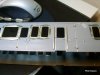
I use round brass rod folded & then flattened for mk1 grab handles as can be seen on the left hand door in the pic below if it's any help Graham.......
Phill
Phill

lancer1027
Western Thunderer
I didnt use the commode brass ones in the kit, i used some lost wax ones off Dick Taylor (Westdale).
Rob
Rob
Dog Star
Western Thunderer
Thank you for the pointer... something to look for at the Reading Trade show. Any chance of a photo of the castings either on or off the model?I didnt use the commode brass ones in the kit, i used some lost wax ones off Dick Taylor (Westdale).
regards, Graham
Dog Star
Western Thunderer
Thank you for posting the photo, what is the carriage?I use round brass rod folded & then flattened for mk1 grab handles as can be seen on the left hand door in the pic...
The Easybuild instructions say to rub down the side before attaching the fittings and window frames - the photo suggests that you primed the side and then added etches... and then used wet-&-dry around the window frames - what caused you to rub down after priming and fitting the window frames?
regards, Graham
Phill Dyson
Western Thunderer
It's a Westdale 121 DMU Graham, but the grab handles are the same as MK1's apart from being chrome rather than brass, so in this instance I used stainless rod rather than brass rod I use for MK1's.Thank you for posting the photo, what is the carriage?
Probably not my best moveThe Easybuild instructions say to rub down the side before attaching the fittings and window frames - the photo suggests that you primed the side and then added etches... and then used wet-&-dry around the window frames - what caused you to rub down after priming and fitting the window frames?
regards, Graham
 , but I used contact adhesive to attach the frames, but they were fine in the end, but did require a little cleaning up afterwords
 Phill
lancer1027
Western Thunderer
Hi Dog Star,
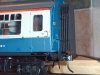
This is a close up of the commode handle on my Easybuild RMB. ( appologies for the photo and again for the very average modelling)
Rob
This is a close up of the commode handle on my Easybuild RMB. ( appologies for the
photo and again for the very average modelling)Rob
Dog Star
Western Thunderer
Thank you for the photo... now I can identify positively the required part on the etch.This is a close up of the commode handle on my Easybuild RMB.
Just checking - the photo shows the Westdale casting?
regards, Graham
lancer1027
Western Thunderer
Yes its the westdale lost wax casting. Theres 10 on the sprue for about £4
Rob
Rob

mickoo
Western Thunderer
Regarding earlier posts on A4 cabs, I have finally come across the definitive photo that shows all that is necessary to resolve said questions .
http://www.flickr.com/photos/dave1963/8118366909/sizes/h/in/pool-795326@N23/
.http://www.flickr.com/photos/dave1963/8118366909/sizes/h/in/pool-795326@N23/


Dog Star
Western Thunderer
Glad you have found this photo as the evidence agrees with what I was told recently (thank you Mr.Caggers... who was standing alonside 3 of the 6 at Shildon a few days back).Regarding earlier posts on A4 cabs, I have finally come across the definitive photo that shows all that is necessary to resolve said questions...
Dog Star
Western Thunderer
The EZ Mk.1s are to run with Cl37/4 no. 37408 (Large Logo Blue with the West Highland Terrier emblem and ends dipped in custard - the terrier must have been rooting in the Yorkshire Rhubarb Fields). So the period is 1985-1988 and a lot of water has flown under the bridge since the Mk.1 first rolled in 1951... which rather means that the fleet had been reduced significantly in numbers and that the survivors might well have suffered "improvements" over the years. The challenge here was to decide on:-
* which types of carriages were running with refurbished Class 37s in the chosen period?
* which examples of the chosen coach type had survived and were working in Scotland?
* what modifications might have been made to the selected examples?
Given that my preferred railway and period is GW&GC Jt circa October 1910 then we are four hundred miles and 75 years from the comfort zone... and I started with no idea as to which kits to buy at the EZ Sale at Telford. Now that we have the kits for the selected prototypes other WT readers might be interested in how we got from Here to There (and back again). Those of you with a nervous disposition might like to study a crochet pattern or service the car for the next bit... whilst those S7 modellers with their own Time And Relative Displacement In Space transport can explore other continuums whilst considering why they did not offer to sort this problem for me.
The first step was to determine where 37408 was running when first released to traffic - there is a web-site with allocation and movement details for all members of the class and that web-site provided the answer, Eastfield hence the Westie on the side of the engine.
The next step was to look for photographs showing services on the West side of Scotland, in the period 1986-88, and with Cl37/4 haulage. Amongst the many examples which fitted the requirement was a hum-dinger of 37408 by Bob Lumley (reference by Mickoo in an earlier post to this forum). These photographs gave hints as to the types of carriages which were being used for services hauled by 37/4 power.
Richard Carr enabled the next step forward when he suggested "buy a copy of Platform 5's book on Loco-hauled Passenger Stock for 1986". This advice was duly taken... and the book provides details of which Mk.1s were still running in 1986 together with design codes and depot allocations.
Robert Reid provided the key for the next step by suggesting which depots were most likely to have been responsible for the stock seen in the prototype photographs. In the period of interest most of the Mk.1s in Scotland were allocated to:-
* Inverness (not likely to have worked on the West side of Scotland);
* Fort William (for the Jacobite services and hence not running behind Cl37/4 units);
* Polmadie (and from which the final selection was made).
Taking the information from the Platform 5 book and the suggestion from Bob we were able to produce a list of potential Mk.1s which were ETH fitted and of the carriage types shown in the photographs. A list of coaches with corresponding design codes does not help when the EZ list of kits gives carriage types by diagram. Bob to the rescue again - I sent our list of candidates to Bob and he annotated the list with the corresponding BR diagram. The revised list now enabled me to choose examples which could be built from the EZ range and were fitted with vacuum brakes and ETH as a minimum. Further, the information in the Platform 5 book resolved the question as to which type of bogie would have been fitted to the selected examples.
Something like two months from start to finish... many internet and telephone conversations... and a "final" list was drawn up by 8pm on the Friday before Telford. The rest would be easy....
Saturday 10.01am and in front of the EZ stand at Telford.... list in hand... "BCK please". "Sorry sold out". "Sold out by 10.05am?" "Yes... sold out before the show opened". Best laid plans of Mice and Men etc.. Thankfully the prepared list included seven examples and we needed just five kits. The BCK became a BFK and we left happy.
The kits and elected examples:-
RMB, diagram 99, no. 1857 or 1861, Commonwealth bogies, dual heat, dual brake;
BFK, diagram 161, no. 17005, BR1 bogies, dual heat, vacuum brake;
CK, diagram 126-128, no. 7197 or 7238, Commonwealth bogies, dual heat, vacuum brake;
SO, diagram 94, no. 4816, B4 bogies, dual heat, vacuum brake;
TSO, diagram 93, no. 4902, 4909 or 4916, B4 bogies, dual heat, vacuum brake.
Thankfully, all of the above are coaches which were built with window frames.
One might be forgiven for thinking that the rest is easy, "just build it". Humm, not quite. Take the RMB for example... what needs to be added for the air-brake equipment? how is the air-brake integrated with the vacuum brake rigging? Only the BFK will be modelled with brake rigging as designed originally... those coaches with B4 or Commwealth bogies need the supports for the vacuum cylinders / brake cross-shaft to be modified and possibly moved.
Did I mention the interiors? The Platform 5 book records that two of our chosen five had been subject to an interior facelift by 1986... now what does that mean?
Substituting brass etches for the plastic trussing is an easy change...
regards, Graham
* which types of carriages were running with refurbished Class 37s in the chosen period?
* which examples of the chosen coach type had survived and were working in Scotland?
* what modifications might have been made to the selected examples?
Given that my preferred railway and period is GW&GC Jt circa October 1910 then we are four hundred miles and 75 years from the comfort zone... and I started with no idea as to which kits to buy at the EZ Sale at Telford. Now that we have the kits for the selected prototypes other WT readers might be interested in how we got from Here to There (and back again). Those of you with a nervous disposition might like to study a crochet pattern or service the car for the next bit... whilst those S7 modellers with their own Time And Relative Displacement In Space transport can explore other continuums whilst considering why they did not offer to sort this problem for me.
The first step was to determine where 37408 was running when first released to traffic - there is a web-site with allocation and movement details for all members of the class and that web-site provided the answer, Eastfield hence the Westie on the side of the engine.
The next step was to look for photographs showing services on the West side of Scotland, in the period 1986-88, and with Cl37/4 haulage. Amongst the many examples which fitted the requirement was a hum-dinger of 37408 by Bob Lumley (reference by Mickoo in an earlier post to this forum). These photographs gave hints as to the types of carriages which were being used for services hauled by 37/4 power.
Richard Carr enabled the next step forward when he suggested "buy a copy of Platform 5's book on Loco-hauled Passenger Stock for 1986". This advice was duly taken... and the book provides details of which Mk.1s were still running in 1986 together with design codes and depot allocations.
Robert Reid provided the key for the next step by suggesting which depots were most likely to have been responsible for the stock seen in the prototype photographs. In the period of interest most of the Mk.1s in Scotland were allocated to:-
* Inverness (not likely to have worked on the West side of Scotland);
* Fort William (for the Jacobite services and hence not running behind Cl37/4 units);
* Polmadie (and from which the final selection was made).
Taking the information from the Platform 5 book and the suggestion from Bob we were able to produce a list of potential Mk.1s which were ETH fitted and of the carriage types shown in the photographs. A list of coaches with corresponding design codes does not help when the EZ list of kits gives carriage types by diagram. Bob to the rescue again - I sent our list of candidates to Bob and he annotated the list with the corresponding BR diagram. The revised list now enabled me to choose examples which could be built from the EZ range and were fitted with vacuum brakes and ETH as a minimum. Further, the information in the Platform 5 book resolved the question as to which type of bogie would have been fitted to the selected examples.
Something like two months from start to finish... many internet and telephone conversations... and a "final" list was drawn up by 8pm on the Friday before Telford. The rest would be easy....
Saturday 10.01am and in front of the EZ stand at Telford.... list in hand... "BCK please". "Sorry sold out". "Sold out by 10.05am?" "Yes... sold out before the show opened". Best laid plans of Mice and Men etc.. Thankfully the prepared list included seven examples and we needed just five kits. The BCK became a BFK and we left happy.
The kits and elected examples:-
RMB, diagram 99, no. 1857 or 1861, Commonwealth bogies, dual heat, dual brake;
BFK, diagram 161, no. 17005, BR1 bogies, dual heat, vacuum brake;
CK, diagram 126-128, no. 7197 or 7238, Commonwealth bogies, dual heat, vacuum brake;
SO, diagram 94, no. 4816, B4 bogies, dual heat, vacuum brake;
TSO, diagram 93, no. 4902, 4909 or 4916, B4 bogies, dual heat, vacuum brake.
Thankfully, all of the above are coaches which were built with window frames.
One might be forgiven for thinking that the rest is easy, "just build it". Humm, not quite. Take the RMB for example... what needs to be added for the air-brake equipment? how is the air-brake integrated with the vacuum brake rigging? Only the BFK will be modelled with brake rigging as designed originally... those coaches with B4 or Commwealth bogies need the supports for the vacuum cylinders / brake cross-shaft to be modified and possibly moved.
Did I mention the interiors? The Platform 5 book records that two of our chosen five had been subject to an interior facelift by 1986... now what does that mean?
Substituting brass etches for the plastic trussing is an easy change...
regards, Graham
Dog Star
Western Thunderer
Some good news and some news that might lead to good things...
The good news...
I have received a missive from Bob Reid today about the corrision repairs to Mk.1s, more specifically to the coaches which we have selected for our models. Apart from providing pointers to photos of most of the selected vehicles circa mid-1980s Bob has confirmed that each of the carriages had external window frames (either from new or in repair) and visible corrosion repairs to the bodyside adjacent to the door openings ( as against non-visible corrosion repairs to the drip rail if such had been applied).
The news which might lead to good things...
I shall have to go down to the Mid-Hants to see just how the body repairs to Mk.1 door openings accomodate the door hinges and the commode handles. Also measure the vertical "strip adjacent to the door so that we can add that detail to the body side.
Still, progress of a sort.
regards, Graham
The good news...
I have received a missive from Bob Reid today about the corrision repairs to Mk.1s, more specifically to the coaches which we have selected for our models. Apart from providing pointers to photos of most of the selected vehicles circa mid-1980s Bob has confirmed that each of the carriages had external window frames (either from new or in repair) and visible corrosion repairs to the bodyside adjacent to the door openings ( as against non-visible corrosion repairs to the drip rail if such had been applied).
The news which might lead to good things...
I shall have to go down to the Mid-Hants to see just how the body repairs to Mk.1 door openings accomodate the door hinges and the commode handles. Also measure the vertical "strip adjacent to the door so that we can add that detail to the body side.
Still, progress of a sort.
regards, Graham
Dog Star
Western Thunderer
In between working on the PW for Hartley Hill and helping Peter with his kits (read as FFA, HAA, Mk.1 rake, Cl.37/4... ) I occasionally get the opportunity to do something for myself. This week is not as hectic as usual and I have been doing a "homer". Well, it will be a homer at some point, just a long way to go as you will see.
The GWR had some rather natty parcels and luggage vans in the late Victorian / early Edwardian period, mostly from the Dean period so elegant in appearance, consistent in design (an important attribute for what is yet to come), bu**ers to model from scratch (fully panelled sides and ends, turnunder for sides and ends, centreless bogies, gas lit, lots of brass handles all over the place) and a painter's nightmare (crimson lake, lined in gold). Thirty years or so ago one could buy a Keyser 4mm kit for the Dean 40' PLV otherwise known as Diagram K14... around the same time an etched brass kit was introduced for the same diagram in 7mm (Metalmodels and recently Blacksmith Models).
Nothing unusual about the kits in either scale... what was unusual was what was not done by the manufacturers. If you have access to Russell's GWR Coaches (OPC circa 1970) or maybe Model Railway Constructor (1967-ish) then you can read all that you want about the K14 coaches - typical Dean style, guard's lookouts, no clerestory, no corridor... just what every good 1900-30s GWR layout ought to have to run with the archtypical four wheel passenger stock. Keep on reading those references a bit more, or maybe stare a bit harder at the photographs, and something interesting comes to light. Diagram K14 is the best known diagram in a family of 40' PLV diagrams, for example:-
* PLV with guard's lookout and ends with full panelling;
* PLV with guard's lookout and ends with corridor connections;
* PLV with guard's lookout and ends built for corridor connections... and no gangways;
* as above, omit guard's lookout.
So at least six diagrams for what is the same design of carriage body. Hmm, now why did those kit manufacturers not take advantage of the similarity of styles to increase the possibilities?
I can hear some of you thinking "where is this leading?", simples! I have started on the production of a body shell for a generic 40' PLV where the "visible" ends shall be dummies and provided as separate castings /mouldings. At this time the ends with full panelling are to come from the Slater's range of Dean's coaches whilst the other two variants are to be new patterns for resin casting. The body is to be a single resin casting for floor, sides and dummy ends (in the Jenks style)... what is not yet clear is how to cope with the fitting or otherwise of the guard's lookouts.
Apart from the references noted earlier I have little else in the way of photographs... any pointers to photos of the K14 /K15 / K16 body styles, with or without lookouts shall be appreciated.
regards, Graham
The GWR had some rather natty parcels and luggage vans in the late Victorian / early Edwardian period, mostly from the Dean period so elegant in appearance, consistent in design (an important attribute for what is yet to come), bu**ers to model from scratch (fully panelled sides and ends, turnunder for sides and ends, centreless bogies, gas lit, lots of brass handles all over the place) and a painter's nightmare (crimson lake, lined in gold). Thirty years or so ago one could buy a Keyser 4mm kit for the Dean 40' PLV otherwise known as Diagram K14... around the same time an etched brass kit was introduced for the same diagram in 7mm (Metalmodels and recently Blacksmith Models).
Nothing unusual about the kits in either scale... what was unusual was what was not done by the manufacturers. If you have access to Russell's GWR Coaches (OPC circa 1970) or maybe Model Railway Constructor (1967-ish) then you can read all that you want about the K14 coaches - typical Dean style, guard's lookouts, no clerestory, no corridor... just what every good 1900-30s GWR layout ought to have to run with the archtypical four wheel passenger stock. Keep on reading those references a bit more, or maybe stare a bit harder at the photographs, and something interesting comes to light. Diagram K14 is the best known diagram in a family of 40' PLV diagrams, for example:-
* PLV with guard's lookout and ends with full panelling;
* PLV with guard's lookout and ends with corridor connections;
* PLV with guard's lookout and ends built for corridor connections... and no gangways;
* as above, omit guard's lookout.
So at least six diagrams for what is the same design of carriage body. Hmm, now why did those kit manufacturers not take advantage of the similarity of styles to increase the possibilities?
I can hear some of you thinking "where is this leading?", simples! I have started on the production of a body shell for a generic 40' PLV where the "visible" ends shall be dummies and provided as separate castings /mouldings. At this time the ends with full panelling are to come from the Slater's range of Dean's coaches whilst the other two variants are to be new patterns for resin casting. The body is to be a single resin casting for floor, sides and dummy ends (in the Jenks style)... what is not yet clear is how to cope with the fitting or otherwise of the guard's lookouts.
Apart from the references noted earlier I have little else in the way of photographs... any pointers to photos of the K14 /K15 / K16 body styles, with or without lookouts shall be appreciated.
regards, Graham

Buckjumper
Flying Squad
This week is not as hectic as usual and I have been doing a "homer".
Is that Homer as in an epic odyssey, or Homer as in 'Doh!' ?

Dog Star
Western Thunderer
Oh come on, Sir! You know the answer... you have been party to some of the discussions about the methods to be used.Is that Homer as in an epic odyssey or Homer as in 'Doh!' ?
One thing is for sure, there is no room for a Doh! moment in this job.
Graham

jamiepage
Western Thunderer
Graham,
Very interesting stuff.
What was there in place of duckets on the less endowed vehicles?
Would the idea of separate body side sections (left and right of the central area), coupled with an optional moulding for either ducket or 'other' reduce the amount of master making?
The 'central' bit could extend across the vehicle in the interests of alignment and structural integrity if you felt it desirable.
Jamie
PS One possible advantage of building up the sides from three elements is that provision then exists at the vertical mating surfaces to adjust overall lengths slightly if necessary- shaving off a tad or adding a sliver may help balance a pair of sides.
Very interesting stuff.
What was there in place of duckets on the less endowed vehicles?
Would the idea of separate body side sections (left and right of the central area), coupled with an optional moulding for either ducket or 'other' reduce the amount of master making?
The 'central' bit could extend across the vehicle in the interests of alignment and structural integrity if you felt it desirable.
Jamie
PS One possible advantage of building up the sides from three elements is that provision then exists at the vertical mating surfaces to adjust overall lengths slightly if necessary- shaving off a tad or adding a sliver may help balance a pair of sides.
Dog Star
Western Thunderer
The vehicles without duckets were built with duckets, just that the GWR removed the duckets and "panelled" over the opening at a later date.What was there in place of duckets on the less endowed vehicles?
Would the idea of separate body side sections (left and right of the central area), coupled with an optional moulding for either ducket or 'other' reduce the amount of master making?
One possible advantage of building up the sides from three elements is that provision then exists at the vertical mating surfaces to adjust overall lengths slightly if necessary- shaving off a tad or adding a sliver may help balance a pair of sides.
When I have completed one side and shown the result to the intended manufacturer of the full kit then I shall be able to include a photo or two... in the meantime, there are seven "slices" to each side of the body.
regards, Graham