3D printing

DavidinAus

Western Thunderer
Am I going over old ground? If so, I apologise.
I have decided it might be a good thing to learn how to use a 3D drawing program, and the one I have chosen is the freeware "FUSION 360" one.
The learning process is not easy, but it's coming along. The possibilities are enormous.
A few revelations though.
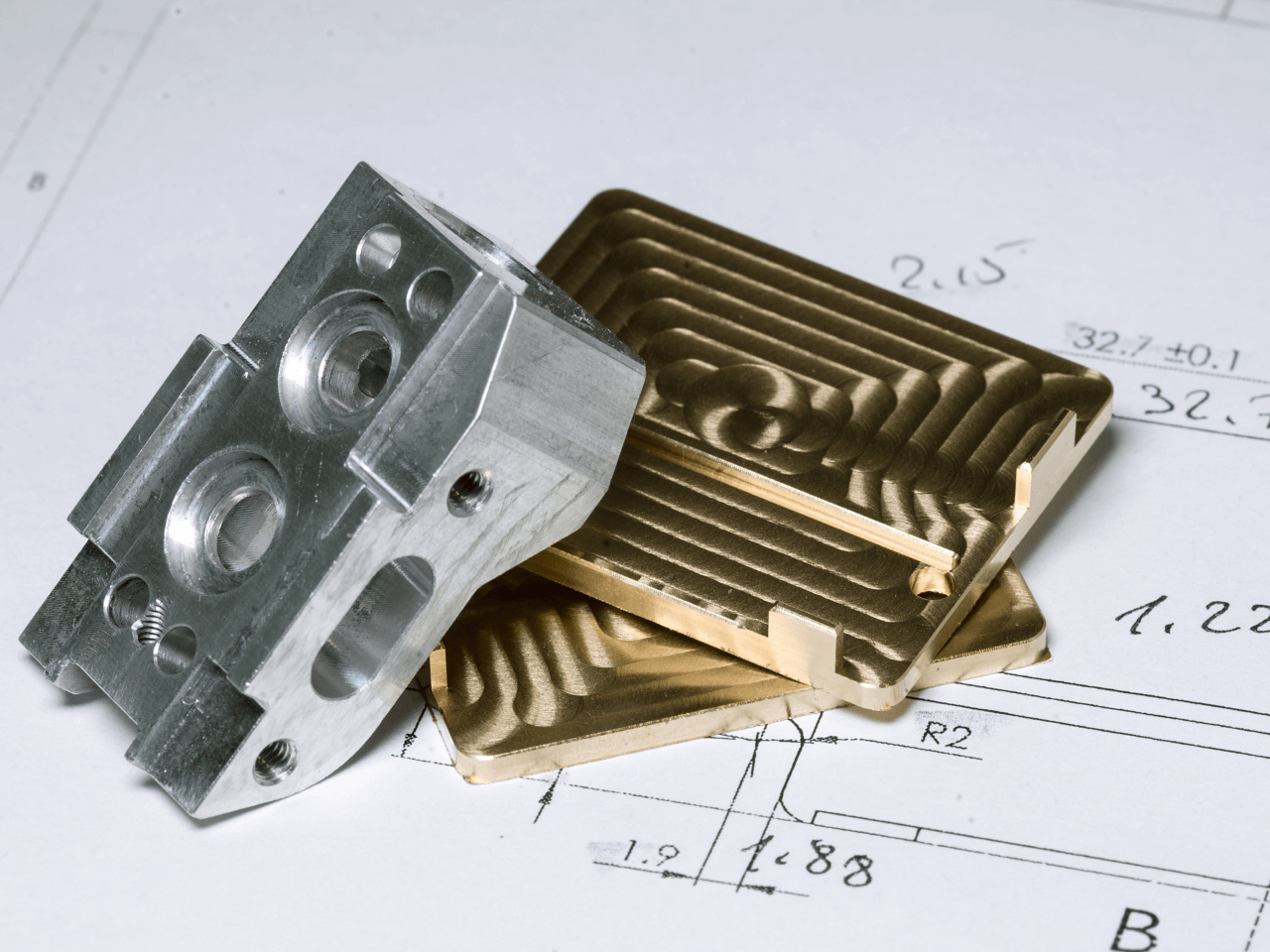
3D printers for plastic parts are cheap and easy to get. Metal? Well that it a different matter: which metal? Copper, steel, stainless steel?
Also, it appears, 3D-printed parts have a rough finish, though how rough I don't yet know.
My plan has been to "draw" a few parts, then see if I can find someone to "print" them for me, preferably in metal. So far I have little idea how much it will cost.
Also, the rough finish: is it noticeable?
If I were to build a "live steam" model, would the 3D-printed cylinders and pistons leak too much steam? If so could I make them up with enough spare metal to smooth them down? Either with files, sandpaper, etc, or even with a lathe?
The metal printer I have found near me in Sydney offers copper, mild steel or stainless steel. Would any of these be suitable?
Learning how to use Fusion 360 seems to have been the easy bit!
Advice, comments, etc., gratefully received.
 
Last edited:

Mikemill

Western Thunderer
David

There are many 3D printing agencies in China, they print in all media at low cost. Suggest you draw a test piece fist and have it printed to see the quality before diving in. Please post the results as we all would like to see how good it is.

Mike
 

Ian_T

Western Thunderer
I've not used JLC for 3D prints (yet) but I have ordered PCBs from them on a number of occassions in the past.

Their process for ordering PCBs is very straightforward (just drop the gerbers in) and the finished quality excellent. My most recent PCB purchase has just arrived and cost just $2 for 10 PCBs! The shipping was the most expensive part at $10 but even so, it cost just £11 (and some pennies) in total. The boards arrived Friday and took about 10 days to get here from order (including manufacture). These are double sided, through hole plated and screen printed PCBs, made to commercial standards. I could not hope to produce anything to this quality myself. Comparing this solution to using proto-boards or Veroboard is like comparing light with day.

If JLC can provide the same high quality in 3D prints in resin or metal for equally affordable prices then this is a step change in what can be achieved by the hobbyist modeller. When I next have a need for a high quality resin or nylon print, then I will certainly try JLC first as I am already a very satisfied customer of the PCB service.


Waveshare_10-adaptor.jpeg
 

NickB

Western Thunderer
Metal printing in our hobby (as opposed to industry) is relatively new and untried. In addition, questions of surface finish, cost, etc are subjective (what is reasonable to you may be outrageous to me, or vice versa). So the only sensible answer is to do the research, try it, and if you do please post the results for the general good. That said, there are some general comments that I can make about printing metals.

Copper and copper alloys (brass, bronze, etc). If you printer down the street can print them, all well and good. There is little use in industry for printing these materials so the process tends to be expensive. Very likely a hubrid process rather than direct printing will be used. From your solid model, a wax will be printed and from the wax the metal component will be cast in the traditional way. That is what companies like Shapeways offer. I've had brass components made that way (see my thread about the LNWR Prrecedent). I think they look good but they were quite expensive, so it depends on your budget.

Mild steel requires a substantial fraction of other materials such as copper to act as a sort of "flux". The result looks and has mechanical properties more like bronze than MS.

Stainless steel is widely available printed (because there is industrial demand for it). The cost is lower and the finish is good (my assessments), but it is difficult to machine or to solder. Okay for parts where these are not limitations.

Aluminium is much as for stainless steel, though generally easier to machine. (But not all aluminium alloys are the same).

For live steam, anything that needs to be steam-tight must be machined to size. Bronze is the usual material for cylinders and copper for boilers, fireboxes and pipework. But really you need to research the whole subject a lot more, and ideally find someone with experience to guide you, if you want to go that way.

Nick
 

simond

Western Thunderer
Am I going over old ground? If so, I apologise.
I have decided it might be a good thing to learn how to use a 3D drawing program, and the one I have chosen is the freeware "FUSION 360" one.
The learning process is not easy, but it's coming along. The possibilities are enormous.
A few revelations though.
3D printers for plastic parts are cheap and easy to get. Metal? Well that it a different matter: which metal? Copper, steel, stainless steel?
Also, it appears, 3D-printed parts have a rough finish, though how rough I don't yet know.
My plan has been to "draw" a few parts, then see if I can find someone to "print" them for me, preferably in metal. So far I have little idea how much it will cost.
Also, the rough finish: is it noticeable?
If I were to build a "live steam" model, would the 3D-printed cylinders and pistons leak too much steam? If so could I make them up with enough spare metal to smooth them down? Either with files, sandpaper, etc, or even with a lathe?
The metal printer I have found near me in Sydney offers copper, mild steel or stainless steel. Would any of these be suitable?
Learning how to use Fusion 360 seems to have been the easy bit!
Advice, comments, etc., gratefully received.
David,

If you fancy live steam, I suggest you start with the classic texts on the subject from the likes of LBSC. As Nick has indicated, cylinders, pistons, valves and other parts will need to be machined. Reading the books will give you a flavour of what is required, which will translate to other gauges & scales.

I do not think that 3DP will give you a shortcut to finished parts, but may offer a route to castings which may not be commercially available.
 

Ian_T

Western Thunderer
Nick, I watched this Dan Gelbart YT a few weeks ago and found it very interesting.

3D Metal Printing -- Dan Gelbart

Clearly, the systems required to do this work are well beyond most 'amateurs' reach (at least at this time) but I do think it gives a glimpse of what will be more widely available before too long. In some ways (given the shrinkage) issues, this is a modern form of the casting process. With respect to their use in (for instance) small steam engines, then solutions such as cylinder liners can be designed in to combine complex parts with the required physical properties.

I do have a small resin printer but haven't actually used it yet, because having looked more closely at the processes involved, I decided that the potential mess/fumes etc wasn't something I could manage at home unless I found a very compelling reason to do so. For rhe same reasons, I haven't explored laser cutting because of the need for fume extraction. My exploration of CNC proceeds very slowly, mostly because it is a much steeper learning curve than 3DP CAD (CAM, G-Code, GSender, Speeds & Feeds etc)

The availability of (hopefully) affordable 3rd Party "3DP" in many materials removes a lot of these practical problems for me, as well as not needing the 'latest' equipment. I spent time learning Solid Edge 3D CAD (five years ago now) and I can export my solid designs in STL, STEP or 3MP as needed (SE can also handle 2D DXF files very well too btw).

But for many modellers, the possibility to download a design and just send it off for printing will open many opportunities. No need to learn CAD, CAM and own expensive equipment. Current 3DP 'home' technology has opened things up but I think being able to get very high quality custom parts in the post (like my new PCBs) is going to really change things...

Regards,

IanT
 

DavidinAus

Western Thunderer
Thanks everyone.
My plan at this stage (trying live steam ...) is to get the parts made in 3D printing. Finish? Well according to JLC3DP if I ask them to "print" in stainless steel, their measure of roughness in "3-6 Ra". The trouble is that I don't know what "Ra" are, and JLC3DP don't give units of measurement. Looking on the 'net, 3-66 Ra looks pretty smooth, but is that centimetres or inches, and in any case I have no comparison. If I bored out a cylinderr on a metalwork lathe, how many Ra would that be?

If 3-6Ra is too rough, could I get the parts printed, but with some extra metal width within the cylinders, and extra surface thickness on the slide valve, and then smooth it off on a lathe?
Could I smooth the surfaces with emery paper? Flat and even enough? How else can you get smooth surfaces?
You see I am not a skilled lathe operator, and the live steam people I know seem to think that I must buy a lathe, almost as a rite of passage, or to show that I'm truly committed to the craft. The trouble is that I won't use a lathe for all that much, I think, and it's a large item to have gathering dust in the garage. I have a friend or two with suitable lathes, so if I am not going to use it all that much, I am happy to learn the skill, but could manage with their equipment, surely?

I am certainly going to use JLC3DP for the decorative or non-moving parts. I have already ordered my first half-dozen 3D-P parts to see how they look. Is it possible to MEASUSE how smooth the surfaces are? Less than A$100. They arrive in 10 days ...

Any further thoughts, my fellow-travellers?
 

simond

Western Thunderer
Ra is “roughness average” As you have observed, you need to know what units the seller is quoting.

this chart gives some guidance,


you can get steamtight finishes by hand methods, but it’ll be a long & tedious process for anything not completely flat

there are machines for measuring surface finish. Eg Mitutoyo 178-561-02a | 5rcg9 | Surface Tester Colour 14200 Micron | Raptor Supplies Netherlands

you can certainly learn to use a lathe. First lesson. Safety glasses. Second lesson, never let go of the chuck key if it’s in the chuck.

After that get some metal, and try to make some simple things to understand the controls, then make more difficult stuff, then work on your castings.
 

NickB

Western Thunderer
And there you see the difference between an industrial designer and a model engineer. The former will know what Ra means and how to assess it. Ask a model engineer what the Ra of the cylinder bore is and they won't know what you are talking about. When you start reading up about building model steam engines, you will find that a cylinder bore requires turning, then honing to what some describe as a near-mirror finish. If it is less than that, it can still be steam-tight initially because that is ensured by O-rings on the piston (opinions differ about the O-ring material to bve used), but the smoother the bore, the longer the rings will last. A rough bore leads to rapid wear, steam leakage, and loss of performance.

I'm not trying to deter you or anyone else, but live steam does need access to a workshop and skills to use it. A few people are starting to use metal printed components for non-functioning parts of the locomotive, but it isn't (yet, and may never be) a shortcut to the "works". If you're serious about live steam in Gauge 3, I have to tell you that there isn't much live steam model building going on in the G3 Society. I suggest you head on over to our friends in 2.5in. (ng25a.org) where you will find more resources and expertise that is pertinent to this scale.

Nick
 

Ian_T

Western Thunderer
" I have to tell you that there isn't much live steam model building going on in the G3 Society "

I do agree that there have clearly been changes to members interests over the years Nick. Twenty five years ago there were no 'ready to run' live steam locos in Gauge 3. You either purchased a vintage B/Lowke, a used LBSC/Martin Evans 2.5" engine, commissioned a new build (a Pavie anyone?) or built your own. The choice made by G3S members then was a matter of whether they spent their time or their money to get up and running. It was probably also true that more members had the engineering skills required to build their own engines then too (often from work experience).

These days less people have an engineering background and the general trend in Model Engineering Societys has been a move to the larger scales (52 & 7.25") and away from 3.5" and 2.5". MES make a good deal of their income from open days and passenger hauling which require larger engines. A member at the AGM mentioned that someone has moved from 2.5" to 7.25" guage. As it was also mentioned that just the cylinder castings for the new engine had cost £600 I did wonder at the time what the boiler would cost.

The availability of RTR live steam in Gauge 3 (GRS, Kingscale and now Barrett) has also changed members attitudes I feel. Kingscale in particular. These are large, very detailed live steam models that would take someone a very long time build themselves, even assuming they could match the engineering quality and paintwork/lining. Even so, I know that live steam is still being built by G3S members, although this might not be so obvious these days.

Steam engines generally take a few years to build (much longer in my case) so don't appear as frequently as other types of build. Many of the live steam builders in G3S are also members of the 2.5" Association too (I am myself). So the live steam expertise is still here but it's probably not quite as prominent these days given the increased interest in (battery electric) G3 'scale' modelling and the increasing prominence of RTR live steam.

Regards,

IanT
 

Chris Veitch

Western Thunderer
I don’t think the OP actually said he was looking at Gauge 3. If someone wanted to have a go at a beginner’s live steam project I’d have thought one of the Gauge 1 or 16mm narrow gauge projects would be an easier start. I’d agree that any live steam project is going to require model engineering skills which can’t currently be replaced by 3D printing (and may never be).
 

adrian

Flying Squad
If 3-6Ra is too rough, could I get the parts printed, but with some extra metal width within the cylinders, and extra surface thickness on the slide valve, and then smooth it off on a lathe?
Could I smooth the surfaces with emery paper? Flat and even enough? How else can you get smooth surfaces?
You see I am not a skilled lathe operator, and the live steam people I know seem to think that I must buy a lathe, almost as a rite of passage, or to show that I'm truly committed to the craft. The trouble is that I won't use a lathe for all that much, I think, and it's a large item to have gathering dust in the garage. I have a friend or two with suitable lathes, so if I am not going to use it all that much, I am happy to learn the skill, but could manage with their equipment, surely?

I would be extremely cautious ( sceptical! ) about using 3D printed metal components for the live steam components, the reason being porosity rather than roughness. The last time I looked at it the direct 3D printed metal was more of a sintering process, lots of micro-metal beads stuck together in the 3D form required, then coated in a ceramic shell then "baked" to melt the metal. Do they quote porosity levels on the 3D metal components? My thoughts are that machined cylinders would be more steam tight than a 3D printed component. Printing a 3D wax master and then getting it lost wax cast would be an alternative.

I suspect a little bartering with your lathe owning friends would be the optimum route - who knows they may want a couple of items drawn and printed in 3D.
 

DavidinAus

Western Thunderer
OK, a little clarity of thought by/for myself. I really enjoy railway modelling, primarily for the construction of detailed models of locomotives (for instance my 'blog about constructing a Stanier 8F in ScaleSeven, published in Western Thunder, and my article about the ScaleSeven industrial Garratt I made). Then when we bought a house in Glenbrook (Blue Mountains NSW) with a 1000 square metre garden, the manager told me that she'd be happy if I had a garden railway, and my thoughts went to the smell of coal-fired steam engines.
So, after looking around for some time on the 'net, I found a model loco. which had apparently been built (lovingly?) probably by a model engineer who really. knew what he was doing, although something happened and although it had been steamed (ash in the firebox), it had never run on its own (tender couldn't be coupled to the loco.). Anyway, I took a gamble and bought it from Station Road Steam based on their description and pictures. A$2,500 later I had the brass-finish loco. in my hands.
With the help of friends I got it running. The gamble paid off. One of the best days which I have had recently was to be pulled around an elevated 2½ inch gauge 400m loop of track by my purchase whilst shovelling coal into its firebox.
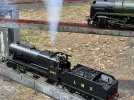
Dyak at the SLSLS22.jpegThe trouble is, it is not a scale model. I have painted it black as an LMS freight engine, numbered as the last of one class of 2-6-0s and just before the Stanier Moguls - although from what little I know about the model, I suspect that the model was made before the Stanier Moguls were built!
I know very little about this model: built to an "LSBC" design (a "Dyak"), but I don't know by whom, or when. Whoever build it, it was/is beautifully done.
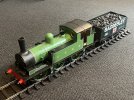
As a parallel project, I have build a 2½" Gauge 3 engine myself for battery-powered radio control (see picture) and several coal wagons (see my previous 'blog) courtesy of Mike Williams - to whom I offer my grateful thanks for his help at various stages. A worthy mention also goes to David White at Slaters, who has been very helpful with my G3 Society model of an LSWR G6. One of the best features of the modelling community is the generous help available.
G6 with lettering 2.jpg
Anyway, I would like to build a proper steamer myself. Looking at my "Dyak", it's all very intricate and small, so I thought perhaps try a 5 inch engine. I even bought a set of plans to build a NSWGR 4-8-2 "46-class", but then realised i) I was being unbelievably ambitious; ii) it would take me several years to build; iii) I couldn't transport the finished project unless I also bought a trailer to pull behind our car; and iv) I certainly couldn't lift the model without several people to help!
So, I thought, before I build a tender engine in 2½" Gauge perhaps I should build an 0-4-0ST and perhaps even in twice the desired size ...

I have obtained plans for a Peckett 0-4-0ST in 5 inch gauge. Now I am a medical specialist NOT a model engineer and don't have a lathe or know how to use one. Although I have friends with lathes, it seems sometimes that buying my own lathe is expected almost as a rite of passage, or evidence of real commitment to the craft. I'm shortly going to retire and so have put myself on the waiting list (!) for a machine-tool course at the local TAFE. I'm happy to buy a lathe, but the thought of a large piece of machinery sitting mostly unused in our garage is not appealing.
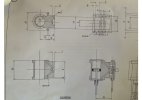
Hence my interest in other possibilities. Whatever else can be said, trying to produce the combined cylinder and slide-valve block on a lathe is a daunting prospect (see diagram). So I have learned (and am still on a steep learning curve with) the computer program "Fusion 360". This is a powerful freeware 3 dimensional drawing program, and even using this it is difficult to construct the cylinder block and avoid the steam channels and the bolt-holes for the cylinder covers running into each other. At least if I do this on a 3D drawing, when I make mistakes I can see them immediately and re-position the channels long before I send it off to get the 3D "print" done.
Peckett cylinders.jpg
However, having read the comments above, the 3D print may simply not be good enough. It is encouraging, however, to look at the page mentioned by "simond" above: comparison of drilling, grinding, cutting (with a lathe?) suggests that "Additive Manufacturing" (aka 3D printing) can be just as smooth.
I have ordered some items from JLC3DP in China to try to find out.
At this stage I am thinking of building it all using 3DP parts, and I cannot see a way of testing whether it will work short of doing a steam test eventually. Mind you, if the parts from China look awful ...
 
Last edited:

adrian

Flying Squad
Interesting plan - it would be great to see it work. I can see some advantages of the 3D printing with the steam chest and steam ports.

The drawing you posted - the design is like that because it is designed to be machined in a lathe and drilled with "straight" drills and end mills. If you do the design in 3D then you don't have the same restrictions eg. to have angular bends in the steam pipes between the valve chest and cylinder. You could make it a curved and smoother flow between the 2. Also on the steam chest you are not restricted to a rectangular port opening - the port openings could be D shaped to maybe give a more progressive steam opening.
 

simond

Western Thunderer
I wholly agree that if it were possible, the model engineering world would have many opportunities presented by 3DP in metals.

I fear I am somewhat pessimistic, but would be delighted to be proven wrong!
 

NickB

Western Thunderer
Like Simon, I am pessimistic, but I will get behind anyone willing to give it a try. That is the only way we will find out how much use to us these new technologies are. I look forward to future posts.

Nick
 

Mike W

Western Thunderer
David, I'd look at it another way. You enjoy building but are happy to use kits. You want this live steamer but are happy to use somebody else's printer as I assume you can't print stainless steel yourself, at home. You are not going to make every single part yourself from raw materials. So, sticking with that theme I suggest you make the bits you can and contract out the bits you can't. Afterall, I doubt you will make your own boiler?

For my Gauge 3 Cauliflowers I did the design, platework, patterns for casting, drawings for laser cutting etc but steam cylinders are another thing, so Barratt Engineering adapted the design and made them specially for me on their CNC machining equipment. They needed a batch of 20 which you may not want(!), but look around for some that can be adaoted, like their own from the J65 kit or, since I assume the Peckett wll have outside cylinders, maybe Roundhouse or some other 16mm narrow gauge parts could be adapted? Also, they will be a tried and tested design.

Last resort - a professional could turn up one set for you, or maybe a friend in the local model engineering society to offset the cost of his own hobby?

Mike
 

Giles

Western Thunderer
You will still want some extra 'meat' on the bore and valve face to machine off to give you a smooth enough surface ( and also cylinder end covers?).
An interesting experiment.....
I experimented with welded (steel) fabricated cylinders, but never completed the job - so no results, I'm afraid.
 
Top