A Garden Railway Pipedream: the odyssey continues

Dikitriki

Flying Squad
That looks so good. Are you planning for any more or will the rest be trimmed plants?
Thanks, Phil,

I think I'd have a walk-out in the work force if I plan any more.:)

We will have a reasonably-sized water feature where the grass is under the ash tree between the railway and the existing bed. Other than that it will be planting under the line where there is space, and maybe stonework from the stone pile where it is very close to ground level. Whether that will be just placed, or something more architectural, I don't know yet.

Richard
 

Dikitriki

Flying Squad
Hi,

Right, a big step back today:(

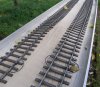
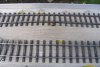
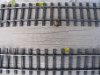
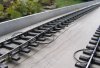
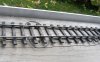
We have had a set-back on the viaduct. I went out to run today and found that the self-levelling top surface had blown in a big way - between Wednesday's running and this morning. I think it had expanded between the aluminium parapets, and with no-where to go, had gone up in major bumps - like up to 15mm. No alternative but to remove the track, chisel off the top surface, and start again with something different.

P1010536.JPG

P1010537a.jpg

P1010538a.jpg

P1010539a.jpg

P1010540a.jpg

P1010541a.jpg

P1010542a.jpg

Now, we used exterior self-levelling compound, and being unversed in such matters, I assume it expanded (why?) and with the fixed aluminium parapets had no-where to go but up. It's very disappointing, but not insurmountable.

We have a fantastic pool of expertise on here. Can anyone shed any light on why this might have happened, and make any suggestions as to what product we may use. It doesn't matter if it shrinks on drying, but best not if it expands!

Thanks,

Richard
 

Focalplane

Western Thunderer
Looks like an Irish peat bog, would tarmacadam offer a solution? The constraining parapets might be a problem, I suppose, so perhaps a gap would not be amiss.

Following the prototype, could you float the track in a ballast base?
 

simond

Western Thunderer
That’s hugely frustrating

would loose chippings work? You might be able to glue them with an exterior grade adhesive once levelled?
 

Overseer

Western Thunderer
Hi,

Right, a big step back today:(

We have had a set-back on the viaduct. I went out to run today and found that the self-levelling top surface had blown in a big way - between Wednesday's running and this morning. I think it had expanded between the aluminium parapets, and with no-where to go, had gone up in major bumps - like up to 15mm. No alternative but to remove the track, chisel off the top surface, and start again with something different.

View attachment 151310

View attachment 151311

View attachment 151312

View attachment 151313

View attachment 151314

View attachment 151315

View attachment 151316

Now, we used exterior self-levelling compound, and being unversed in such matters, I assume it expanded (why?) and with the fixed aluminium parapets had no-where to go but up. It's very disappointing, but not insurmountable.

We have a fantastic pool of expertise on here. Can anyone shed any light on why this might have happened, and make any suggestions as to what product we may use. It doesn't matter if it shrinks on drying, but best not if it expands!

Thanks,

Richard
The self levelling compound will be a polymer modified cementitious mix with very fine sand. The polymer (acrylic or others) are added to make it stick and to prevent it cracking as it dries. Concrete shrinks as it dries, initially due to evaporation of the water in the mix. Acrylic expands over time. Self levelling mixes have a lot of water in them so they flow to produce a level surface, without acrylic in the mix they would have shrinkage cracks all over and be powdery when dry. I suggest using a cement render mix without any additives, or a mortar mix such as 1 cement : 2 hydrated lime : 9 sharp sand. Mix it fairly stiff (less water) and trowel into place using the angles to control the top surface height. Wet the concrete before applying the mortar to reduce suction, you don’t want it to dry before it sets.
 

simond

Western Thunderer
Fraser, does that suggest that putting something sacrificial such as corrugated cardboard strips along the aluminium edging strips (and maybe down the middle) would offer a solution, whilst still getting the benefit of the self levelling?

once it had all set & stabilised, they could be removed and some suitable grout (silicone?) used to backfill the remaining slots?
 

Dikitriki

Flying Squad
Thank you for your thoughts.

Fraser, does that mean the use of the self-levelling compound was a non-starter in the way I used it?

Simon, the problem as I see it with expansion slots is that I would need to match the height of the angle as that height is used to determine the level of the track bed. They wouldn't need to be filled as we will ballast the track, but not until next year now.

Richard
 

Overseer

Western Thunderer
Fraser, does that suggest that putting something sacrificial such as corrugated cardboard strips along the aluminium edging strips (and maybe down the middle) would offer a solution, whilst still getting the benefit of the self levelling?

once it had all set & stabilised, they could be removed and some suitable grout (silicone?) used to backfill the remaining slots?
Cardboard would be difficult to remove, corflute or similar plastic should work. No real reason to fill any gaps, especially if ballasted.
 

Overseer

Western Thunderer
Thank you for your thoughts.

Fraser, does that mean the use of the self-levelling compound was a non-starter in the way I used it?

Simon, the problem as I see it with expansion slots is that I would need to match the height of the angle as that height is used to determine the level of the track bed. They wouldn't need to be filled as we will ballast the track, but not until next year now.

Richard
Probably. The self levelling compounds are intended to level floors under vinyl or carpet. Usually they are unconstrained at the edges, or feathered to no thickness, and are mostly in stable conditions once installed. So your relatively thick layer constrained along two edges combined with large temperature changes is just too far from what the product was designed to do.
 

3 LINK

Western Thunderer
Personally I would try a mix of 1 cement to 4 kiln sand. Kiln sand is finer than sharp or builders sand and is easy to gain an accurate level. Kiln sand is what most builders used on block driveways .

Martyn.
 

Dikitriki

Flying Squad
Hi,

Well, the viaduct track has been unscrewed, unsoldered, and put to one side, and I have attacked the errant self-heaping compound. In truth, not too difficult to remove, just hassle and effort.

OMG!!

Would lengths of Hardie Backerboard screwed and/or glued to the concrete surface be a solution?

Tim

No, the Backer Board is uniform depth, while that of the top surface varies. I don't think it's going to take too long to restore.

I suggest using a cement render mix without any additives, or a mortar mix such as 1 cement : 2 hydrated lime : 9 sharp sand. Mix it fairly stiff (less water) and trowel into place using the angles to control the top surface height. Wet the concrete before applying the mortar to reduce suction, you don’t want it to dry before it sets.

Fraser: you have suggested 2 possible courses of action and Martyn suggested cement and kiln sand. Given that we have a width of 23 cm and a depth of between 6.5mm to 10.5mm, can you say which one would you favour please.

Thanks.

Richard
 

Pencarrow

Western Thunderer
The self levelling compound will be a polymer modified cementitious mix with very fine sand. The polymer (acrylic or others) are added to make it stick and to prevent it cracking as it dries. Concrete shrinks as it dries, initially due to evaporation of the water in the mix. Acrylic expands over time. Self levelling mixes have a lot of water in them so they flow to produce a level surface, without acrylic in the mix they would have shrinkage cracks all over and be powdery when dry. I suggest using a cement render mix without any additives, or a mortar mix such as 1 cement : 2 hydrated lime : 9 sharp sand. Mix it fairly stiff (less water) and trowel into place using the angles to control the top surface height. Wet the concrete before applying the mortar to reduce suction, you don’t want it to dry before it sets.

Would you recommend painting the viaduct deck surface with diluted exterior grade PVA first as a bonding key?
 

Overseer

Western Thunderer
Hi,

Well, the viaduct track has been unscrewed, unsoldered, and put to one side, and I have attacked the errant self-heaping compound. In truth, not too difficult to remove, just hassle and effort.


No, the Backer Board is uniform depth, while that of the top surface varies. I don't think it's going to take too long to restore.


Fraser: you have suggested 2 possible courses of action and Martyn suggested cement and kiln sand. Given that we have a width of 23 cm and a depth of between 6.5mm to 10.5mm, can you say which one would you favour please.

Thanks.

Richard
I would use the 1:2:9 mix. Use a washed sand (ie without dirt and clay in it), the size is not too critical but I wouldn’t go too fine for the thickness you are talking about. The bed thickness is the same as typical brick courses so there shouldn’t be a problem provided the cement can cure - keep it damp or covered for a day or so. I wouldn’t use a PVA bonding agent on the concrete, there should be enough key on the surface. I would place the mortar with a hand trowel and finish with a wood float for a sand textured finish. If you want a shiny surface use a steel trowel to finish. If you make a float to span between the side angles it should be straight forward to achieve a level surface at the correct height.

If in doubt, mix up some small batches and do some trials.
 

3 LINK

Western Thunderer
Would you recommend painting the viaduct deck surface with diluted exterior grade PVA first as a bonding key?

I think that would be a good idea, especially as it will be quite a thin layer of screed. Also you could add a strip of flattened chicken wire fixed to the bed first to aid rigidity.

Martyn.
 

class27

Active Member
I think the self levelling compound was a good enough idea. Just too thick a bed in 1 go may be a better idea to build up with mortar using sharp sand (previously mentioned ) as a sort of very fine concrete then a thin layer of self levelling to finish off. It looks like an exothermic reaction, just like you can get with certain adhesives, resins etc. Shame it was looking great !!!
 

vonmarshall

Active Member
I use self levelling resin when at work before we fit tiling or wooden floors, both internal and external and with underfloor heating. There is no reason why once set they should move. They are designed specifically to handle temperature changes. Have a look at resin rather than a cement based product.
 

Dikitriki

Flying Squad
Thank you for all your comments and thoughts on the viaduct.

I am pleased to say it is back and better than ever. We removed the top surface - not very difficult, it was in such a bad state - and the aluminium angle. Everything was cleaned up, new holes drilled in the angle, and stronger concrete screws used to resite it. We then used a cement/lime/sand mix and that appears to have been a total success. The levels are marginally better either end, and it has dried well. The track has been relaid and the electrics reinstated, and we took the opportunity to have a live steam play today. The ballasting generally has taken a pounding this year with all the garden work, so that will be the priority once we have some dry weather next spring.


Richard
 

isambardme

Western Thunderer
Thank you for all your comments and thoughts on the viaduct.

I am pleased to say it is back and better than ever. We removed the top surface - not very difficult, it was in such a bad state - and the aluminium angle. Everything was cleaned up, new holes drilled in the angle, and stronger concrete screws used to resite it. We then used a cement/lime/sand mix and that appears to have been a total success. The levels are marginally better either end, and it has dried well. The track has been relaid and the electrics reinstated, and we took the opportunity to have a live steam play today. The ballasting generally has taken a pounding this year with all the garden work, so that will be the priority once we have some dry weather next spring.


Richard
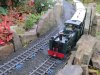
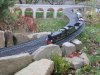
Live steam running is always great fun. The chance to get to run over the new viaduct in this fairly mild weather for November was too good to miss, before more usual colder temperatures arrive.
I've tried to show running over and near the viaduct from various angles in the garden to show how the viaduct really fits into and compliments the garden lines.
I had bought quite a few more G1 wagons for the Tom Barratt Hall to pull than the photos show. The not so cunning plan was to light the Hall up first, then put the wagons on the track. As recommended by other, wiser operators, for cooler weather, I filled the Hall with warm water from an old vacuum flask. However that meant the loco raised steam much more quickly than expected. Well, when a lady is getting steamed up, you can't keep her waiting, can you! She ran at a steady, very controllable freight pace for over 35 minutes, so I was happy. Hope you like the photos.

Steve216.JPG 213.JPG 214.JPG 215.JPG 220.JPG 230.JPG
 

Ressaldar

Western Thunderer
Thank you for all your comments and thoughts on the viaduct.

I am pleased to say it is back and better than ever. We removed the top surface - not very difficult, it was in such a bad state - and the aluminium angle. Everything was cleaned up, new holes drilled in the angle, and stronger concrete screws used to resite it. We then used a cement/lime/sand mix and that appears to have been a total success. The levels are marginally better either end, and it has dried well. The track has been relaid and the electrics reinstated, and we took the opportunity to have a live steam play today. The ballasting generally has taken a pounding this year with all the garden work, so that will be the priority once we have some dry weather next spring.


Richard
Hi Richard,

enjoyed the read, but no photos came up, however, I did enjoy Steve’s photos.

regards

Mike
 
Top