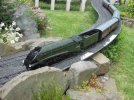
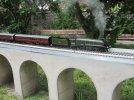
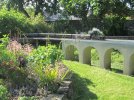
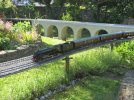
A Garden Railway Pipedream: the odyssey continues

isambardme

Western Thunderer
Hi all,

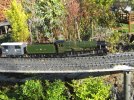
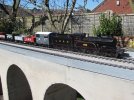
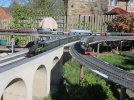
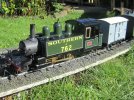
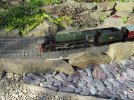
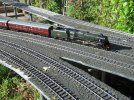
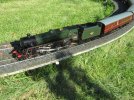
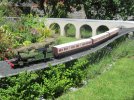
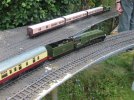
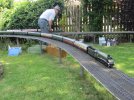
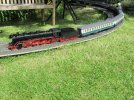
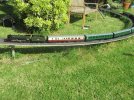
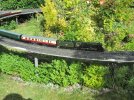
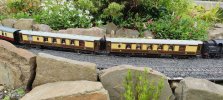
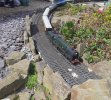
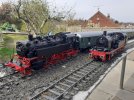
Well, after a long winter we were invited for a GTG today when lots of sunshine was forecast. Luckily the sun obliged us so we got in lots of running. Hope you like the photos. Apologies to Brian, I must have missed shots of his Merchant Navy on a new long train as I was busy getting my loco to run properly. Steve 067.JPG086.JPGSteve 051.JPG076.JPG084.JPG063.JPG
 

isambardme

Western Thunderer
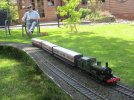
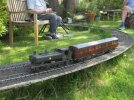
As you can see from the above photos there was quite an L & B flavour, with two locos in steam at one time (not easy to photograph when you're running one yourself). Richard was running his pre owned L & B 2-4-2T Lyn for the first time. I saw it on e bay and gave him the heads up a good few months ago. I suspect she hadn't had much running before. She had four runs yesterday and was running very well by the last run. Richard felt it was happiest pulling three coaches on that last run. I think she's a lovely loco.
My two best locos ran very well too, both GWR (who said 'of course'?), the Accucraft Prairie and the Tom Barratt Hall. Here's to future running as summer approaches.

Steve
 
Last edited:

isambardme

Western Thunderer
Well, time passes and another sunny day was forecast. Amid the sunshine Richard's Bowande Duchess was examined. The water pump bearings appeared to be sticking. The bottom one was easy to access and was freed. However the top one would need body removal. It was decided to leave this and probably visit Dave Hawker, the Coventry based Bowande service agent. Meanwhile Richard's unrun acquisition from e bay, an Aster Standard 5, kit built by an engineer who had successfully rebuilt a traction engine and taken advice from a knowledgeable Gauge one operator, was prepared for rolling road testing. After advice and032.JPG fine tuning, the Aster ran beautifully smoothly in the garden sunshine for just over half an hour with plenty of power to spare. What a result for a first run ! I remarked to Richard that this could become a favourite loco of yours to run. I also mentioned that , should he ever get tired of it, I would be very interested in acquiring it, but I suspect this will be a firm keeper for Richard, with very good reason !

Hope you like the photos.

Steve026.JPG029.JPG021.JPG020.JPG023.JPG
 
Last edited:

isambardme

Western Thunderer
Hi, well, a sunny day was forecast, it turned out a real scorcher yesterday. Luckily we were prepared with suitable hats, drink and lots of trains to play with (sorry, operate in a proper manner !)
It was great to see Allan's Accucraft Adam Radial running well with his LSWR coaches to match. My Bowande A4 was able to run well with 8 coaches. We had the opportunity to eat our packed lunches in the shade while Allan's pannier and autocoach with very impressive r/c dcc sound kept us entertained. Later Richard S gave his German Aster a run and garden owner Richard L got a very impressive second run from his Aster Standard 5, also on the 8 coaches. I understand that Richard S got some video footage of the Standard 5 attempting to break a certain Mallard's speed record !! However Richard L assures us that it never happened and his Standard 5 was running in a sedate manner at all times! Anyway, a great time was had by us all. Good job we had not planned to run in today's drenching conditions. Bless the English weather!
Hope you like the latest photos.024.JPG027.JPG032.JPG043.JPG052.JPG053.JPG058.JPG060.JPG

Steve
 

Dikitriki

Flying Squad
Hi,

A year to the day since the last post!

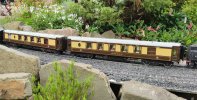
Most of last year was spent getting Heyside ready for the NEC. Since then, we have been undertaking the maintenance on the outside track that we should have done over the last 4 years. We decided that to smooth out some rough running, sections of the track would be lifted, levelled then reballasted, and we have been taking advantage of the recent good weather to do just that. We're not yet all done, so mainline live steam is not advisable, but battery powered radio control is fine. I have acquired a couple of Pullman cars that had never been run and spent some time making sure they could - adjusting the ride height, coupling length, bogie articulation - and today was a test run. They ran for about an hour on the inside track without problem, but they consistently derailed on the outer track at a point where we have not yet got round to levelling - not the coaches' fault.

I took some phone video:


and a couple of pics to mark the occasion. Yes, I shall be renaming 'James' when I work out where the original transfers came from.


IMG_20230618_110343a.jpgIMG_20230618_110356a.jpg
 

Scanlon

Western Thunderer
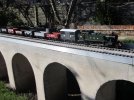
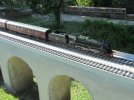
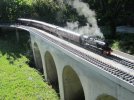
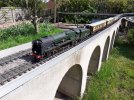
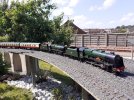
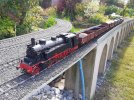
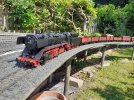
Today dawned bright and sunny so the opportunity was taken to see how the railway had fared over the winter. Our ballasting work has stood the test of time and the track bed is firm wherever the new ballast has been installed. These photos show Brian's Merchant Navy testing the track work.
20240501_122204_resized.jpg
I glorious sunshine 35024 with 10 vehicles including 2 Pullmans is put through its paces.
20240501_115739_resized.jpg
Crossing the viaduct.
 

W H Ayerst

New Member
I notice you painted the backer board early on and it seems to have reverted to grey - did I miss something, or is that a natural process please?
 

AdeMoore

Western Thunderer
Well that was 24 delightful pages I’ve just completed reading. Inspirational stuff. Certainly got me thinking!
Great idea with the build using scaffold base jacks and cable tray. Simple and as a commercial sparky cable tray is an everyday thing. So quite cost effective.
It looks at home in your garden and the viaduct is rather splendid.
The last 2 years have seen less posts on here, but I take it running days have continued much as previously written about? Do keep posting and giving us inspiration.
 

Dikitriki

Flying Squad
Hi everyone,

Last year was a year of fairly major maintenance and improvement to the infrastructure of the garden railway. It went well, and the resultant running and looks was well worth the effort. However, that and the weather meant that running was somewhat spasmodic. This year has started well with lots of sun, and running, and I'm determined to do more outside and keep this thread updated.

To this end, I took some video of the first run of my A4. I picked it up at the G1MRA show at Statfold, and have spent the last week and a bit fettling it - putting in a wiring loom and charge point for the R/C (on the regulator), replacing the servo, straightening out the guard irons, tightening bolts and touching up the paintwork, replacing the wicks and generally checking it over. There's more I want to do, but I thought playing with it was the order of the day to find out how it behaves. Very well is the answer, and I got about a 45 minute run out of it.


I shall run it with the teak coaches on Saturday, and if i remember, time the run!

Richard
 

Scanlon

Western Thunderer
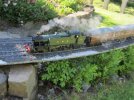
Seen recently on the railway was this unusual double header
2 180625.jpg
Both locos are San Cheng products owned by Dave Milford.
A few weeks earlier, Brian Malyon's Merchant Navy had a special working
20240501_115739_resized.jpg
It is thought a minor Royal was travelling in the Pullmans along with their entourage.

Enjoy.
 

simond

Western Thunderer
Richard,

I’ve just re-read your thread as my planned extension has proven ridiculously expensive and we just cannot justify the cost, you could buy a house for the quoted price of a garage & railway room. A combination of complicated foundations, builders being in demand, low mortgage rates, and many staff returned to Europe post Brexit I guess, bad timing on my part. Anyway, the project has reverted to an overgrown garden room, and some outdoor track.

It’ll be 7mm to 0MF standards with curves of around 2.5m minimum radius, and will be an out-and-back to terminus & FY. In simple terms, a 7mm model will be about 34% of the volume of a 10mm scale model, and I guess the weight will be more or less in that ratio too. It will not be scenic as it’ll be around 1.1m above the grass (which is too small to be called a field, and not groomed enough to be called a lawn), but it will give me somewhere where I can run decent sized trains.

I guess my key question is, if you were doing it all again, would you go down the same route, using driven scaffold poles and scaffold jacks, and cable tray with Hardiebacker, or do you think there’s a better way? Having spent quite a bit of time in recent years helping maintain & repair my late pal’s garden line, I am anxious not to rely on wooden posts and trackbed. I note that you found the cable tray a bit flexible cross-ways, and I gather that the angle iron stiffeners and spacers were necessary to beef up the whole structure. Was the 1.2m spacing sufficiently close, you went down to 1.1 in places I think?

Our garden is around 200m (horizontally) and 65m (vertically) from the English Channel, so there will be no lack of salt air, and whatever I do will need to be well protected from corrosion.

I wonder if doing away with the cable tray, and having a pair of galvanised angle iron beams between the jacks, with the Hardiebacker bolted directly to them might not be a simpler (and potentially cheaper) approach. Any thoughts and recommendations you may have ( indeed, any other garden rail builders/operators may have) would be very welcome.

Thanks,
Simon
 
Last edited:

HDSmith

Active Member
Simon, it's a long time ago that my garden railway was built (2008) and demolished following a house move (2015), but I shelled out for a garden contractor to concrete in sawn-down fence posts, with timber decking tops, the overall planning being a terminus station at one end with a balloon loop at the other. The structure was remarkably solid and suffered from minimal warping on the trackbed. The plus factor was the ability to clip cabling in place with ease (LGB analogue operation, track power), although easing of one or two curves and the subsequent addition od an extra siding called for some less than elegant carpentry on my part. When the time came to move, I had to call in paid help to dig out all the uprights. When we moved to my present address in 2018, I rebuilt some of the line in a loop inside the garage, and used galvanised cable tray to create a lifting bridge across the access doorway. It was a nightmare to cut it to size. I probably didn't have the right tools, but never again.
 

Greengiant

Western Thunderer
Richard,

I’ve just re-read your thread as my planned extension has proven ridiculously expensive and we just cannot justify the cost, you could buy a house for the quoted price of a garage & railway room. A combination of complicated foundations, builders being in demand, low mortgage rates, and many staff returned to Europe post Brexit I guess, bad timing on my part. Anyway, the project has reverted to an overgrown garden room, and some outdoor track.

It’ll be 7mm to 0MF standards with curves of around 2.5m minimum radius, and will be an out-and-back to terminus & FY. In simple terms, a 7mm model will be about 34% of the volume of a 10mm scale model, and I guess the weight will be more or less in that ratio too. It will not be scenic as it’ll be around 1.1m above the grass (which is too small to be called a field, and not groomed enough to be called a lawn), but it will give me somewhere where I can run decent sized trains.

I guess my key question is, if you were doing it all again, would you go down the same route, using driven scaffold poles and scaffold jacks, and cable tray with Hardiebacker, or do you think there’s a better way? Having spent quite a bit of time in recent years helping maintain & repair my late pal’s garden line, I am anxious not to rely on wooden posts and trackbed. I note that you found the cable tray a bit flexible cross-ways, and I gather that the angle iron stiffeners and spacers were necessary to beef up the whole structure. Was the 1.2m spacing sufficiently close, you went down to 1.1 in places I think?

Our garden is around 200m (horizontally) and 65m (vertically) from the English Channel, so there will be no lack of salt air, and whatever I do will need to be well protected from corrosion.

I wonder if doing away with the cable tray, and having a pair of galvanised angle iron beams between the jacks, with the Hardiebacker bolted directly to them might not be a simpler (and potentially cheaper) approach. Any thoughts and recommendations you may have ( indeed, any other garden rail builders/operators may have) would be very welcome.

Thanks,
Simon
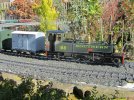
Simon,
On my garden line I have used upturned steel roofing sheet supported by greenhouse staging, steel office desk legs and Dexion angle, most of which I was fortunate enough to obtain free. The trackbed is about three feet off the ground, I cannot be doing with scrabbling around on the ground. I started eight years ago and it has not shifted out of true at all.

Here are a few pictures to give you an idea. The railway is 16mm narrow gauge.

This gives the basic idea.


Early stages, front legs suppoeted by the path and the rear legs are sitting on concrete bases I cast in.


I trimmed the front with white UPVC fascia (Mistake, should have used black) and off cuts of shiplap I bought off FB market place cheaply.


Roll on a few years, it is still a work in progress.


A use artificial grass for the scenery.


If of interest I can do a build thread of the layout from start until where I am at the moment. Those on NGRM or the Garden Rail forum will already have seen.

Martin
 

James Spooner

Western Thunderer
I went down the route of running the track at ground level, partly because I think it looks more realistic but also partly because it is less obtrusive in the garden and Mrs B was prepared to tolerate something at ground level but not structures three feet in the air. I’m sure as I get older I will regret it but at the moment it is a great height for the grandchildren to watch the trains go by…


Nigel
 
Top