
You are using an out of date browser. It may not display this or other websites correctly.
You should upgrade or use an alternative browser.
You should upgrade or use an alternative browser.
BR(S) Smokebox Number Plates
- Thread starter Stevers
- Start date


Stevers
Western Thunderer
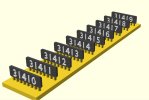
An OpenSCAD script takes a start number and the number of sequential plates to be generated. Before I change to the white resin I'll give this a go in grey to see if this is even remotely feasible.
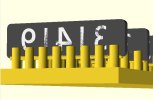
The areas between the supports will not form neatly, so a sacrificial strip has been provided to transition the cylindrical supports into the plate. Once the concept and number of supports required is established, I should be able to come up with a more elegant way of doing his.

Yorkshire Dave
Western Thunderer
The areas between the supports will not form neatly, so a sacrificial strip has been provided to transition the cylindrical supports into the plate. Once the concept and number of supports required is established, I should be able to come up with a more elegant way of doing his.
Could you not print the plates at 45° with the supports on the rear then any cleaning up upon separation from the sprue will be hidden?
Stevers
Western Thunderer
Some degree of tilt works for most things, so yes that would be something to explore. My Mono 4K has 0.035mm pixels so there are visible steps that applying Lychee 'anti-aliasing' doesn't seem to do anything much to reduce. You would also need a stout set of initial supports to stop it flapping in the resin, and those stout supports would need to be removed.Could you not print the plates at 45° with the supports on the rear then any cleaning up upon separation from the sprue will be hidden?
Still pretty new to this. My thinking was that vertical or horizontal planes would have the smoothest finish on my machine, and there's definitely an element of seeing what I can get away with. Then when that doesn't work, Iooking the next 'least worst' way!
Stevers
Western Thunderer
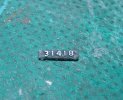
Rubbish paint job and poorly trimmed, but loads of potential. The first one (31419) I squeezed in a toolmakers vice to trim - that just squashed the numbers flat! The basic idea seems sound, with the numbers very well formed (pixels being 35μm x 35μm and layers 50μm), but I think it needs to be thinner (if possible) and more obvious where it needs to be cut. I'll try and make a neater job of 31416 - which is the one from this batch that I need.

BrushType4
Western Thunderer
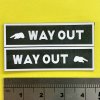

I make these commercially and it’s near impossible to get rid of the ridges under close examination but with normal eyes you can’t see them. This is Trotec own laminate material.
My laser is 120 watts so these take seconds to make and I use the highest dpi possible for the laser.
Attachments


Last edited:
Stevers
Western Thunderer
Fair enough, but I'm after the holy grail of curly 6s and 9s and any number I might need in 4mm scale.I make these commercially
Lots of people offer or have offered smokebox plates. Two companies that are actually the same outfit will do plates to order but ignore the existence of curly 6s and 9s even when sent evidence of same. Those that have done curly 6s and 9s in the past have retired or only have a limited range of numbers. Brian of 247 Developments was the go to, but he's no longer doing custom plates. Desperation brought me to this!
BrushType4
Western Thunderer
I’ve got the character set on file but I draw them out so they are not a font but a dxf file. Found the original BR drawings and took them from there. I think the six and nine are the same but could be wrong!
Stevers
Western Thunderer
That's the only way that I've been able to reproduce the home made look of the Ex-LSWR signal box nameboards and running in boards that I needed. I'm also sure that it's the only way to reproduce a truly accurate smokebox plate. I was just using what I have, to do something that will be good enough, in the absence of 247 Developments (or someone else) doing them for me.I’ve got the character set on file but I draw them out so they are not a font but a dxf file.
I get the impression that a number of almost identical (hand crafted) curly 6s and 9s were available as patterns that might well be utilised either way up as required to make the moulds up for casting.Found the original BR drawings and took them from there. I think the six and nine are the same but could be wrong!
These things are tiny and '31416' has managed to completely vanish. Two coats of black Humbrol enamel on '31615' was too much to pick out the numbers in white. Will thin the plates and that will raise the letters a fraction for the next attempt using an array (list) of the numbers I need. With 3D resin printing there seems to be a sort of 'additive kerf' that means the items printed are not exactly as drawn and artwork may need to be adjusted for the finished part to be the exact size required. In this case The plates I printed were drawn 0.4mm but have printed 0.6mm which is in line with the 0.1mm additive kerf that I've previously observed in holes to make them smaller and shafts to make them thicker. The numbers don't look much thicker than drawn so luckily this 'additive kerf' not obvious there. I'll also switch to the standard white resin. Not being 'ABS-like' it should be a bit harder (though more brittle). I'll put a decent coat of black paint on those and hope that a rub of a file or emery paper will make the numbers show neatly. That was plan A after all - about £17 of resin to make a zillion smokebox plates!

I've had a quick look for your smokebox plates and haven't found them on the website linked to your post; how would someone go about ordering custom plates from you?
Stevers
Western Thunderer

Interesting results with the more brittle (not ABS-like) resin taking detail better and printing much thinner (0.4mm when drawn 0.35mm). The idea that the black paint could be scraped away to reveal gleaming white numbers is a non-starter, the resin being translucent when this thin. I'd say the plates are almost perfectly formed, but imperfectly painted - the same issues that I have with etched plates. These are earmarked for my U and my Q. Very easy for me to set these up and 3D print them in small batches as required.
This was my first attempt using the settings from the AnyCubic Water Washable ABS-like 3.0 resin. The 'Cones of Calibration' print in the same batch failed - possibly because it's becoming impossible to completely straighten the no-name magnetic build plate that is now a tad wavy. A second attempt with two sets of Cones away from the centre of the plate gave me no cones of failure and all the cones of success, which is about as good as it gets. The ale was a tight fit in the mug, and the sword a tight fit in the skull, so based on last time I did this, an overexposure of perhaps 0.1 secs. I used 2.0s, but will try 1.9s next and that funnily is what the Cones gave me for the grey Anycubic W/W ABS-Like 3.0 resin I have been using. The Elegoo resin seemed less water washable than the Anycubic resin, though more opaque.
Penrhos1920
Active Member
My Anycubic Photon Mono 4K is up and running and it's time to try this out. Having now gained some practical experience of 3D printing I am completely at a loss as to how something so thin could be supported off the plate in a way that the supports could be removable. There are also lots of reasons (no supports to remove, print times, efficient use of resin) to at least try to print these on the plate. The problem then is that a 4mm scale plate is going to be quite chunky even at 0.5mm, and that is only ten layers at 0.5mm or say fourteen at 0.35mm. The normal burn in layer will suffer from light bleed and is likely to adhere too strongly - especially as flexing my magnetic build plate is unlikely to release something so small and thin.
For a first attempt with Elegoo white water washable resin I'm thinking .035 layers, three 10s burn in layers to reduce the elephants' foot, a couple of layers to transition to nine layers at normal exposure. When printing on the bed I lose 0.5mm somewhere in the first 6mm of printing, but exactly where that occurs is not known except that it's not all in the first 1mm or so. The thoughts and experiences of others much appreciated.
Richard, It looks like these are resin rather than filament printed. Is that right?
Rod
Yes a resin printer, Mars 4 9k. I’ve been printing straight onto the bed. The key is to reduce the exposure of the initial layers and reduce the number of initial layers so that the total base layer thickness is what you want for the thickness of the numberplate minus the numerals thickness. Then dial down the exposure of the numerals layers a light to reduce bleed and increase numeral definition.