Lathe Tool Height Gauge

Rob Pulham

Western Thunderer
Those with long memories may remember this.

54118718467_09f005e1a6_h.jpg

I bought it along with a number of other hand tools which I have subsequently restored over the last year. But I actually bought the job lot on the basis of it containing this. My idea was to make a lathe Tool Height Setting Gauge from it loosely based on the GH Thomas example which is marketed as a kit by Hemingway Kits.

A fellow parish councillor recently gave me a few pieces of steel one of which was perfect for making the two height setting arms.
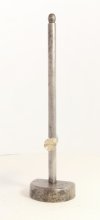
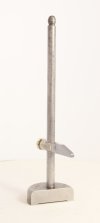
54842807724_571223959e_h.jpg

54842807714_eaa793ec8f_h.jpg

54842893790_81e8ab1e9a_h.jpg

I have a second ‘arm’ partially made which I will finish off at some point. Finished off with a nice nickel silver thumb screw it works perfectly.
 

Ian@StEnochs

Western Thunderer
A late friend was building a large scale live steam Hunslet ROD 4-6-0T. He worked for years making special tools , jigs and fixtures to make building it easier. He never did get anywhere near finishing the model but he left an awful lot of special tools!
 

Rob Pulham

Western Thunderer
I am a self confessed tool junkie. I get a lot of pleasure from making, restoring and using tools that I have contributed to in some way.

I haven't shared it but in the same lot of what I believe were apprentice made tools*, there was a curved sliding bevel. Although it moved, you could neither fully tighten or fully slacken the thumbscrew. So at the same time as working on the height gauge, I cut the old one off and made a new stud and thumbscrew. I may never actually use it but if I do at least it will now work as intended

*They are all marked with the initials FC and are not quite refined enough to have been made by a master craftsman. Which is why I believe them to have been his apprentice pieces.
 

NickB

Western Thunderer
If the object is to set the tool on centre (which I believe it usually is), I use the age-old technique of lightly trapping a straight edge between the cutting edge of the tool and a piece of round stock, then visually checking that it is vertical. Surprisingly senstive.

Nick
 

Ian@StEnochs

Western Thunderer
If the object is to set the tool on centre (which I believe it usually is), I use the age-old technique of lightly trapping a straight edge between the cutting edge of the tool and a piece of round stock, then visually checking that it is vertical. Surprisingly senstive.

Nick
My method too.
 

Rob Pulham

Western Thunderer
If the object is to set the tool on centre (which I believe it usually is), I use the age-old technique of lightly trapping a straight edge between the cutting edge of the tool and a piece of round stock, then visually checking that it is vertical. Surprisingly senstive.

Nick
Hi Nick,

That was my method too but having watched a really good video on making the Hemingway kit. Then picking up the scribing block and a number of other tools for just over £10, I couldn't resist making one, for the pleasure of making it.
 

Matt Rogers

Member
I was always taught to stick a dead center in the tailstock, and then center my lathe tools to that, never faffed around with anything else and certainly not a surface gauge\ scribing block (which is the device pictured).

Regards
 

Brian McKenzie

Western Thunderer
For me, it is far quicker to make a quick skim across the end of material, and adjust tool height if necessary, relative to any pip left at the centre.

I'm not keen on using a 6inch steel rule (as many do), for setting tool height - when it's trapped vertically between tool and workpiece. This can harm finely honed edges on HSS tools. Should be OK with carbide tools and tips though - as they are not normally produced with a ground finish.

-Brian McK.
 

Ian@StEnochs

Western Thunderer
For me, it is far quicker to make a quick skim across the end of material, and adjust tool height if necessary, relative to any pip left at the centre.

I'm not keen on using a 6inch steel rule (as many do), for setting tool height - when it's trapped vertically between tool and workpiece. This can harm finely honed edges on HSS tools. Should be OK with carbide tools and tips though - as they are not normally produced with a ground finish.

-Brian McK.
I have used a strip of brass etch waste for years. Does the job and is no danger to a honed edge. It hangs on a nail wth the other frequently used tools. It was one of those wide pieces that surrounded the sheet. I think it came from a Jidenco kit so been in use for many years!

Ian.
 
Top