LSWR G6 0-6-0 tank engine

Mikemill

Western Thunderer
To anneal brass sheet, stand the sheet vertical against a fire brick. Heat the sheet with a torch by moving left to right from the bottom until it is dark red, work your way up the sheet until all the sheet has been heated, leave to cool DO NOT QUENCH as this will distort the sheet. If it is a small piece of brass I often use the gas hob in the kitchen, hold the sheet with a pair of pliers.

If you need to make several bends in the sheet you may need to anneal again as brass work hardens.


Mike
 

Jon Nazareth

Western Thunderer
Does anyone if the floor in the cab of this loco would have been made up of wooden planks? I’ve looked in the books that I have and can’t see one way or the other.

Jon
 

NickB

Western Thunderer
Jon,

I can't find a photo showing a cab floor, someone here may have one. In its absence, it's fairly safe to assume it was wooden planks. The G6 drawing suggests that without being explicit about it, and it was very common in many classes and companies. Alternatively, you could pop up to the Bluebell and inspect the preserved 415 class or to the IOW and the preserved O2. Same company, same period, same CME, so almost certainly reads across to the G6. Actually, in your position I'd do that anyway and take a lot of photos of the cab interior (not just the floor).

Nick
 

Jon Nazareth

Western Thunderer
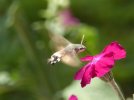
The above is just a test to see if I could post photos from my iPad. It seems to work.

I think that my sister took the picture of this hummingbird moth.

Jon
 

Jon Nazareth

Western Thunderer
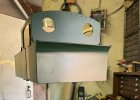
Looking at the rolling chassis, I’ve noticed that I’ve not fitted the brake vacuum pipes. Well, I’m not going to risk damaging the paintwork trying to drill into the buffer beams to fit them now. I think that this is going to be a bit of a rogue G6 by the time that it’s finished. There are other bits and pieces that I’ve forgotten to solder on too. Once again, those items have been painted.
There are a mass of painted items waiting to be joined as a whole but I need to finish the main body before that happens.
I finished off these sand boxes this morning and I’m pleased with them. So much so that I thought that I’d share.

Jon

IMG_0064.jpeg
 

ovener

Western Thunderer
Looking at the rolling chassis, I’ve noticed that I’ve not fitted the brake vacuum pipes. Well, I’m not going to risk damaging the paintwork trying to drill into the buffer beams to fit them now. I think that this is going to be a bit of a rogue G6 by the time that it’s finished. There are other bits and pieces that I’ve forgotten to solder on too. Once again, those items have been painted.
There are a mass of painted items waiting to be joined as a whole but I need to finish the main body before that happens.
I finished off these sand boxes this morning and I’m pleased with them. So much so that I thought that I’d share.

Jon

View attachment 221739
Those are beautiful. Lovely work.
 

Jon Nazareth

Western Thunderer
Would you Adam and Eve it. I put on what I thought was a decent coat of paint but Sod’s Law came into play. When I looked this morning, a fly had done a backward somersault and fixed its wings to the back of the bunker!!! I was going to gently rub it back and try and bring back the finish with some mild Tcut. The problem is that I’m not too sure how thick the paint is. I’ll have to give it some though. I’m not keen on masking up and repainting it. Oh, and no jokes about the chap who fell into a vat of varnish.

Jon

IMG_0066.jpeg
 

Jon Nazareth

Western Thunderer
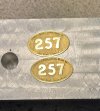
These are the number plates for this engine and the book says that the background should be red. Before applying the paint, I decided to rub them over a piece of 2000 wet and dry in order to highlight the lettering in order to see how the small lettering would fare. As can be seen, the small lettering, which has remained dull, would disappear under a layer of paint. Therefore, I’ve decided to leave them as they are.

Jon

IMG_2904.jpeg
 

Jon Nazareth

Western Thunderer
Paul
The problem is that the small lettering is lower than the border and the numerals. It can be seen in the way that the small letters appear dull. I’ve used the rubbing off method before and it does work. I’m not sure that it will in this instance.

Jon
 

Bigjohn

Western Thunderer
Interesting that the line drawing show the axle flush with wheel boss as do some photos BUT the final photo shows the axle projecting beyond the wheel boss, sufficient to allow a rod/tube to be added. How close to the crank pin does it get????????
 

Jon Nazareth

Western Thunderer
Interesting that the line drawing show the axle flush with wheel boss as do some photos BUT the final photo shows the axle projecting beyond the wheel boss, sufficient to allow a rod/tube to be added. How close to the crank pin does it get????????
BigJohn
Have you posted your/this post in the correct place?

Jon
 
Last edited:

Jon Nazareth

Western Thunderer
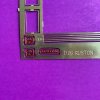
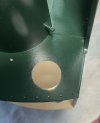
I was very carefully cleaning the paint away from the inside of this widow opening when some paint chipped off. This picture shows it feathered back. It’s all a bit of a b^$$€¥ really but it does mean that I can now rub down the back of the bunker where that fly stuck its wings to the original wet paint. I’ll blow a bit of primer over the window opening and then go over the whole body with some fine wire wool before I go over with a coat of top coat green. By the way, what is the proper name for those round window openings? I’m sure that someone here will know.

Jon

IMG_0072.jpegIMG_0073.jpeg
 

Bigjohn

Western Thunderer
Jon
If you go back to the first page there are some line drawings and a series of B/W photos. The last of the photos shows the extended axle to which I made reference.

John
 
Top