7mm MOK 8F - 8425

Rob Pulham

Western Thunderer
Although progress has been slow since my last post, I haven’t been entirely idle.
First, I fitted the brake cylinder that Adrian made for me some time ago for which I am very grateful.

54967284010_d09b903e43_h.jpg

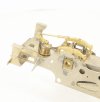
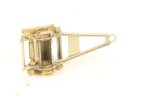
Then for some reason which I can’t recall I was looking at the GA of the pony truck in the Wild Swan book and realised that detailed as the MOK Pony Truck is it’s missing the side control spring.

54964050457_2ce96a553b_h.jpg

54965244290_6e60138e40_h.jpg

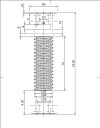
I scanned the GA, imported it into Fusion and having scaled it, I then drew up the spring and it’s mounting.

54967842387_88086aaa0c_c.jpg

From there it was easy to create a dimensioned drawing to allow me to attempt to make one.

54967850337_cc79f2c9a7_c.jpg

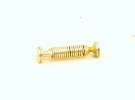
I debated whether to make it in one piece and then wind wire around it to represent the spring or to make it in two pieces and thread the centre section 4ba (3.6mm) which is the nearest sized die that I have to the 3.5mm that I had worked out from the drawing. I decided to have a go at making the one-piece version first. If that didn’t look good enough, I would have another go.

54967160138_a861d2d0f3_h.jpg

There was a slight discrepancy between the GA and the actual width of my pony truck so I ended up turning a couple of thin spacers to fill the gap but it worked out okay in the end.

54967236729_b7b80d247a_h.jpg

54967283975_a62041a4f0_h.jpg

54966085167_91783f949c_h.jpg

As you can see, it actually sits largely out of sight (when viewed from the front) but I enjoyed making it, and I know it’s there.
 

Dave Holt

Western Thunderer
Very nice addition, Rob. Being out of sight is beside the point. But, on that basis, where's the spring on the rear end of the truck?
Dave.
 

adrian

Flying Squad
There was a slight discrepancy between the GA and the actual width of my pony truck so I ended up turning a couple of thin spacers to fill the gap but it worked out okay in the end.
Nice to see progress on this - but this does surprise me, unless you're now building to Scale7 I'd have expected the pony truck to be narrower than the GA, not the other way around.
 

Dave Holt

Western Thunderer
Rob. If you have the Wild Swan profile book, the pony truck drawing on page 69 shows the two side control springs in the side view cross section but the rear one is omitted in the part plan view. Of course, as you say, even the front one is almost completely obscured so the rear spring will be almost invisible on the finished model and my question was only tongue in cheek.
I can see how the frames can be too far apart (hence your spacer washers) whilst the overall width across the external springs/axleboxes is less than scale to suit O gauge finescale rather than S7.
Dave.
 

Rob Pulham

Western Thunderer
Rob. If you have the Wild Swan profile book, the pony truck drawing on page 69 shows the two side control springs in the side view cross section but the rear one is omitted in the part plan view. Of course, as you say, even the front one is almost completely obscured so the rear spring will be almost invisible on the finished model and my question was only tongue in cheek.
I can see how the frames can be too far apart (hence your spacer washers) whilst the overall width across the external springs/axleboxes is less than scale to suit O gauge finescale rather than S7.
Dave.
Thanks Dave,
I see it now but I had completely missed it initially. Of course now that I have seen it, I can't unsee it. Hence, I will have to make another...
 

Rob Pulham

Western Thunderer
Don't be sorry Dave, I would rather you pointed out omissions when I am building it than when I have finished. Then I have the choice of doing something about it while its accessible or accepting that the finished article won't be correct.

In this case it would be quite easy to retro fit at the end but there might be other things that I miss which would be much more difficult to fix if not done during the build.

Thanks again.
 
Last edited:

Rob Pulham

Western Thunderer
Like most things making a second one was easier than the first because I revised the order of operations and I didn’t part it off from the main stock until after I had wound the ‘spring’ wire around it giving me a hand to hold whilst winding.

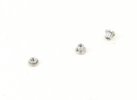
I also turned all the centre section down to the largest diameter which is that of the plates at either end of the spring, then I used a hexagonal collet block to mill the two nuts using a 2mm end mill and then finally turning the other sections to final size then using a round file to shape the curved sections at each end.

54973378126_30c83cf2bc_h.jpg

Once the cosmetic spring was added it looked like this. It only needed the finest touch with a file to remove the parting nub to make it fit between the frames.

54973555003_a69dd39121_b.jpg

For a mad moment I did consider remaking the first one but then sanity prevailed and I decided to put the first one to the back where it won’t be seen at all and put the second better (in my view) one at the front where not much of it will be seen either.

54973378116_bf5325c0ea_h.jpg

54973555008_7d45d214c6_h.jpg
 

Rob Pulham

Western Thunderer
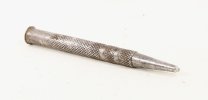
I have spent the last week or so fixing a number of mistakes that I made back when I didn’t know any better. For example, I realised when trying to fit the wheels that I had assembled the Premier coupling rods as a pair rather than handed, so one side only fit inside out. At the back of the workbench, I found an old pin punch. I popped it in the lathe and turned a small spigot on the end, to allow me to carefully pop out the rivets and swap the sections of rod around.

55007964094_f10b44521f_h.jpg

Once corrected I was happy to find that the rods ran smoothly in both directions without any sign of binding.

55007955104_4a7477a099_h.jpg

(As an aside I do like the built in motor restraint which is a nice bit of design work.)

The next bit of corrective action took most of a day to sort out. I had previously bent and fitted the two steam pipe sections that fit between the grease separator and the exhaust steam injector. These are made from 3.1mm copper rod which takes a bit of working to shape. Fast forward a few years and the grease separator casting had come adrift from its mounting pad and I hadn’t actually secured the front section of pipe. It was just pressed into the front flange of the grease separator casting. Without paying much attention I soldered the grease separator casting back in place and moved on to more of the motion parts.

While working on these I thought that it might be wise to fit the wheels and check that the Premier coupling rods matched the MOK wheel base and that I had a smooth-running chassis. It was at this point that I realised that the route of the steam pipe prevented the rear axle from moving through its full travel once the motor was fitted – The rear axle sat a good millimetre higher than the front axles. So, I removed the pipe (and the castings at either end) adjusted them and refitted to find that the pipe now hit the tyre on the rear wheel.

At this point I stopped refitting the castings and just kept adjusting the pipe bends. I did much of this with the aid of my vice, a thick-walled steel tube filled with lead and a white rubber mallet. I also made use of the “Markits” BA nut spinner set for making the tight tweaks to the very end bends after finding that the 8BA size just fit over the copper rod. I spent a couple of hours on Christmas Eve and around six hours yesterday before I finally got it to fit in place and clear both rear wheel and allow full vertical movement of the gearbox.

In reality once I come to set the ride height, the vertical movement of the gearbox may be less of an issue but better safe than sorry.

55007864838_96c5d74dd8_h.jpg
 

Rob Pulham

Western Thunderer
One of the many things that I love about having a lathe, is the fact that it makes it so much easier to get a consistent result while tackling some of the more tedious tasks in railway modelling.

A task that I have aways found tedious*, is cutting/filing crank pin bushes to length so that they allow some play in the coupling rod and don’t bind or unscrew themselves when running in reverse.

*Mainly because although I can follow a line with a saw without too much difficulty, I really struggle to file surfaces at 90 degrees to the edge.

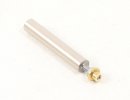
To get around this on the 8F, I turned up a little Arbor from some mild steel bar (more recycled toner cartridge rod). I threaded the end 10ba and using a 10ba nut, I was able to fit the tapped bush on the end then lock it with the nut and quickly and consistently remove 0.9mm from each one.

55014150673_801e95ca13_h.jpg

55014160273_e30383e696_b.jpg
 

simond

Western Thunderer
little jigs and fixtures like that are de rigeur if you have and use a lathe, and are more useful again if a milling machine is involved.

what I find particularly interesting is the speed with which 3D printing (usually FDM rather than resin) has become similarly stock-in-trade in the workshop. Jigs and fixtures that would have taken hours and saved minutes or tens of minutes, now get printed overnight, cost next to nothing in materials, and save minutes or more in the workshop.

bring it on!
 

Rob Pulham

Western Thunderer
In between the festivities I have been making further progress on the 8F chassis and motion. Way back I had bought a full set of motion from Premier in ignorance at the time that sometimes for what ever reason the kit centres don’t always match those of the Premiers rods. In this case the coupling and connecting rods are fine but most of the others aren’t. I had previously spent some time fitting forks to the radius rods but I hadn’t assembled enough of the motion to check that they would actually fit.

55017387154_b2d43693a9_h.jpg

Spoiler alert, they don’t.

Which was a bit of a shame because I had also fitted a sliding block for the reversing links. Hey ho, I still had the kit rods so I made those up.

I had in the past, determined that the Combination levers for my engine should be fluted, whereas the Premier rods are plain. So, they too are in the spares box, as are the Union links because I couldn’t see how I might make them forked.

Returning to the coupling rods, after shortening all the bushes I decided that I couldn’t live with the brass bushed for the two front axles because they ultimately become the ‘crankpin nuts due to lack of clearance on the prototype. So using the nothing looks like steel than steel maxim I made some replacements from steel and I also made up some of the large flanged nuts that retain the rear of the coupling rods.

55013093822_7dea95ed35_h.jpg

After this image was taken I did thin down the flanges somewhat.

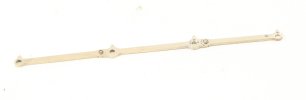
Next up was recessing the coupling rods at the first pair of holes.

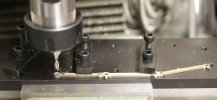
I machined up a stub of bar that was a close fit in the coupling rod holes and fastened them to my Metalsmith drilling plate. Using the stub of ba as a locating pin I was able to adjust the mill tables until it dropped smoothly into the hole and then swap the stub out for a 4mm slot drill which I used to recess the our hol for the flange of the bush.

55017391059_0abb7f669d_h.jpg

55017445095_7e6ade07d0_h.jpg

You will note the black marker spot on the side of the rod. This was to ensure that I didn’t inadvertently recess the wrong end…

55017307473_c1ae18de9d_h.jpg

Here we are to date with the bits that are fitted so far working without catching or unscrewing them selves when the loco runs in reverse. The next job is the return cranks when I will determine if the Premier Eccentric rod, fits or not.

55018006314_8d9beba19a_h.jpg

55017921283_8575bc5f28_h.jpg
 

Rob Pulham

Western Thunderer
No they are just screwed in from the back, so an easy fix.

I have had the cylinders and motion bracket on and off multiple times per modelling session just recently, so them being removable is essential.

Thanks for the heads up, I'm sure that I would have worked it out at some point but there might have been much head scratching before then...
 

Rob Pulham

Western Thunderer
Sorted, it also gave me the opportunity to correct something that I had been too lazy to do until I had to unsolder the forked end to swap the expansion link around.

It's not really visible in the photos but the pin that goes through the radius rod to connect the the links which attach it to the reversing gear is flush on the photos in the earlier shots. It now has a protrusion to represent the end of the retaining pin. Which was present all along, but on the inside. This was due to my swapping the radius rods over to get them to better align with the top of the combination lever.

55021213018_6442be422c_h.jpg
 
Top