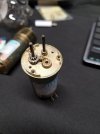
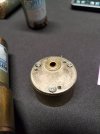
7mm Poor man's Alamosa.

Big Train James

Western Thunderer
Sadly these are pretty much the same size as Jims but a much higher ratio, although I'm sure you can open them up and change the ratio downward if needed.

You might even be able to take the whole gear head off or cut it down if there's no other option.
At the 60.5:1 ratio, your motor will be the same length as my 19.5:1 version pictured above. They both utilize the shorter "universal" gear head housing, even though neither gear train uses all the space available.

The 60.5:1 version is simply the 19.5:1 version with two additional compound stage gears added. All the stage gears stack on a pair of axles, and slide on and off easily. So yes, you can change the ratio very easily. You would need to reposition the final gear that is an interference fit on the output shaft, but that is should be a straightforward operation. Or you can substitute the final gear and output shaft assembly from a 19.5:1 version motor if you have one available (I do, although mine may require a swap of bushing for bearing).

Here are some photos of the innards. In the first photo, it's the 1804:1 motor on the top, 19.5:1 on the bottom. The 1804:1 motor features ball bearings on the output shaft, while the 19.5:1 motor has bronze bushings.
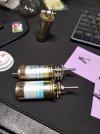
pittman guts-001.jpgpittman guts-003.jpgpittman guts-002.jpg


The shaft on the right has the ball bearing, the shaft on the left uses a bronze bushing which is still seated in its pocket to the right of the motor pinion gear in the second photo above.
pittman guts-004.jpg


And the bearing versus bushing in the housing cover....
pittman guts-005.jpgpittman guts-006.jpg

It strikes me that the "ring" housing could be chucked up in a lathe and parted off to reduce its length, and the drive shaft could likewise be shortened. Whether any of that would get the motor and gear head down to a size that would fit in your application is another story. Between us, we should have the parts if you ultimately decide to give it a go.
 

mickoo

Western Thunderer
Very useful, just checked mine and they're ball race fitted.

Talking about trimming the gear box I was more inclined to take it all off and use the tail end shaft (for flywheels) as the output shaft to the model, there are threded fixin holes in that end so presumably that must be some sort of option.

With DCC you can control (clamp digitally) top speed and I'm sure the motor has more than enough grunt without a gear box to drive the model?

I mean, the original set up doesn't look like it had a gear box on the motor and suspect there's further gearing in the tower box the motor feeds into.....in which case a gear head is probably going to be too slow with respect to model speed, ratio's on top of ratio's etc.
 

Big Train James

Western Thunderer
Very useful, just checked mine and they're ball race fitted.
Wouldn't have told you to bother with them if they had the bronze bushings.

I wish I had thought about using the tail end for the drive rather than the gear head end. I should have figured that out. And yes, you can fix the motor by either end, or both if you really wanted to. The one issue with essentially turning this gear motor into a regular motor is that the motor cover on the gear head end is the larger diameter to accept the housing. A regular motor would have a cover on that end that matched the diameter of the motor body. It matters because the motor body will fit inside most if not all O scale locomotives including hood units like sd40-2's or 08 shunters. On the other hand, the diameter of the gear head on these units is often too big to fit inside some of the plastic O scale shells with their armor plate wall thickness. Could you take the gear head cover off and replace it? You could, it's screwed on from the other end. I've never had one off because I couldn't break the screws loose, I presume they are set with a thread locker that will require some heat to break. I've considered contacting Pittman and seeing if I could get some replacement ends, but the other solution would probably be to turn new ones if the desire was strong enough. Actually the proper solution would be to keep an eye out on ebay and just buy regular motors of the right type, ideally ones with shafts at both ends, when they finally turn up at the right price. It's bound to happen eventually. But that's too simple, so nah. :rolleyes:

No question that the motor has enough power without the gear reduction, it's actually how most of them have been used over the years. The gear motor implementation is really the anomaly, not the other way around. Actually it's not accurate to say the motor is fine without reduction, because all the gear head does is change where the reduction takes place. If it's not at the motor, it's at the truck. And no, you probably don't want reduction at both the motor and the truck, at least not full reduction in both places. It would take you a long time to get anywhere.

The premise behind the use of the gear motor is that all the reduction happens at the motor, so all components downstream are spinning at a 1:1 rate, much slower than they would be otherwise. Theoretically that means less noise than otherwise. Gearing at the trucks is accomplished with 1:1 helical gears at right angles. I'm not sure who started using it in model trains, but I know that Jay Criswell further developed the idea and uses it for most of his drive conversions.

My issue with the system is that it requires two drive shafts if powering trucks on both ends of the motor. There is the output shaft on the gear motor, but that needs to transfer power to a jack/cardan shaft which then powers the trucks. By necessity, those two shafts have to be one above the other, which means the motor must move up, which means less room inside the hood for any required boards or speakers. My goal is to have a low-profile drive which has the motor as low as possible, thus leaving as much room as possible in the shell above. The conclusion is that for my wants, I will need a double shafted motor that fits within the length of a fuel tank, with all reduction at the trucks. Unfortunately, that means that all of these gear motors I've acquired over the years are not suited for my purposes.

If you're doing a loco with a full width body, especially driving only one truck (sound familiar to anyone), or doing a steam locomotive with a single gearbox, then these motors would be great choices.
 

mickoo

Western Thunderer
If you rip all the gears out and casing off you're left with a central shaft and small pinion, if it offended then it could be pulled off or simply ground off to leave a stub shaft.

You're also left with a flanged end plate that the gear head casing sat on, it's diameter being slightly larger than the motor diameter.

Basically everything you said above, yes.

So, being ever pragmatic, rather than taking that adaptor plate off and making a new end blah blah blah, just stuff the whole motor in the lathe with the tail end inside and simply skin the flange flush with the motor casing. Take a few seconds to do that and leave all the bearings and motor end caps intact and in place whilst drastically reducing the length and matching the diameter.

If you wanted to get the A++ anorak, then face off said plate and remove all the stubs that held the secondary gear shafts and located the casing.

Job done, swagger down the pub in smug mode.

Of course, you could already be sat in the pub long before having simply bought a non gear head Pitman :))
 

Big Train James

Western Thunderer
So, being ever pragmatic, rather than taking that adaptor plate off and making a new end blah blah blah, just stuff the whole motor in the lathe with the tail end inside and simply skin the flange flush with the motor casing. Take a few seconds to do that and leave all the bearings and motor end caps intact and in place whilst drastically reducing the length and matching the diameter.

If you wanted to get the A++ anorak, then face off said plate and remove all the stubs that held the secondary gear shafts and located the casing.
I really must get more sleep, or consume more caffeine, something to sharpen my senses. All of this this should have been obvious to me. :rolleyes:

Of course, you could already be sat in the pub long before having simply bought a non gear head Pitman :))
Not that I'm getting anywhere fast, but this does take a bit of patience. It's not difficult to find Pittman motors, but finding them at 12V with better magnets is a bit trickier. And finding them at 12V with neodymium magnets while also having double shafts is a rare feat indeed. All of that for a decent price could take some time.
 

mickoo

Western Thunderer
I really must get more sleep, or consume more caffeine, something to sharpen my senses. All of this this should have been obvious to me. :rolleyes:


Not that I'm getting anywhere fast, but this does take a bit of patience. It's not difficult to find Pittman motors, but finding them at 12V with better magnets is a bit trickier. And finding them at 12V with neodymium magnets while also having double shafts is a rare feat indeed. All of that for a decent price could take some time.
You forget a life time of looking for alternative solutions where no one else tends to, needs must irrespective of process :D

I wouldn't know anything about the magnets so no idea what's in these, but, being as they have ball races you'd assume they might be neodymium.

If solo Pitmans with these features are hard to come by but more available as gear heads, then it makes sense to chop them down. Much like folks buying up cheap Roco O gauge Xmas train sets to pull out the DCC controller and sell on at twice/three times the purchase cost, why, because Roco Maus controllers are bleedin hard to find as a solo purchase.
 

Scale7JB

Western Thunderer
Latest addition to the Alamosa fleet - a Max Grey L-105. A purchase from the Chicago show. A rather lovely pair. Very disappointed to hear from this vendor that he’d sold another of the L-131’s before I had got to him. Would have been nice to have two of the same.

Both still need a bit of super-detailing though.

Luckily a quick test on the L-105 wheels shows that they are steel, so i’ll be able to blacken them shortly, which will massively help the appearance.

IMG_5941.jpeg

JB.
 
Top