Shop made Tap Spinners For Small Taps

Rob Pulham

Western Thunderer
Ahh, got you. In that case I wouldn't use the tap spinner with the tapered depth stop. One of the thinner plain ones would possibly do the job depending on how small your tap was of course.

That said, I suspect tapping a 10, 12 or 14ba thread in 1"x 1" angle would be a bit of a rarity no matter what you were using as the tap wrench
 

Rob Pulham

Western Thunderer
Further to the discussion about making, versus buying tools above, I duly bought said tap follower from Arc Euro Trade and what a journey that turned out to be.

When it came the grub screw in the image fitted into the back of the tap follower to retain the spring.

View attachment 198312

View attachment 198313

Which in itself was fine aside from the fact that the body of the tap follower was too big to fit in either of my Jacobs chucks and although I could have swapped the chuck out for a collet chuck that would have been a lot of messing about each time I wanted to use the tap follower. My solution was to turn up a threaded pin to replace the grub screw. Which on the face of it is simple, except I couldn't determine what thread* was in the tap follower as supplied, so I ended up re-tapping it to M10.

That done I gave it a whirl and found that the hole in the body is far too big with too much slop for the guide rods to actually hold the tap straight. Which of course is the whole point of the exercise...

Hopefully you can just make out the gap between the two in the close up below. What should be a close sliding fit is far from it.

View attachment 198314

As I had already modified it I couldn't really return it to Arc Euro so I put it in a drawer in disgust and moved on.

Fast forward to a couple of days ago and I had need to tap another hole in the lathe and I just happened to have the length of 8mm stainless rod (which I use for tightening my collet chuck) in my hand when I saw the tap follower in the drawer. I took it out and quickly dismantled it and tested the 8mm rod inside the body of the tap follower. It was a perfect fit. I cut another length from the piece I have in stock, to suite a new double ended guide rod and then turned each end down to a close sliding fit. One end has a point, the other has a 60 degree countersink to accommodate taps with points on the end.

View attachment 198315

View attachment 198316

Now I have a tool that does what it was supposed to when I bought it. I cannot blame Arc for the initial problem of the shank not fitting my drill chucks because it does state the shank size on their website but I missed taking note of it.

The poorly fitting guide rods is another matter.

You live and learn and I suspect that in this instance I would have been better making my own tool or buying a better quality example in the first place. At least I have been able to remedy it and I may at some point make up a second shorter version to utilise the spare guide rods.

*Having checked the Arc Euro Trade site as I was typing this to confirm that they do indeed note the shank size, I also noted that all the other measurements although primarily stated in millimetres, are in fact conversions of imperial sizes.

As I don't possess any imperial taps or dies I was doomed from the start in working out what size the thread might be.
Since buying and later modifying this tap follower back in 2023 I have used it many times and I wouldn't be without it. However one thing about it is a bit of a pain, or perhaps I am just bit lazy. That is swapping the piston over end for end depending on whether my tap has a point or a dimple.

As a rule of thumb most of the bigger size taps have dimples whereas the smaller sized ones tend to have a point or at least a tapered end.

To get around this I dedided to make a second smaller tap follower with lighter springing that could be dedicated to the smaller taps that I seem to use a lot.

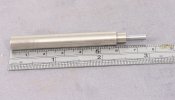
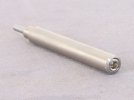
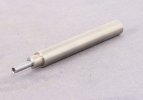
I decided to make it from a couple of pieces of rod recovered from a printer drum unit. The main barrel being 8mm in diameter which will fit in all my Jacobs drill chucks without issue and the piiston end made from some 5mm rod, again from the drum unit.

Springs from my spares box and an M6 grub screw and away I went.

I chose M6 because the tapping size is 5mm which meant that my piston could be a 5mm rod with the end turned down to pass through a smaller hole in the end. So it was a case of drilling the main body 4.8 mm and then reaming to 5mm with a 2.9mm hole in the other end reamed to 3mm. Sadly all didn't go as planned because in a moment of inattention I broke my 3mm reamer in the hole. After trying a couple of pins to knock it out and a 3mm carbide end mill I turned a little off the length until I exposed the broren end of the reamer then using my vice as a press I managed to push it part way through. Then I found in my bits box a short length of rod with a smaller stub which fitted in the 3mm hole. Using this as a drift I managed to push the reamer a little further in, then I turned the small stub end a little longer and repeated the process it took turning 3 more sections down before the reamer popped out. Then I ran another 3mm end mill through the hole to tidy it up and get it concentric before finally turning the small end of the piston to be a tight but sliding fit in the hole.

55160460200_0422924fdb_h.jpg

55160242573_08d2f9bba2_h.jpg

55156970557_f58f2cf4af_h.jpg

55158255005_55363ee0c0_h.jpg

55158030188_c2933242a5_h.jpg

A fun little project that had I not broken the reamer would have only taken an hour or so. I'm sure that it will see much use in the future
 

Rob Pulham

Western Thunderer
I should add (in case you are wondering), the step down in the 'barrel' was already part of the piece of stock that I used, and I saw no advantage to removing or reshaping it.
 
Top