
You are using an out of date browser. It may not display this or other websites correctly.
You should upgrade or use an alternative browser.
You should upgrade or use an alternative browser.
7mm The Old Man's Workbench - tales of a rivet side
- Thread starter Dog Star
- Start date




Phill Dyson
Western Thunderer
But full marks for the copy of the GOG Gazette
Richard
Surprised at you Richard !
 ...........that Gazette is clearly out of scale


Dog Star
Western Thunderer
A notable event has occured... an event which, according to posts on this forum, most WT-peeps are unfamiliar. My son has opened a new JLTRT kit and... "All of the parts are present"... and the instructions are readable!
So begins the inevitable and onerous task of decidning upon which springs to fit so my Son has set off on a browse through Paul Bartlett's photo-collection for inspiration on owners and liveries, such is how the choice of castings is made.
regards, Graham
So begins the inevitable and onerous task of decidning upon which springs to fit so my Son has set off on a browse through Paul Bartlett's photo-collection for inspiration on owners and liveries, such is how the choice of castings is made.
regards, Graham

Steph Dale
Western Thunderer
Yep, I had the same surprise when I opened my recently-acquired Western; not only was everything there, but there was also a comprehensive packing list. Maybe the penny has dropped at Chez-NQLTRT.
Steph
Steph
Dog Star
Western Thunderer
Joined the hydraulic brigade eh? The recruiting list for the 52nd Western Warriors (the Maroonites) is open at the moment, just fill in your details on the back of an open cheque in the name of Prof Barking (who has need of a bigger kennel for his hydraulics).I had the same surprise when I opened my recently-acquired Western...
regards, Graham
Steph Dale
Western Thunderer
Graham,
Yep, '15, as preserved...
With my own mech and compensated bogies.
Steph
Yep, '15, as preserved...
With my own mech and compensated bogies.
Steph
Dog Star
Western Thunderer
And now for something completely.... bonkers. This little project has the potential to go rather wrong although I do hope that the advice and support from Steph-the-hat-Dale is going to steer the ship through the storm.
Peter has been building a JLTRT Class 37 for a while and the time has come to give some mobility to the underframe - which means fitting the ABC motor bogies and connecting the wires for the motors / pick-ups / decoders, kettle and toaster. Connecting wires seems to be a simple task... just that the model is to be capable of running as either DC or DCC dependent upon need, the changeover being by way of plugs and sockets within the body of the model.
Today has been about deciding how to approach the job and taking the first steps. The JLTRT instructions are not much help here... neither is "over there"... so bear with me as we make this up as we go along. Diversionary comments are welcome!
First... making sure that there is no opportunity for untoward short-circuits. The fuel tanks of this kit are retained by screws into nut-serts in the floor. As supplied the screws project about 5mm above the floor, those items need to be shortened as here:-
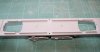
I thought that my first attempt was acceptable except that the result was two screws of different lengths - this comes about because the fuel tanks are of different depths. If I had left the screws "as is" then there is a good chance that, at some time in the future, the longer screw would be used with the thinner tank... a scenario with dire results. To avoid future problems here I made the two screws to the same length and then deepened the countersink of the thicker tank.
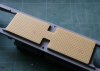
A piece of PCB strip board has been cut to fit on top of the side flanges of the floor moulding, the piece being cut as long as fits comfortably between the bogie cut-outs:-

Using a board presents a sniggle in that the lugs of the sides finish inside of the floor flange. The solution is to make a cut-out in the board to clear the fixing lug of each side:-
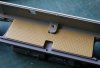
This is the way in which the board fits when a side is offered up to the floor:-
regards, Graham
Peter has been building a JLTRT Class 37 for a while and the time has come to give some mobility to the underframe - which means fitting the ABC motor bogies and connecting the wires for the motors / pick-ups / decoders, kettle and toaster. Connecting wires seems to be a simple task... just that the model is to be capable of running as either DC or DCC dependent upon need, the changeover being by way of plugs and sockets within the body of the model.
Today has been about deciding how to approach the job and taking the first steps. The JLTRT instructions are not much help here... neither is "over there"... so bear with me as we make this up as we go along. Diversionary comments are welcome!
First... making sure that there is no opportunity for untoward short-circuits. The fuel tanks of this kit are retained by screws into nut-serts in the floor. As supplied the screws project about 5mm above the floor, those items need to be shortened as here:-
I thought that my first attempt was acceptable except that the result was two screws of different lengths - this comes about because the fuel tanks are of different depths. If I had left the screws "as is" then there is a good chance that, at some time in the future, the longer screw would be used with the thinner tank... a scenario with dire results. To avoid future problems here I made the two screws to the same length and then deepened the countersink of the thicker tank.
A piece of PCB strip board has been cut to fit on top of the side flanges of the floor moulding, the piece being cut as long as fits comfortably between the bogie cut-outs:-
Using a board presents a sniggle in that the lugs of the sides finish inside of the floor flange. The solution is to make a cut-out in the board to clear the fixing lug of each side:-
This is the way in which the board fits when a side is offered up to the floor:-
regards, Graham

mickoo
Western Thunderer
If the tanks are removable it might pay to put your DC/DCC switches in there and thus negate taking the body off to change over, an alternative rather than plug and sockets is a small rotary switch, the sort changed with the end of a flat bladed screwdriver, I.E. one with a slot cut in the end of the shaft, that way you need not even take the tank off if there were a corresponding hole in the floor of the tank over the switch.
If your loco is pre 1980 rebuilds then one of the tanks is for water, the other for fuel, the water tank was changed to allow greater range in the mid life refurbishment program and dual fuel tanks (1,670 gal) are only fitted to locos 37 401 and above, however....it appears that some locos under 401 have dual fuel tanks, especially in more current TOC owned circles, DRS etc. I don't think the tanks changed physically but the pipework did to accommodate a single point filler. An almost sure sign of dual fuel tanks is the blanking off of the gauge on one the tanks.
If your loco is pre 1980 rebuilds then one of the tanks is for water, the other for fuel, the water tank was changed to allow greater range in the mid life refurbishment program and dual fuel tanks (1,670 gal) are only fitted to locos 37 401 and above, however....it appears that some locos under 401 have dual fuel tanks, especially in more current TOC owned circles, DRS etc. I don't think the tanks changed physically but the pipework did to accommodate a single point filler. An almost sure sign of dual fuel tanks is the blanking off of the gauge on one the tanks.
Dog Star
Western Thunderer
A good idea, feasible although I am not sure that I could cope with cutting the necessary holes in the resin castings.If the tanks are removable it might pay to put your DC/DCC switches in there and thus negate taking the body off to change over.
This is a neat idea - suggestions for parts anyone? Easier to drill a small, round hole for the shaft than a bigger, rectangle for a complete switch/socket.... an alternative rather than plug and sockets is a small rotary switch, the sort changed with the end of a flat bladed screwdriver, I.E. one with a slot cut in the end of the shaft, that way you need not even take the tank off if there were a corresponding hole in the floor of the tank over the switch.
Cl. 37 408 circa 1986-8 so a dual fuel tank example.If your loco is pre 1980 rebuilds then one of the tanks is for water, the other for fuel, the water tank was changed to allow greater range in the mid life refurbishment program and dual fuel tanks (1,670 gal) are only fitted to locos 37 401 and above... I don't think the tanks changed physically but the pipework did to accommodate a single point filler. An almost sure sign of dual fuel tanks is the blanking off of the gauge on one the tanks.
If a blanking plate for a gauge is an almost sure sign of a dual fuel tank engine then the large diameter pipe which interconnects the inner faces of the two tanks is a definite sign that fuel is flowing between the tanks. Martin (aka Pugsley) has posted a photo, either here or there, which shows this pipe - appears to be on the longitudinal centre-line of the engine and about 3 - 5 " from the tank bottom.
regards, Graham

daifly
Western Thunderer
GrahamMartin (aka Pugsley) has posted a photo, either here or there,
here and there seem to be nowhere!
Dave

TheSnapper
Western Thunderer
... just that the model is to be capable of running as either DC or DCC dependent upon need, the changeover being by way of plugs and sockets within the body of the model.....View attachment 21980
Hi Graham
Pardon me for asking, but why are you doing this?
A simple CV change will allow a DCC chipped loco to run perfectly OK on DC.
If it's a sound chip, you will get some sounds too.
Regards
Tim

Ressaldar
Western Thunderer
Graham,
why do you need to switch between DC & DCC, does not the decoder do that for you, or have you switched that option out already?
On the plugs & sockets, I have used the 2, 3 & 4 pin micro sets from All Components, very good service.
cheers
Mike
seems Tim's post came through while I was preparing mine.
why do you need to switch between DC & DCC, does not the decoder do that for you, or have you switched that option out already?
On the plugs & sockets, I have used the 2, 3 & 4 pin micro sets from All Components, very good service.
cheers
Mike
seems Tim's post came through while I was preparing mine.
Steph Dale
Western Thunderer
Graham will no doubt be back shortly with a more comprehensive reply, but he's decided to run the loco from two HO decoders rather than one of the larger scale versions. Personally I'm unconvinced by this having seen a couple of my dad's diesels run well enough on just one HO decoder.
I've had problems running decoder equipped locos double headed on analogue and advised Graham of this. A couple of switches seems a pragmatic solution.
Also worth noting that switching the relevant bit in CV29 to digital-only gives a significant improvement in performance of the decoder.
Steph
I've had problems running decoder equipped locos double headed on analogue and advised Graham of this. A couple of switches seems a pragmatic solution.
Also worth noting that switching the relevant bit in CV29 to digital-only gives a significant improvement in performance of the decoder.
Steph
Dog Star
Western Thunderer
Hi Mike and Tim,... why do you need to switch between DC & DCC, does not the decoder do that for you, or have you switched that option out already?
In much the same way that FS modellers decide not to adopt S7 because they wish to run stock on more than one layout the same consideration can arise with S7 modellers when faced with DC and DCC layouts. In this case Peter wants to be able to run his diseasels here (DCC) and there (DC or DCC). We have experimented in running our stock on the Guildford 0-gauge layout (pure DC) and that was not a pleasant experience in that the motors made noises of impending doom - we did not investigate, just do not wish to repeat. Similarly, we were not impressed with the behaviour of a pure DC model which was run on our DCC layout. Given that the motors and electronics in our CL.37 cost circa £600 we do not want to risk that investment and hence decided to provide wiring for alternative DC / DCC operation which keeps 12V DC away from the decoders.
Do not worry Tim, this beast is not going to have a Merrymaker ticket to the Oldham loop... Richard would ban the movement as being injurious to the PW (the bogies would try to spread the track).
regards, Graham
Dog Star
Western Thunderer
Accepting that this model has two ABC motor bogies I sought the advice of Brian Clapperton as to how to set up the DCC aspects of the build. Brian was firmly of the opinion that separate decoders was preferable and that is what we are doing. The two ESU 4mm decoders are circa £130 (one with / one without sound) whilst the ESU 7mm decoder is significantly more (with sound).... he's decided to run the loco from two HO decoders rather than one of the larger scale versions. Personally I'm unconvinced by this having seen a couple of my dad's diesels run well enough on just one HO decoder.
ABC motors act as very efficient generators and when coasting a motor can generate sufficient power as to lock or reverse the other motor. This situation has occured during initial testing, when I was working out how much to enlarge the holes in the underframe, and caused some mirth when I asked Brian Clapperton about the behaviour. Elementary physics which I ought to have remembered and thereby avoided an embarasing call to ABCI've had problems running decoder equipped locos double headed on analogue and advised Graham of this. A couple of switches seems a pragmatic solution.
 .
.This concern about B-EMF has lead to some interesting aspects of the wiring and the plugs / sockets. I shall provide a wiring diagram when all is finished, suffice to say for now that:-
* with pick-ups on both bogies there is the opportunity to have an internal power supply bus which has eight pick-ups spread over about 15";
* when running in DC mode the motors are arranged in parallel;
* when running in DCC the motors are driven by separate circuits.
Ta-dah! Thank you Steph (aka Prof DCC)Also worth noting that switching the relevant bit in CV29 to digital-only gives a significant improvement in performance of the decoder.
 .
.regards, Graham
TheSnapper
Western Thunderer
...... We have experimented in running our stock on the Guildford 0-gauge layout (pure DC) and that was not a pleasant experience in that the motors made noises of impending doom...............
That might have been due to incorrect back-emf settings. My ABC-powered '37 was the same until Steph pointed me in the right direction, CV-settings-wise.
...........Do not worry Tim, this beast is not going to have a Merrymaker ticket to the Oldham loop... Richard would ban the movement as being injurious to the PW (the bogies would try to spread the track)...........

......... he's decided to run the loco from two HO decoders rather than one of the larger scale versions. Personally I'm unconvinced by this having seen a couple of my dad's diesels run well enough on just one HO decoder.Steph
I'm sure it would run with just one HO-sized decoder, with the motors you are using. I actually run a Heljan 20 with a Loksound v4 & a Heljan 31 with a Zimo645, both HO sized.
..........worth noting that switching the relevant bit in CV29 to digital-only gives a significant improvement in performance of the decoder..........
Totally agree, but if it was only changed when required to run on DC, I don't think it would affect DC performace, would it?
At the end of the day it's Graham's choice...........
Tim
Dog Star
Western Thunderer
Whilst that sentiment is true, I admit freely and regularly that I do not understand this DCC-malarkey which is more than just two wires, there is a lot of smoke and mirrors in getting thing just so. I am pleased to see practical contributions to any DCC discussion and encourage such within any topic of mine.At the end of the day it's Graham's choice...
regards, Graham
Steph Dale
Western Thunderer
This comment seems to beg the question... when will Steph contribute a tutorial on adjusting CVs for tuning the performance of specific motor types?
regards, Graham
All the decoders I use have really good step-by-step routines in their manuals for setting up motors and I suspect I'd struggle to do better. Added to which, each manufacturer has their own approach, so I can't even provide any generic info.
On ESU there's also the automatic set up routine, although I haven't tried this yet...
Steph