7mm The Old Man's Workbench - tales of a rivet side

Dog Star

Western Thunderer
Any chance of a view of the underside of that Vero-Board?
I shall do that and include a wiring diagram as and when the work is done - because at the moment I am not sure how this work is going to achieve the objective.

One thing is clear so far, the quality of the plugs and sockets which are available at railway shows is not that good - and the stuff from Maplins is worse. The four way plug/socket is American and sound, makes a firm connection - the two way plug/socket of unknown provenance is so loose that the plug can fall out of the socket if the model is laid on the side.

regards, Graham
 

alcazar

Guest
I've done a few cursory searches for plugs and sockets, and there does seem to be a lack of decent stuff.

Some years ago I had two-way ones from Rapid, they would only plug in one way, and had captive leads about 12" long. They cost around 20p each, and were very firm when mated.
Rapid no longer seem to stock them.
 

ZiderHead

Western Thunderer
One word: Molex™

The latching power connectors (used in PC PSUs, cars etc) are great for DC/DCC/CBUS bus wiring.

The small signal connectors (again in PCs for fan connections, audio etc) would be ideal for use in locos.

They do a massive range with latching and sealed versions with power ratings suitable for everything modelling-wise, all available from RS or Farnell :thumbs:


edit: the standard 0.10" pitch latching PCB connectors from Maplin are fine too, although only rated 2.5A. I use them inline by soldering to the PCB pins and heatshrinking over them.
 

richard carr

Western Thunderer
Graham

I have been testing one of my class 37 as it wasn't running too well and it needed some weight adding to it.
The speaker it had was an 8 ohm visaton sc 4.7 ND connected to a loksound V4 chip. It was running very jerkily which I put down to dirty track and wheels, so I got one of the ESU power packs and carefully soldered this to the chip, it wasn't as difficult as I thought. This did improve things but not to extent I expected, yet the power pack was clearly working as you could lift the loco off the rails and it would continue running for a good 2 seconds afterwards.

So I had a read of the ESU website and found that Loksound version 4 chips should use a 4 ohm speaker and that the maximum current output for the auxiliary outputs is half an amp. A quick application of V=IR to an 8 ohm 2 watt speaker implies a current draw of half an amp ! It looks like the poor running was due to the chip shutting down as the speaker drew too much current, the speaker can produce 4 watts

So now it has a 4 ohm version of the visaton speaker and it runs so much better. It also has a lot of lead in it which makes a big difference.

Its worth noting the speakers are only £6.24 at RS components they are at least £10 from model suppliers.

Richard
 

Dog Star

Western Thunderer
I have been testing one of my class 37 as it wasn't running too well and it needed some weight adding to it.
Where are you going to put the ballast weight for your Cl.37? I ask because:-

a) I have had to move some of the body fixing points as a result of installing ABC motor bogies, the replacements for the bulkhead nut-serts are at the outer ends of the underframe. The underframe is flexible to a degree and I have noticed that the underframe dips in the middle under the weight of the fuel tank castings. Extra weight in the middle of the underframe is going to exacerbate the bending. I acknowledge that there are two underframe / body fixings in the centre of the engine... just seems to me that adding weight between the bogies is not a good idea given the flexibility of the underframe.

b) Whilst there is a reasonable space under the hood, on our model that space is going to be taken with extra body fixings and plumbing for the headcode/marker lights.

regards, Graham
 

richard carr

Western Thunderer
Graham

I have put some of the weight in each nose under the hood but most of it is in the roof between the centre of the loco and the fan, the fan end on mine being the powered end.

I'm surprised at the underframe flexibility as the fuel tanks should help make the underframe more rigid, I have't noticed any problems with mine.

Richard
 

Dog Star

Western Thunderer
I have put some of the weight in each nose under the hood but most of it is in the roof between the centre of the loco and the fan, the fan end on mine being the powered end.
As diesels are outside of my experience with 7mm models, how did you realise that your model needed more weight? How much weight are you adding?

I'm surprised at the underframe flexibility as the fuel tanks should help make the underframe more rigid, I have't noticed any problems with mine.
A preliminary examination of the underframe suggests that the flexing is taking place in the vicinity of the motor cutouts. The fuel tanks are retained by one screw per tank at this time - have you glued the tanks to the frame on your model?

thanks Graham
 

richard carr

Western Thunderer
Graham
All JLTRT diesels need weight adding, they are quite light compared to any other 7mm locos steam or diesel. I have added about a kilo of lead. Dikitriki is correct though in his observations that powering only one end can lead to better traction in one direction, getting the balance right reduces this, but its trial and error to do it and with DJH locos they are so heavy already that adding more weight isn't desirable.

I have just screwed the fuel tanks on, but I haven't had to enlarge the motor hole on mine, is it possible to put some steel or even brass angle down the sides of yours to stop this ?

Richard
 

Dog Star

Western Thunderer
Almost two months since the last time that the yard shunter pushed the TTA triplet into the works and no progress...

Today was a sticky day, getting sticky stuff on the fingers whilst fitting buffer stocks to the underframes. Soon have some working buffers to go clang in the night (yard shunter prefers the night shift as that is double time) - although the promise of sprung buffers has prompted a question. How far does the buffer head of an Oleo buffer project from the headstock of a (JLTRT) TTA?

regards, Graham
 
Last edited:

Dog Star

Western Thunderer
Those TTAs have refused to budge from the workbench... someone says that the Wagon Inspector was practicing for his other job as a football referee and that he had an attack of the red cards, so the things are still there and in need of repair.

In the meantime, I sought the opinion of a modelmaker, who is a member of WT, about painting the completed model because I have no experience of spray painting and I am unsure how to deal with masking the model to add the red solebar. The advice received is to ensure the tank is separate from the underframe... now that is difficult given that there are some parts of the underframe which are suspended from the tank body, viz:-

* a central V-hanger;
* air distributor valve;
* brake lever safety loop.

There seems to be no point in asking for advice and then not taking those pearls of wisdom especially when the information proffered seems to be sensible. A workable solution to the dilemma has been devised and tried on one JLTRT TTA model, the result of that experiment is okay and a similar "bodge / hack" has been done on a second model. Here are some photos which show what was done to the tank body.

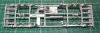
This photo shows the tank as received from JLTRT - I have marked the areas to be modified. The top right square is where the air distributer valve fits to the tank. The horizontal stripe to the right is where the central V-hanger is meant to fit. The horizontal strip to the left is to provide clearance for the support of the brake safety loop. Initial material removal used a 1" wide flat file with a coarse cut, followed by a n0. 4 cut 6" barrette file and then 240 grit wet and dry.
tta-tank-1.jpg

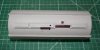
The initial work with the files removes a section of the tank body which fits between longitudinal members of the underframe, the space between the longitudinals is to be filled with styrene to support the central V-hanger. Now that the locating lug has been removed the flat surface is marked for removal of a "slot" which will provide clearance for a styrene support to support the air distributer valve. Please ask if you wish to have details of dimensions.
tta-tank-2.jpg

The tank body now has clearance for the pending styrene support of the air distributer valve... that support is to be added to the underframe. Time to remove a portion of the tank body which rests on the top of a longitudinal member of the underframe, this is done by drilling 1mm holes along the top and side of the existing tank moulding (as in the next photo).
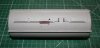
tta-tank-3.jpg

This is the result of drilling about ten holes along the top and ten holes along the side of the moulding... arranged so that the top holes break into the side holes. When all of the drilling is done then the laterial can be cut away with an Xacto blade followed by draw filing.
tta-tank-4.jpg

with this result... the tank body has had attachments removed / replaced for the three underframe parts listed at the beginning of the post. The modifications to the tank body are such as to provide clearance of new styrene supports to be added to the underframe moulding.
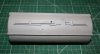
tta-tank-5.jpg

regards, Graham
 

BrushType4

Western Thunderer
Doggers, your up to your old tricks again :))


Doggers, Do not bring football rivalry onto here. Its bad enough on facebook, people get upset. I'm white & Black & detest (bit polite for me) them down the road in red :rant::headbang::)):)):))

Steve :cool:
If we are talking football, its got to be blue ;)
 

richard carr

Western Thunderer
Graham

There is no need to have the tank separate from the chassis for painting. Spray the whole tank the body colour, then hand paint the red stripe down the sides. You can then spray the the rest of the chassis with whatever colours you choose you can mask off the tank if you want a ex works one.

Even if you do want to separate it for painting you can always fit the few chassis bits that fit to the tank after painting and finish those by hand.

Richard
 

Dog Star

Western Thunderer
There is a recurrent theme amongst the topics of WT-members and that is the arrival of "white boxes" around the date of annual events - especially birthdays - and often provided by the Good Lady of the household. Some months back a classic JLTRT package arrived on the workbench with contents to produce a Wizzo. How the GW&GC Jt. knew that the New Line would be needed for these greyhounds has not been recorded in official histories so we shall just note that I have had a liking for these wonderful machines since the early 1960s when I would watch the Brum services from the school playground. Fending off any possible peer pressure from WT-members, the model is going to be a Swindon-built example and finished in maroon circa 1962-3.

I know very little about diesels in general and I guess that the best thing to do is read the instructions and then pay some attention to those words.

First question... I have some photos which show the class on the Brum New Line services, often the 09.10 "The Inter City" and those photos are mid/late 1960s. Any ideas as to which engines were used on those services in the early 1960s?

Second question... taking note of the instructions, painting the inside of the cab and the desk / bulkhead is up front so what colour(s) did Swindon use for the interior of the cab and engine room when the engines were built?

regards, Graham
 

alcazar

Guest
A sort of light grey.

After some use it would be darker and dirty.

I used to travel to Birmingham on a West Mids Rover from Nottingham as a student there, and spend the day traveling backwards and forwards to and from Paddington behind Westerns in 1974...often on the same ticket.
1005 and 1070 were regulars by then.
 

Ressaldar

Western Thunderer
Hi Graham,

lucky you (I hope to join you soon) - as a starter, have you got:

Modern Locomotives Illustrated 200 (Nice picture of D1007 - yellow buffer beam, dated Aug 62 on page 19, north of Beaconsfield)

Diesels in Depth - The Westerns (ISBN 978-7110-3250-7) I picked up a half price copy at Telford

Hope this helps - if only a bit.

cheers

Mike
 

Ressaldar

Western Thunderer
Hi Graham,

Reading your questions to Heather regarding 'additional' bits - whether needed or for personal choice on the JLTRT Mk1s and then reading Brian Daniels thread on RMweb, a similar question was asked by Alcazar as to what extra bits Brian fitted to his Western, Brian's reply was - "nothing, all as supplied, but there were a couple of pipes hanging down on the second man's side that I didn't bother with"

So, will we be seeing it running at Reading in December then?

cheers

Mike
 

Dog Star

Western Thunderer
Whilst waiting for some paint to do the interior of the Western cabs the pesky TTAs have pushed their way back onto the workbench... or rather the underframes are making a trip to the fore.

What Richard has written about spraying a complete model makes sense - just that I asked a professional painter for his advice and seems kind of rude to pass over the models for painting without taking that advice, so here is another installment in how the underframe is being completed without the tank body.

First up, the pieces which are to be added to the underframe. On the left is the support for the air distributer valve, made from 0.250 x 0.060 inch and 0.125 inch square Evergreen sections - the hole is to provide a key for the epoxy glue, rather like a rivet. In the centre is the support for the central V-hanger, made from three layers of 0.040 x 0.125 inch Evergreen - the slot is made to fit the V-hanger casting (which is roughly 0.040 th thick). On the right is the support for the brake lever safety loop and made from 60 thou styrene - the holes are 0.7mm OD and are located by reference to the existing holes on the tank body.
tta-uf-c.jpg

Here is the central V-hanger support fitted to the iunderframe, fixed with epoxy glue.
tta-uf-b.jpg

Now the air distributor support is fitted to the underframe with epoxy glue, located such that the hole in the tank body is roughly half way across the styrene strip.
tta-uf-a.jpg

Finally, this is the safety loop support fixed with epoxy glue. Whilst the air valve support is "horizontal" and mostly hidden by a V-hanger bracket, the safety loop support is angled up at the outer edge, to reduce visibilty of the support from the outside the wagon, and fitted underneath a lip at the top of the solebar.
tta-uf-d.jpg

Here is the result of adding the three supports to the underframe.
tta-uf-e.jpg

Yes, some of the bits are not quite as JLTRT intended - replacement castings were better, slightly, than those provided in the box and yet left something to be desired so I accepted what was there and made brake rods from brass wire (so the brake rods are at least straight now).

regards, Graham
 

richard carr

Western Thunderer
Looks good Graham, have you tried with the wheels in ? If so is it square ?

Don't be surprised if it isn't once you add the tank.

Richard
 

Dog Star

Western Thunderer
Looks good Graham, have you tried with the wheels in ? If so is it square ?

Don't be surprised if it isn't once you add the tank.
Richard, I can see where you are coming from re a four square underframe. We have three kits here, one has a complete underframe, two are as featured in the posts of this week so I am aware of the fun and games to get axles parallel to each other and at right angles to the long centre line of the underframe.

We spent time getting the underframe moulding "straight" using a hairdryer, masking tape and leather gloves... then the axleguards were fitted to the solebars ensuring that the axleguards had the horn slots aligned to give axles at right angles to the centreline. Axleboxes with bearings and wheelsets were then fitted and axle alignment adjusted by moving the bearings in the boxes. Finally, with wheels / axleboxes in place, the underframe and tank were placed on a piece of float glass and the bottom of the spring buckles filed until there was no rocking of the underframe when pressure was applied to each corner in turn.

regards, Graham
 

richard carr

Western Thunderer
Graham

I do something similar but I have found that the key moment is gluing the tank to the underframe, this often results in the frame becoming a little bit distorted and a final bit of fettling is required to get everything square again.


Richard
 
Top