To make a boiler - Tube? Turned from round stock? Cut and bent from sheet?

WM183

Western Thunderer
Hi folks.
I'm currently working at my engine build, and I want to make up the boiler barrel. I find myself wondering how do most people make these? I'm building one of the "M" class which has a (for the Midland) a pretty standard B class boiler, which seems to be 4'7" diameter over the cladding. There is essentially no taper to these boilers, so I planned to just make the "tube" from the rear of the smokebox to the cab wall. I will add the firebox sides and solder them nice and flush later. I figured I could probably just make this from a piece of 9mm OD brass tubing, and lightly turn it so the boiler bands are visible, but how would you all do it? Would you make it from a solid piece of stock so to leave some weight up front, over the front wheels, and just turn the inside far enough for the gearbox to fit inside the firebox? The motor will go in the tender, naturally.
Seems... lathey?

Amanda
 

WM183

Western Thunderer
Seems that boring is out. My rather small Emco Unimat cannot end bore with standard jobber length drills, so an order was placed for some 12 mm od/10mm ID tube and some 10mm od/8mm id tube. I need a bigger lathe, and I'll watch the above video. Thank you!

Idk how user-friendly rolling boilers is in 2mm though. Kinda like rolling a cigarette with sheet metal for a paper.
 

Eastsidepilot

Western Thunderer
My method for 7mm scale is to use 010.000" nickel sheet, rolled and fitted to circular formers, I'll admit to using a pantograph mill for producing the formers which makes life easier and if cutting by hand can be more work,...........er ! having just written this I've only just noted that your working in 2mm scale :rolleyes: :D so a tube or boring round bar is going to be easier.

Col...gone to specsavers ! :))
 

Kevin MH

Western Thunderer
I recently rolled a boiler for my 7mm LNWR Class A. It took all four inches of the width of the sheet, and six inches of the length. And my chum's rolling mill. From 16 thou stock. The boiler did not quite meet at the bottom, but no one can see that. No boiler bands: these will be depicted by the transfers. And I cut the firebox sides free from the boiler with my jeweler's saw, and filled the front with more 16 thou brass. My first scratch built boiler, and it turned out well. Without the rolling mill I'd have had to anneal the whole thing and rolled it with dowel and a lot of swearing.
 

Ian@StEnochs

Western Thunderer
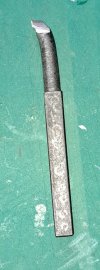
It's quite easy to bore a bit of bar in a Unimat but you need a boring tool which is held in the toolpost. See photo below of one for my machine, smaller ones are available for Unimat/Cowells lathes.

If you have a small, 1/8", drill or milling cutter broken or blunt, you can shape it with a grind stone or even a slitting disc to make a boring tool but you will need to make a holder for it.

Ian
20230921_162324.jpg
 

Ian Smith

Western Thunderer
I have always used a piece of brass tube for my boilers. I don’t turn any boiler bands, preferring to add the bands with transfer sheet at the painting stage.

I have only built round topped fireboxes, so part cut the boiler tube along the bottom and cut vertically upwards to give sections that can be bent down for the firebox sides. Any excess being cut/filed off to allow boiler/firebox sub assembly to fit on the footplate at the correct height and level.

Hope that helps,
Ian
 

WM183

Western Thunderer
Thanks folks! I will try to just do it with some tube and make the boiler bands of tape or transfers, etc.
Thank you much!

Amanda
 

WM183

Western Thunderer
I have always used a piece of brass tube for my boilers. I don’t turn any boiler bands, preferring to add the bands with transfer sheet at the painting stage.

I have only built round topped fireboxes, so part cut the boiler tube along the bottom and cut vertically upwards to give sections that can be bent down for the firebox sides. Any excess being cut/filed off to allow boiler/firebox sub assembly to fit on the footplate at the correct height and level.

Hope that helps,
Ian

I have been reading through your thread and your website with interest, as the Dean Goods build will be quite similar (sizewise, anyway) to the Midland engine. I will try your method with just using tube and cutting the firebox sides from the tube and folding them open.
 

Tim Watson

Western Thunderer
I agree completely with Ian. Turned boiler bands are nearly always over-scale in 2mm scale. It is useful to turn scratched witness marks for the boiler bands to help in aligning the transfers. I much prefer solid boilers for their weight, but that does cause some issues with drilling the deepish holes for the handrail knobs, unless you have a decent drill press.

Tim
 
Last edited:

adrian

Flying Squad
Doesn't Tim Watson turn his boilers from solid rod to add weight?? The motor goes in the tender etc...
Tony
Agreed in 2mm weight is everything. So solid bar where possible, motor in the tender if appropriate but for a tank loco either solid bar and a dremel to gouge out a recess for the motor, alternatively a tube for the boiler and solid bar for the tanks.
 

Northroader

Western Thunderer
Either use a brass sheet passed through rollers or a tube if you can find the right size. Then worry about opening out or cutting clearance for motor, gears and so on. Add weight where you want it with lead strip from roof flashing.
with boiler bands, I just wait until I have painted the loco, and make them from paper, paint the lines out with a springbow pen on a flat sheet, cut them the right width, and paint the cut edges, then glue them in place, followed by a coat of varnish. This is in 0 scale, and they’re plenty thick enough. In my opinion turning them on the barrel with a lathe in N scale will be hard work and they’ll be too thick anyway.
 

WM183

Western Thunderer
Thanks folks. I will use tube of the nearest size to make the boilers and will use a bit of brass round bar to add weight ahead of the motor, and anywhere else i can. Sounds way easier to me.
 
Top