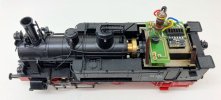
Trix loco with Selectrix decoder NEM 651 interface

Tim Hale

Western Thunderer
Just encountered something unknown, a rather lovely but tiny Trix HO loco 22565 with an NEM 651 interface for Trix Selectrix. I suspect that Selectrix was unique to Trix whilst their recommended decoder 66841 (no longer available) was dual purpose for Selectrix and DCC……..

Has anyone found a solution, presumably a standard NEM 651 will fit but sometimes the orientation is tricky and sometimes specific decoders are needed with angled pins, there simply is very little free space in the model

Unfortunately, the German sites tend to be rather odd, if not using Selectrix their response seems to be ‘you are not one of us’ whilst approaching the relevant suppliers of DCC products in the UK is similar but merely ‘never heard of it’


Thanks in advance

Tim
 
Just encountered something unknown, a rather lovely but tiny Trix HO loco 22565 with an NEM 651 interface for Trix Selectrix. I suspect that Selectrix was unique to Trix whilst their recommended decoder 66841 (no longer available) was dual purpose for Selectrix and DCC……..

Has anyone found a solution, presumably a standard NEM 651 will fit but sometimes the orientation is tricky and sometimes specific decoders are needed with angled pins, there simply is very little free space in the model

Unfortunately, the German sites tend to be rather odd, if not using Selectrix their response seems to be ‘you are not one of us’ whilst approaching the relevant suppliers of DCC products in the UK is similar but merely ‘never heard of it’


Thanks in advance

Tim
Hi

The 66841 is a multi protocol decoder according to the search which ESU have IMG_4946.pngembraced.

A ESU 6 pin decoder should suffice unless there is a smoke generator.

A screenshot of the decoder information.

Cheers

Joe
 

Tim Hale

Western Thunderer
Hi,

As if by magic a Zimo MX615N micro-decoder appeared on a certain website and made its way into my basket.

And a kind soul posted this image on DSO, it really helps to clarify not only what to use but the actual installation.

This wiki page goes some way to describe this little known class of locos, they were (with the BR98.8) the de facto branch line locos of Bavarian, similar to the GWR 57 and 45XX.

IMG_3673.jpeg

Tim
 

Yorkshire Dave

Western Thunderer
I'm not familiar with Märklin/Trix loco wiring but I suspect the resistor is there to reduce the voltage to the motor. I would follow the DSO photo and solder the red wire to the same terminal as the resistor then test the loco on analogue control with the original blanking decoder first to see if it still runs ok. If it does then replace with the Zimo MX615N decoder.

However, in the DSO photo it's hard to see what the owner has done as the soldering appears to be a bit messy with exposed brown cable wire looking like it touches the yellow terminal.

The problem is Märklin/Trix do not follow the conventional DCC wiring colours and use a heavier gauge wire.
 

Simon H

Western Thunderer
I suspect that the brown object is an inductor (coil) rather than a resistor; if in series with a motor lead, it will stop Radio Frequency (RF) energy generated by the motor from getting to the rails and being radiated as interference to radios, TVs, etc. If you connect a multimeter on the Ohms range across it, it should give a very low reading, close to zero.
It looks like the loco in the DSO photo has had this removed and effectively bypassed, with the red wire connected to the PCB, but as Yorkshire Dave says, it's not clear what's going on with the soldering.
 

Tim Hale

Western Thunderer
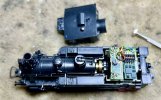
IMG_1944B.jpg

This is the beast fitted with a tiny Zimo MX17N, not sure what to do with the resistor and the remainder of the wires.

Nevertheless, it is an essential model and very nice.

Tim
 
Top