Rob P's Journey Into Miniature Gear Cutting

Rob Pulham

Western Thunderer
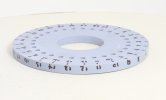
A friend and fellow Guild member took pity on me and offered to have a go at 3D printing my 29 hole division plate.

It turned out really well with all the indexing holes fitting perfectly and the main bore just requiring a little scraping with a 3 cornered scraper to enable it to ease onto the shaft.

54843091730_72ac9ad673_h.jpg

54843020548_e912226157_h.jpg

Had I been quicker on the uptake I might have added the numbers to the STL file before sending it but it only occurred as I was fitting it to the Spin indexer.

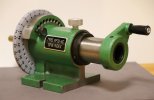
For those that don’t know what a Spin Indexer is, this is mine fitted with the 29 hole division plate.

54844915378_33572f6a23_h.jpg

54844984525_b081aa9156_h.jpg

The eagle eyed will note that the label says ‘5C’ 5C is the type of collet what these indexers come equipped to accept as standard.

I don’t have any 5C collets nor am I likely to make use of any so when I saw the Spin Indexer offered at a discount price already fitted with a 5C to ER32 collet adapter I decided that I could make wider use of ER32 collets so I bought the indexer and a set of ER32 collets.

Since then, I have added an ER32 collet chuck for my lathe so now I can use the ER32 collets in both the lathe and spin indexer alongside my more often used ER25 collets.

This means that I am now set up to have a go at cutting the 2 x 29 tooth gears that I need for the Shogun gearboxes. I am still on carer duties and Chris doesn’t have her stitches out until next Wednesday. Ao it will probably be later next week before I take the plunge and have a go.
 

Rob Pulham

Western Thunderer
While awaiting the opportunity to make a start on cutting the gears. In spare moments, I have been having a play with the Gear Generator add in, in Fusion 360.

I decided to create myself a working drawing of the Shogun gear replacements that I need and I was quite pleased that Fusion came to the same conclusions about size etc. that @PaxtonP4 and other helpful fellow modellers (who are far more experienced in the subject than I,) had already worked out on my behalf.

54858296836_69bce0acc8_c.jpg
 

Rob Pulham

Western Thunderer
I naively thought, that I had my head around Module/Metric gears. In my mind the term "Module" equated to millimetres pitch or linear spacing. That was until I was idly remeasuring a Roxey Mouldings worm and wheel set, which I had measured up during my original online discussion. But I had understood even less at that point so I figured that I must have got it wrong. When I measured it and the worm pitch was 1.25mm according to my metric thread gauge but the accompanying gear wheel was marked as 40 tooth Which in my head should have equated to MOD 1.25.

While head scratching, I played around with the Fusion gear generator add-in until I worked out by trial and error that the worm and gear wheel were in fact Mod 0.4. At this point my mind was completely blown as everything thing that I thought I understood was in fact nonsense and it proved that I understood very little.

Thankfully when looking in the Ivan Law book on Gears and Gear Cutting, I found a table of reference for Module Gears and although I don’t pretend to understand how the term “Module” relates to anything identifiably metric* I now have something to go on when working things out.

*The nearest thing that I can find which remotely relates, is that the millimetre data under the 14.5 degrees pressure angle column, is almost equivalent to the associated Module reference number.

Further reading of the book confirms (to me at least) that the term “Module” despite being referred to as ‘Metric’, isn’t. It’s based on there being 25.4mm to an inch, which if it’s based on an inch then it isn’t metric.

I took a bit of time and copied out the table into a spreadsheet and then manipulated the spreadsheet into a layout that works better for me – Metric measurements, before imperial equivalents and the smaller modules to the top of the lists (as I doubt that I will ever use the larger modules because I am not equipped to cut such substantial gears).

54880801035_fa7df8bb5b_b.jpg
 

simond

Western Thunderer
This seems pretty clear, and is what I recall from my studies, many decades ago…


How to calculate gear module​

The basic formula for calculating gear module is as follows:

Formula for calculating gear module
As an example, consider a gear with a pitch diameter of 60mm, and 30 teeth. Using the formula above would result in the following calculation:

Example gear module calculation
In this example the module of the gear is 2 mm, meaning every tooth of the gear would span 2 mm along the pitch circle.

Diametral pitch​

In places where imperial sizing is used instead of metric, diametral pitch is often used either as an alternative to gear module, or to find the gear module without using metric measurements. Calculating diametral pitch is very similar to gear module: the number of teeth (z) is divided by the diameter of the pitch circle (d) in inches.

Formula for calculating diametral pitch
Once the diametral pitch is calculated, the gear module can be found by dividing 25.4 by the diametral pitch.

Formula for using diametral pitch to find gear module
Gear module can also be used to calculate diametral pitch by rearranging the above equation to solve for diametral pitch, as shown below.

Formula for using gear module to find diametral pitch
 

Bob Essex

Western Thunderer
The basic difference between the terms module and Diametral Pitch is that the former describes the measurement between individual teeth while the latter says how many teeth will fit onto a 1" PCD. So... 100DP is the equivilent to MOD 0.254 and so forth. Sometimes ( well very often) it does make my tired old brain hurt... So long as there are charts and tables I can just use I'm happy to let it all wash over me.....:)

Bob
 

Rob Pulham

Western Thunderer
Whoa, there, not so fast…

“Standards for the exact length of an inch have varied in the past, but since the adoption of the international yardduring the 1950s and 1960s the inch has been based on the metric system and defined as exactly 25.4 mm.”

Wikipedia, but the ISO agrees!

ain't life complicated? :rolleyes:
Simon

I appreciate that all this is completely academic because we are where we are but I remain unconvinced.

In my view, like so many things that have supposedly improved things or brought them into line in the past, making an inch 25.4mm is a fudge to appease, not a true option based on the metric system. If it had been a true adoption then the inch would have been adjusted to exactly 25mm and how much simpler life would have been for those who have to regularly convert between the two.
 

Rob Pulham

Western Thunderer
I did rather hope that my post might stimulate some discussion which would hopefully clarify things for me so thanks for adding to the picture.
This seems pretty clear, and is what I recall from my studies, many decades ago…


How to calculate gear module​

The basic formula for calculating gear module is as follows:

View attachment 250698
As an example, consider a gear with a pitch diameter of 60mm, and 30 teeth. Using the formula above would result in the following calculation:

View attachment 250699
In this example the module of the gear is 2 mm, meaning every tooth of the gear would span 2 mm along the pitch circle.

Well, it might be clear to those trained in such things but this is why I got so confused. The formula that you quote here, is exactly what I thought I understood. But that doesn't meaningfully equate to the tables that I posted above.

For Module 2, which is what I would 'expect' that equation to relate to (given the answer of 2mm), the Linear pitch is 6.28mm not 2mm
The nearest linear pitch to 2mm is 2.2 in Module 0.7.

It's not the calculations that don't make sense, it's the labelling of the defined common "Modules" that is difficult to easily relate to anything.

I am obviously missing something.
 

Rob Pulham

Western Thunderer
Having hurt my brain far too much in trying to understand "Modules" a friend needed a worm and wheel for his G5 build and he was going to order one from Jim McGeown (and he still might) so I said that as he wasn't desperate for it that I would have a go at one for him and if it failed he could still buy one from Jim.

I had a go based on the earlier discussion with Ian (@Ian@StEnochs) and Bob (@Bob Essex) about using a tap and die to create the worm and wheel. I used a 0BA die to create the worm. Which was relatively straightforward.

54895604007_d8fd37a2ce_b.jpg

Then I set about cutting the wheel. I had previously watched a few Youtube videos on cutting gear wheels using a tap albeit on a much larger scale.

First I found an offcut of steel to make a jig from to hold the gear blank while cutting. It was quite a rough odd sized piece but I was easily able to square it up using a fly cutter. Initially I drilled a 4mm hole in one corner and turn a 4mm spigot on the end of a short length of 3/16 bar for the blank to rotate on.

I cut the first wheel and it was moderately successful in that it worked. But I had struggled because the pin holding the blank although a tight fit in the hole had a tendency to move under load and I ended up trying to hold it steady with one hand while feeding and lubricating with the other.

This is what the first attempt looked like.

54896477216_54b9fd9ea6_h.jpg

I decided to modify the jig to make the post much more rigid. I turned the spigot a little longer and threaded a portion M4 to allow me to put a locking nut on the bottom.

54896709708_89cd702f85_h.jpg

I also made the gear blank much wider and on the basis of a more recent video. Also instead of turning the rod to the major diameter of the gear as I had with the first one, I pre grooved it with a round nosed tool to the depth of the major diameter. The combination of the two gave a much more satisfactory result.

54896780310_f6cbe0abf2_b.jpg
 

Bob Essex

Western Thunderer
Rob,

First, to go back to your chart, the details in the Ivan Law book are concerned with producing lathe cut involute worms, not involute tooth gears. I admit I don't fully understand it as regards the linear pitch figures but I used all the others as the basis for generating all my tooling for both making the hob cutters and the tooling for the worms, which I did lathe cut. As you say with the linear pitch and worm PCD bits there is probably something we are not quite getting.

I would say you have made a really good job of free hobbing the worm wheels, but If you‘ll forgive me producing wormwheels like this for what could be termed high speed applications such as model locos etc. isn't ideal as there are a number of downsides. Generally I’ve known these to be called ‘dished’ gears as the worm is sunk into the wormwheel whose teeth are dished/curved to follow the worm rather than being straight cut where there is only a chordial line where the two mating faces align. Machinerys Handbook refers to them as 'throated' worm gears meant for power tranmission with another where the worm is not sunk in so far for motion applications. Even in these cases the wormwheel will usually be narrower and with the edges chamfered at around 45degrees.

I have scanned the relevent page in Machinerys Handbook but can't post it in an open forum thread re copyright so have Pm'd it to you. I hope you find it useful.

The well known Romford gears used to be produced like this - although with quite narrow teeth to allow sideplay - but the dishing of the teeth still caused trouble with getting a proper mesh for many modellers, and that was with involute teeth with deeper tooth meshing distance. Basically the design parameters were right in engineering terms but wrong for model application where sideplay of any amount - even a minimal one, is required. Basically such worm gear sets need using in gearboxes with shims to absorb any free play from worm or wormwheel.

Bob
 

Boyblunder

Western Thunderer
My IT literate chums have been trying to convince me that AI is useful so I asked Gemini for an explanation of the use of the word "Module" for gears. The answer may not be very useful but may be true?
"While the search results confirm the formula and its role in modern gear standards (like JIS B 1701 and ISO), the exact moment or person who coined the term "module" specifically for gears is not explicitly documented in the snippets.

However, the use of "module" fits within the broader concept of modular design , which was formalized in the 20th century but has deeper historical roots in architecture and design. The general etymology of the word "module" comes from the Latin word modulus, meaning "a small measure" or "a standard of measure."

It appears that the term was adopted in mechanical engineering to denote a standardized unit for sizing gear teeth, allowing for interchangeability and mass production, consistent with its general meaning of a standard or proportional unit in design."

So now we know, maybe.
 

Rob Pulham

Western Thunderer
My IT literate chums have been trying to convince me that AI is useful so I asked Gemini for an explanation of the use of the word "Module" for gears. The answer may not be very useful but may be true?
"While the search results confirm the formula and its role in modern gear standards (like JIS B 1701 and ISO), the exact moment or person who coined the term "module" specifically for gears is not explicitly documented in the snippets.

However, the use of "module" fits within the broader concept of modular design , which was formalized in the 20th century but has deeper historical roots in architecture and design. The general etymology of the word "module" comes from the Latin word modulus, meaning "a small measure" or "a standard of measure."

It appears that the term was adopted in mechanical engineering to denote a standardized unit for sizing gear teeth, allowing for interchangeability and mass production, consistent with its general meaning of a standard or proportional unit in design."

So now we know, maybe.

Reliable in terms of accuracy or not, that actually makes perfect sense to me. Especially if you take it one step further and suppose that someone in the dim and distant needed to distinguish the new fangled modular gear standard from Diametral Pitch and so labelled it 'Metric' despite the fact that it's really based on inches.
 

Rob Pulham

Western Thunderer
Rob,

First, to go back to your chart, the details in the Ivan Law book are concerned with producing lathe cut involute worms, not involute tooth gears. I admit I don't fully understand it as regards the linear pitch figures but I used all the others as the basis for generating all my tooling for both making the hob cutters and the tooling for the worms, which I did lathe cut. As you say with the linear pitch and worm PCD bits there is probably something we are not quite getting.


Bob

Thanks Bob,

I think that you may have hit the nail on the head as to what I was missing. I hadn't noted that the chart was in relation to worms not gears and now that I know, I suspect the linear pitch is somehow related to the spiral as opposed to the direct distance between the teeth as I have been reading it.

In fairness there can't be a massive amount of difference in the two because what started me questioning myself was due to the fact that my Roxey worm accepted a metric thread pitch gauge of 1.25mm almost perfectly as did the corresponding wheel. The Module 0.4 stated linear pitch is 1.26 so a difference from my thread gauge of (in theory*) 100th of a millimetre.

*I say in theory because I don't know how accurate my thread pitch gauge actually is, as it came in a set of Metric taps and dies.

Thanks again to all the contributors to this thread, they are helping me slowly gain some small understanding and hopefully at some point they may well help someone else who might be mad enought to venture down this route.
 

Rob Pulham

Western Thunderer
Buoyed by my small successes with the worm and wheel yesterday I decided to take the plunge and set up the mill to actually cut an involute gear.

I took Brian's (@Brian McKenzie) advice and did a test cut on a stub of aluminium to take the burrs off and bed in the cutter.

It has to be said I made some mistakes but it was a great learning opportunity and as a number of fellow members asked on the GOG online modellers meeting I recorded a video of the process. I recorded the whole thing which is about 12 minutes long and I suspect may be a little boring in the middle where I was just repeating the cuts.

Here's a list of the things I did wrong/didn't do that I should have etc.

1. I didn't fully tighten the locking collar when I refitted the 3D printed division plate which mean that after a few cuts it stopped moving and I lost my index position.

2. Although I checked some of the index pin holes in the division plate, I didn't check them all and that came back to bite me as I struggled to get the pin in some of the holes properly this didn't really affect the indexing too much but it did make it really hard to get the pin out between cuts

3. I forgot to lock the Y axis of the mill table which meant that the cutter eventually pushed away from the workpiece a little.

Taking all that into account I did manage to cut a gear (ish)

54899396005_b0c8dcb02a_h.jpg

The other 'side' isn't quite so pretty...

54899321733_55fd4eeafa_h.jpg

Here is the video for those who are interested in the how.

 
Last edited:

simond

Western Thunderer
Rob

Module is really metric - no inches required at all. Diametral pitch is imperial.

30 teeth, 60mm pitch dia. Module 2

It does depend on pi

The circumference of a 60 dia circle is 60 x pi and if there are 30 teeth (and hence 30 gaps between teeth) the distance around the arc from the pitch circle on one tooth to the same point on the next tooth must be 60*pi / 30 =6.283 mm or 2 pi mm

This is the same as the linear pitch of a meshing rack or worm.

Obviously mod 2 gears are a bit big for models!
 

Rob Pulham

Western Thunderer
Rob

Module is really metric - no inches required at all. Diametral pitch is imperial.

30 teeth, 60mm pitch dia. Module 2

It does depend on pi

The circumference of a 60 dia circle is 60 x pi and if there are 30 teeth (and hence 30 gaps between teeth) the distance around the arc from the pitch circle on one tooth to the same point on the next tooth must be 60*pi / 30 =6.283 mm or 2 pi mm

This is the same as the linear pitch of a meshing rack or worm.

Obviously mod 2 gears are a bit big for models!
Thanks Simon,

The mists are beginning to clear, I hope. I did find another chart via Google which showed the pitch circle as being the same values as in the Ivan Law table column, described as linear pitch so it seems that it will be quite useful rather than being a potential red herring.

Regarding your later note, I am beginning to think that MOD 0.5 might even be a bit big for 7mm models. But until I have actually cut some myself and put them alongside the existing gear sets that I have from the trade I won't know for sure.
 

Rob Pulham

Western Thunderer
Later in the day yesterday I stripped down the spin indexer and took the division plate off. I mounted it on the dividing head chuck of my Proxxon mini drill and reamed out all of the holes to 5mm.

Then, having ensured that the locking collar was tight on the spin indexer and the Y table locked to ensure a consistent depth of cut, I had another go using the opposite end of my aluminium stub.

All went swimmingly and I ended up with a perfect gear.

54899297161_48e4840493_h.jpg

54899297191_797e6a6937_b.jpg

Now I need to do it for real to produce the missing final drive gears for my two Shogun Gearboxes.
 

simond

Western Thunderer
nice work, looks like you are well on teh way!

I hope this might help

1762260357530.png


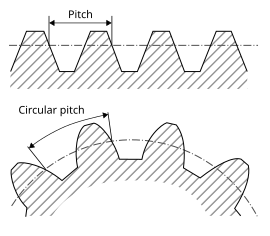
Wrap a string around a salt drum, jam jar, pan (the pale blue circle), whatever, keep it taught, and unwrap the tip of the string a small amount - the green line the end of the string will move in an involute, which I have cheated with the purple curve.

The green line is the same length as the red curve.

the green line is the linear pitch of a worm or rack, the red line is the circular pitch.

Regarding modules for models, you'd expect to do a 30:1 with a single stage worm drive, and the wheel would be less than the driver diameter, say 5' so 35mm, so say 30mm PCD. That would indicate a mod1 gear was feasible, but as you suggest, probably on the coarse side.

atb
Simon
 

Bob Essex

Western Thunderer
Thanks Simon,

The mists are beginning to clear, I hope. I did find another chart via Google which showed the pitch circle as being the same values as in the Ivan Law table column, described as linear pitch so it seems that it will be quite useful rather than being a potential red herring.

Regarding your later note, I am beginning to think that MOD 0.5 might even be a bit big for 7mm models. But until I have actually cut some myself and put them alongside the existing gear sets that I have from the trade I won't know for sure.
Rob,

I have managed to dig out my gear cutting notes etc. and below is the revised chart taken from Ivan Law's book that I made. Some of the original headings were misleading as my notes now make clear. It now makes more sense and I'm sorry not to have realised that I did it. Been rather a long time.

WT 10.jpg

This now aligns with what I did, which was to cut both M0.5 and M0.4 gears, with the latter being the most used. I did this for a few reasons. One that the lathe - a Hobbymat MD65, could cut 1.25mm & 1.5mm threads. And that combined with using worms cut from 1/4" steel stock I could produce wormsets of 36-1 (M0.5) and 42-1 (M0.4) ratios that fitted the etched fold-up gearboxes in Jim McGeown's kits.

Here is a 36-1 set in a box with a Mashima 1883.

WT 09.jpg

The set screw is a 3/16" 6ba using a 50 thou allen key.

All the two stage boxes I made used M0.4's to get the higher ratios I use of 60-1 etc. which aren't generally common in 7mm combined with the small diameter wheels of the small locos involved.

Bet your pleased with the gears your now able to produce.

Bob
 
Last edited:
Top