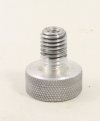
I don't think that I will ever need to make enough gears to warrant going down the hobbing route but the whole process has taught me much
Rob,
I'd encourage you to try hobbing some gears. The setup can be simple, needing only an easily made screwcut hob, and a peg for the gear blank to rotate on. Any gears and wormwheels so produced will be an excellent match to each other.
Gear blanks need to be 'gashed' though, prior to hobbing. I use a piece of ground HSS tool steel for this, and a cobbled up division plate for the indexing.

This hob was screwcut using 12mm dia silver steel, hardened, then flutes ground as pictured to provide the cutting edges.
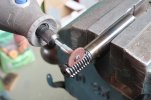
The hob can be conveniently of a much larger diameter than for the worm gears used in the model. To get the correct helical angle of teeth in the worm wheel - to match the 'lead' of smaller dia. worm gears in the model, the shaft on which the worm wheel rotates for hobbing is angled suitably (which angle can be calculated - when I remember how

).
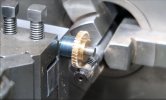
The gear blank is on a shaft that rotates in a block of steel, which is screwed to another block, for clamping in the lathe tool holder.
Photo above shows the hob has just started to engage and cut the true form of the teeth into the 'gashed' blank. The tool holder is set for the helical angle required.
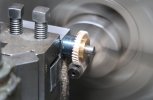
Photo below shows the now fully hobbed gear, after the blank has been fed across the top of the rotating hob.
I'm stuck for time now, to illustrate more - as I'm about to dash off to the UK. Shall be at the GOG Winter Show at Wigan, and could bring samples if you are attending. I'm old, grey with short whiskers, and have a yellow tin badge that says WT (when I'm not too self-concious to wear it

)
-Brian McK.