Rob P's Journey Into Miniature Gear Cutting

Bob Essex

Western Thunderer
Sorry Rob, should have explained it a bit clearer. Keep the width of the spur gear narrow when trying to mate with a worm. Helps with mating worms to straight cut spurs when the Helix angles don't match at 90 degrees. It only really works where there is minimal wormwheel side movement though. Over-cutting can be tried with either going in a bit deeper, or using the next size up - to cut larger spaces between the teeth. It's all a bit trial and error at these small sizes because it's all a fudge.

Yes, machine tooling of all kinds can be a bit of a rabbit hole you can fall down.......:)

Bob
 

Rob Pulham

Western Thunderer
Thanks Bob,

I have cut the angled gears at just under half size with a 3mm thickness gear and a 6.4mm worm and it seems to be working nicely.

I will need to buy at least next size up of the last two gear cutters because I want to cut some bigger gears for my Cravens crane. They will be straight cut gears but one of them is 120 tooth I think.

I am running it in with a bit of pink stuff* mixed with vaseline as a kind of grinding paste to take the rough edges off.

*Pink stuff is a coarse paste cleaning agent -https://www.thepinkstuff.com/products/cleaning-paste

Once it's had a good run in both directions I will wash it of with WD 40.
 

Brian McKenzie

Western Thunderer
I don't think that I will ever need to make enough gears to warrant going down the hobbing route but the whole process has taught me much

Rob,
I'd encourage you to try hobbing some gears. The setup can be simple, needing only an easily made screwcut hob, and a peg for the gear blank to rotate on. Any gears and wormwheels so produced will be an excellent match to each other.

Gear blanks need to be 'gashed' though, prior to hobbing. I use a piece of ground HSS tool steel for this, and a cobbled up division plate for the indexing.
Gashing 35t worm wheel blank before hobbing to finished profile_5185a.jpg


This hob was screwcut using 12mm dia silver steel, hardened, then flutes ground as pictured to provide the cutting edges.
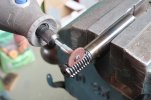
IMG_4924a Grinding flutes in Hob.jpg

The hob can be conveniently of a much larger diameter than for the worm gears used in the model. To get the correct helical angle of teeth in the worm wheel - to match the 'lead' of smaller dia. worm gears in the model, the shaft on which the worm wheel rotates for hobbing is angled suitably (which angle can be calculated - when I remember how :) ).

Hob just starting to engage gashed blank.jpg
The gear blank is on a shaft that rotates in a block of steel, which is screwed to another block, for clamping in the lathe tool holder.

Photo above shows the hob has just started to engage and cut the true form of the teeth into the 'gashed' blank. The tool holder is set for the helical angle required.


Photo below shows the now fully hobbed gear, after the blank has been fed across the top of the rotating hob.
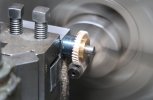
35t gear blank now traversed across hob.jpg

I'm stuck for time now, to illustrate more - as I'm about to dash off to the UK. Shall be at the GOG Winter Show at Wigan, and could bring samples if you are attending. I'm old, grey with short whiskers, and have a yellow tin badge that says WT (when I'm not too self-concious to wear it ;) )

-Brian McK.
 

Rob Pulham

Western Thunderer
Thanks for the detailed explanation and photos Brian that looks definitely doable. While I don't have any 12 silver steel to hand I do have some 10mm so I might have a go with that.

Sadly I won't be at Wigan it's not the best place in the world to get to from where I live especially in December. I do appreciate that you are flying half way around the world to get there which makes my excuse a bit feeble.
 

Rob Pulham

Western Thunderer
Although I haven't hobbed it, I have had some success with my latest spur gear once I had the 'lean' the right way.

By trial and error I arrived at a lift 3mm under the end of my spin indexer which seems to mesh quite well. I am sure that Brian's method of hobbing would make it even better so it's something not too complex to look at going forward.

At least I can turn the other spur gears down and re-cut them into gears with a lower tooth count so they won't be scrapped.

It does make a bit of noise but I think that at least some of that is down to the etched gearframe. I say that, because I did a test using a proprietary worm and wheel from Roxey Mouldings in the same gearframe attached to the same motor and it too made a similar level of noise.

54931939975_597ef7a701_h.jpg


Rob Pulham

Western Thunderer
That looks the business, I can see another little side project on the horizon. Thanks for taking the time to take the photos Bob.

Talking of side projects. I have mentioned a few times that I am using a Spin Indexer to index the gear blanks for cutting.

Most comercial Spin Indexers are made in China and having seen quite a number of videos on the use of, and improvement of them one thing that pretty much everyone comments on is the locking screw which locks the barrel both while indexing and fitting and tightening items in the collet holder. As supplied they come with and aluminum screw which has a nice knurled head but that's the only good thing that you can say about it.

54931571571_d1bc7a9885_h.jpg

The fit in the internal thread is so sloppy that I wouldn't be surprised if there wasn't getting on for a millimetre of play in the thread. Now most of the videos that I have watched have been Americans and the other thing that they found really frustrating was that they couldn't work out what thread it was. That's because it's an metric M12 x 1.75 thread.

I do have a tap and die for M12 x 1.75 but by good fortune I was recently given a bag of big bolts to use as raw materials and amongst them was a number of M12 coach bolts. I tried screwing one of them into the hole of the Spin indexer and the fit was perfect.

I cut of the head of the coach bolt and then cut a length of the threaded section and included short length of the plain shank, which I turned down to make it round as it was slightly oval to start with. Then I drilled all the way through 5mm because the aluminium version has a hole through it. I opened out the threaded end to 8mm and turned a brass top hat bush to fit inside it and secured it with Loctite.

Next I used a boring bar to open out the hole in the knurled part of the aluminium screw until it fitted the turned down section of the replacement threaded section. Then I parted it off and Loctited that to recreate the screw.

54931775018_c04dfa3a72_h.jpg

Now I have a screw that will tighten down properly with no slop in the threads and the brass end will stop the barrel of the Spin Indexer from getting chewed up by the steel screw thread.
 
Top