A Sherline-based CNC mill

simond

Western Thunderer
Nick,

thanks for that write-up - there is a factor of 8 or 9 between my "cheapo" setup and what you have invested, but the results that you are able to obtain show that what you have done is well worth it.

Such finesse has so far eluded me - whether that is because of the cheap and cheerful machine or because I have not invested the time or effort, or more likely a combination of both - is open to some question. The cheapo machine has its uses, but they are limited. Perhaps a good place to start if you don't want to splash out too much money, and have time to play. I am seriously considering a more substantial set up, but there are so many things on the go at the moment (in addition to a full-time job!) that it is obvious that today is not the day to start. Perhaps once the extension is built... But of course that is a case of buying cheap and buying twice.

I wholly agree with your comments about ballscrews, rigidity and sharp cutters. (the only one I can aspire to presently is the last!) I have access to Solidworks via work (and some very nice machine tools too) and a good 3D package is vital as you say.

thanks again
Simon

(and I should have said I found it very enjoyable and informative and I’ll bet I’m not alone)
 
Last edited:

Penrhos1920

Active Member
Making 3D parts is a lot more fun. Fun? Is that the word? … anyway, it’s a whole different ball game, as they say.

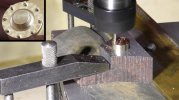
On the top of Webb tenders there were two injector controls, quite distinctive but also quite fiddly. Fortunately I had a photo of the preserved tender that was the basis of a CAD model. The model is simplified (yes, I do simplify) to make it machinable with infill below the operating arm and removal of the handle, to be added later as a separate component.

View attachment 241841

View attachment 241840

And here is the cutter path. Complicated enough? It’s a very small component so I was using a 1mm diameter cutter and to avoid lots of broken cutters, the maximum stepdown (the vertical distance between successive cuts) is only 0.1mm.


View attachment 241842


So the cutter is really just nibbling away. Each one took 90min to cut.


View attachment 241843

When the CNC had finished, I removed the excess stock by hand, removed the infill, and drilled for a separate handle. This cruelly enlarged photo shows them ready to be parted off.

View attachment 241844

Was it worth the effort? That’s something I don’t ask, let alone answer. It was a challenge and a problem and the fun (I’ve decided that is the word) was in solving it.

Nick

Have you considered roughing out the part with a much bigger cutter, like 4mm?
 

Giles

Western Thunderer
I use 2D software to draw using layers for the heights, and V-Carve to generate the paths, and finally CCCNC to control the machine.
 

NickB

Western Thunderer
Simon - I agree that the investment in time and/or money may deter some people. CNC milling isn't for everyone. You're not the first person I know who bought a low-cost machine to experiment with. You may decide it is not for you, or you may choose to go for it. If anyone here learns anything (positive or negative) from my experiences, that is great.

Penrhos - That is something I've still to get to grips with. The problem is that the first machining file cuts away stock but leaves some stock still attached. The second machining file must "know" where the new stock boundary is so that it doesn't waste a lot of time cutting fresh air. I'm sure that is possible in F360, I just haven't yet worked out how to do it. Unlike a commercial shop, time on the machine isn't critical to me so I haven't prioritised that.

Giles - Interesting. I'll have to see what it can do.

I'll be off-line for the next week, but if there are any other comments or questions, I will get to them.

Nick
 

NickB

Western Thunderer
Here are a couple of things I have used the CNC mill for recently.

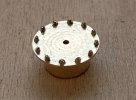
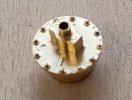
I agreed to make sets of motion parts for two LNWR Ladies of the Lake in 7mm, and I decided that some of the parts could very usefully be CNCed. First up is the cylinder covers. Back in manual days, I would turn a disk, drill a circular array of tiny holes for simulated nuts and bolts and solder them in. Machining them all in one go would reduce the number of operations to one.

Cylinder front cover.jpg Cylinder rear cover.jpg

The results weren’t bad. The rear cover also has a piston rod gland and supports for the slidebars, and was a bit more tricky. I did it in two operations, a rough cut with a 2mm cutter to remove the bulk of the material and a finishing cut with a 1mm cutter to get to the final dimensions. In both cases the nuts were not formed as well as separate parts are, but I decided that they were quite good enough.

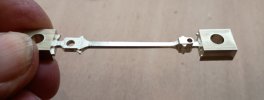
The connecting rod was much more tricky. It has to be machined on all four sides and how do you hold it once you start machining away the stock? Noting that when finished, the rod itself is fairly slender. I decided I needed a jig to hold it firmly and to do it in two operations. Cut down one side down as far as the centre line, flip it over, and do the other side.

Conn rod 1.jpg

To hold it, I set two pins in my tooling plate and drilled two holes in the stock. One at the big end would eventually be for the crankpin, and the other at the little end for the crosshead pin. The stock was held down to the tooling plate using bolts at each end. Then I made the first cut, leaving a substantial tab at each end holding the rod to the rest of the stock.

Conn rod 2.jpg

Remove it from the jig, flip it over, and bolt it down again.

Conn rod 3.jpg

The toolpath for the second cut is the mirror image of the first because the rod isn’t quite symmetrical. (If it was I could use the same toolpath file but in Fusion, once you have one it is simple to generate the other). Note the packing underneath the rod to prevent it bowing downwards under the pressure of the cutter.

Conn rod 4.jpg

And here is the result, straight off the machine. The tabs still hold it all together and will be cut away by hand. Then I will cut out the fork for the crosshead. I plan to do two horizontal cuts using a slitting saw in the manual mill and remove the rest by hand. The machined finish is pretty good and will only need a quick rub over to remove the last vestiges of machining marks and to remove the cusps on the corners around the cotters. I will then overlay some brass pieces to simulate the bearings on the big end, which are very visible. Oil pots on both ends will be little pieces of wire soldered into drilled holes.

All told, there is still quite a lot of hand work to do, but the CNC has made a major inroad into the manufacture.

Nick
 

Fitzroy

Western Thunderer
Beautiful work! I really must dust off my machine and machine some EDM electrodes. Haven't used it as a CNC for ages.
 

NickB

Western Thunderer
Brian,

You highlight an important point - for components like this you can either plunge the tool from top and bottom, or from the sides. There are pros and cons with both. If I went from top and bottom I would be able to remove most of the material between the forks. In fact I chose the sides because it gives me a better definition of the cotters, and the plunge depth is smaller and I can use a shorter tool. You have to figure out the best cutting strategy for each part as it comes along.

Nick
 

Brian McKenzie

Western Thunderer
Thanks Nick. The bothersome rods were much smaller than your LNWR rods, leaving little material to work with - despite soldering on some temporary reinforcement in lieu of packing.

Had more joy machining these cylinder covers:
S3720016b Front Cylinder Cover.jpg
The CNC technique in this instance was to use a plug in a drill chuck to position the work holding fixture, relative to suitable pre-judged work offsets, then clamp the jig down in that position. Avoids needing to find the workpiece G54 conventionally.

In reality, the fixture (of scrap steel) was clamped on top of another workpiece already set up in the machine, that I didn't want to disturb ;)

-Brian McK.
 

NickB

Western Thunderer
A new spindle

IMG_20251212_124046481.png

The CNC mill now has a new spindle, capable of speeds up to 12000 rpm. Not that rotational speed alone matters, as I've previously argued, and I got good results with slower speeds by reducing the feed rates to suit. Time on the machine isn't my first concern, but jobs that were taking hours to do did get tedious, so I hope the new spindle will improve the throughput.

I made a mounting plate for the motor so that it would clamp directly to the Sherline mountings and I can revert to the Sherline motor and headstock should I want to. I probably won't ever do that because I have another use for the Sherline parts, which was another incentive to make this replacement. I took the opportunity to increase the throat dimension because that had proved a bit restrictive.

So far it works but only under manual control. I want to be able to turn it on and off and control the speed in software, mainly so that it shuts itself off at the end of a job rather than waits for me to come along and do it, but I haven't been able to make that work yet. Problems are (a) the documentation of the motor driver, the CNC controller, and the software are either non-existent, out of date, or just plain awful, and (b) I don't know enough about it to be sure of what I am doing. I've left it for now and will come back to it when the motivation returns.

Nick
 

richard carr

Western Thunderer
Hi Nick

Could you give us some more details on the control electronics and the new spindle please.

I have a Sherline based CNC mill but the control electronics failed a long time ago and the original supplier is long gone.

I found that sticking the metal stock to a mdf base with double sided tape was sufficient to hold it firmly in place and forget the tabs.

Thanks

richard
 

NickB

Western Thunderer
Hi Richard,

The CNC controller is generic, but if you search for "CNC Mach3 Breakout Board", that will turn up lots of suppliers. To distinguish it from other controllers, it is red, and approximately 60mm square. There is no documentation supplied, but lots of info on the web since this board seems to be widely used. I have found www.buildyourcnc.com to be very helpful. The stepper motor drivers are DM542T - similar remarks apply. The spindle and controller are sold as a package, see here. There is some documentation and they have been helpful answering my questions. For manual control it is fine but I still haven't solved the problem of software control using my breakout board.

This setup isn't a direct replacement for the Sherline controller and I never set out that it should be. For one thing, the Sherline box combines the CNC controller and stepper motor drives on a single board. Such things do exist (a web search will turn up examples) but I have no experience of them. More fundamental differences are that my controller is connected to the computer by USB whereas the Sherline uses a parallel port, and mine works with Mach3 and the Sherline one uses Linux.

If you have any further questions about my setup, PM me. But I'm really not an expert on these things so, for instance, I won't be able to comment on anything outside of my experience.

Nick
 
Top