
You are using an out of date browser. It may not display this or other websites correctly.
You should upgrade or use an alternative browser.
You should upgrade or use an alternative browser.
Rob P's Journey Into Miniature Gear Cutting
- Thread starter Rob Pulham
- Start date

Rob Pulham
Western Thunderer
Thanks again Bob,
Do you then use this chart for the settings for both worms and wheels?
What you have done with your 36:1 gearset is where I wish to start off but I plan to make my own more rigid frames from 1.2mm brass sheet (I recently bought a 3/4 kilo pack of off cuts which are too small for most peoples applications but idea for making frames for 7mm gearboxes).
Then I hope to progress to more complex multi stage gearboxes. I can see the purchase of a et of M0.4 cutters at some point.
I have yet to discover the joys (or not) of single point threading but yesterday I discovered that the shank of a broken carbide drill already had a 20 degree taper on it. So I did a little more grinding to make a cutting tool.
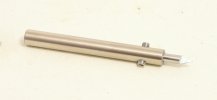
Whether it will be any use or not remains to be seen but if you don't try these things... if I can cut a worm succesfully with it, then making an arbour to hold the tool in the mill to make a matching wheel shouldn't be too difficult.
Do you then use this chart for the settings for both worms and wheels?
What you have done with your 36:1 gearset is where I wish to start off but I plan to make my own more rigid frames from 1.2mm brass sheet (I recently bought a 3/4 kilo pack of off cuts which are too small for most peoples applications but idea for making frames for 7mm gearboxes).
Then I hope to progress to more complex multi stage gearboxes. I can see the purchase of a et of M0.4 cutters at some point.
Oh yes, the "Cheshire Cat" grin was much in evidence once I had done the successful test gear cut. I am not going to waste that either. I plan to cut it off and further machine it and ultimately paint/weather it to make a wagon load. - I am a Yorkshireman after all...Bet your pleased with the gears your now able to produce.
Bob
I have yet to discover the joys (or not) of single point threading but yesterday I discovered that the shank of a broken carbide drill already had a 20 degree taper on it. So I did a little more grinding to make a cutting tool.
Whether it will be any use or not remains to be seen but if you don't try these things... if I can cut a worm succesfully with it, then making an arbour to hold the tool in the mill to make a matching wheel shouldn't be too difficult.
Rob Pulham
Western Thunderer
Rob, module 0.5 should be fine for O gauge gears. Bassett Lowke used to do a two stage mech which was 48 DP, 14.5 deg, close to 12:1 ratio, and 48 DP is slightly larger teeth than M0.5. I use the same set up for my locos.
I was purely basing my caution, on the fact that most of the proprietary gear sets that I have, seem to be Mod 0.4 rather than 0.5. But to be fair I haven't checked them all and I do have some wheel and worm sets that are much coarser. I have the mod 0.5 gear cutter set, so having bought them I will definitely be using them.
Do you then use this chart for the settings for both worms and wheels?
Yes I did. Whether that was stricktly correct I'm not sure. This was of course in the 1990's when there was no web to get a range of info from. More to the point I used the same techniques for the worms to make the cutters, at the same sizes, basically so I could hob cut helical gears without messing around finding the correct helix angle.
I think that's a point to note. The wormwheels are not really wormwheels as such and as per Machinerys Handbook where the faces constantly match each other, but rather helical cut spur gears with the helix matching the worm so they can be run together.
Whether it will be any use or not remains to be seen but if you don't try these things... if I can cut a worm succesfully with it, then making an arbour to hold the tool in the mill to make a matching wheel shouldn't be too difficult.
Not sure that will work except with gears with very large numbers of teeth. It's the reason why there are a range of disc cutters. The 'gap' between the teeth varies in size. Hob cutting automatically removes the correct amount for the size of the blank and the number of teeth but single tooth cutting can't do this. It also difficult to cut at an helix angle because depending on the gear width the verticies will be increasingly different at one side to the other so the tooth form 'twists' across the face.
Good fun this gear cutting challenge isn't it?
Like so much surrounding engineering you can really get drawn in.....

Bob
Rob Pulham
Western Thunderer
Good fun this gear cutting challenge isn't it?
Like so much surrounding engineering you can really get drawn in.....
Bob
Oh yes, even if it all goes Pete Tong, I am definitely having fun.
And, of course the only thing that I'm wasting is my time and a few small pieces of material. A beauty of dabbling at this scale is you don't need much in the way of raw materials.
Rob Pulham
Western Thunderer
Sorry Bob, I forgot to add that the ideas behind the cutting tool is mainly to produce worms should I need them.
Having done it this morning I idly searched for pre ground 20 degree cutting tools without expecting much. I was a bit surprised when Rennie tools stock them in a variety of tip sizes. Although they are really designed for use in a router, being carbide they will probably do the job of cutting worms. There is a guy that I follow on Youtube who has used carbide dovetail bits designed for a router to cut steel without issue.
Not too expensive to buy one to test.
Here
Having done it this morning I idly searched for pre ground 20 degree cutting tools without expecting much. I was a bit surprised when Rennie tools stock them in a variety of tip sizes. Although they are really designed for use in a router, being carbide they will probably do the job of cutting worms. There is a guy that I follow on Youtube who has used carbide dovetail bits designed for a router to cut steel without issue.
Not too expensive to buy one to test.
Here


Rob Pulham
Western Thunderer
The last two days have been a bit of a milestone in my gear cutting journey as I have managed to cut the missing gears for my two Shogun gearboxes.

I initially test fitted them and ran the motors with the gear rotating on the axle as I didn’t have any small enough grub screws and was pleasantly surprised when they ran freely. Next, I made some tiny grub screws from some lengths of 10ba stud that I had cut off some one inch, 10ba screws. I keep all such things in a plastic Ferrero Rocher box as they do come in from time to time. I was trying to be a bit clever by using a very small slitting saw in the Proxxon pillar drill to cut the slot but the blades that I have, are too thick and it ate away half the thickness of the screw. So I cut the slots by hand with a piercing saw.
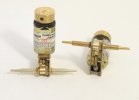
After chasing them around the workshop floor and miraculously finding them after dropping one grub twice and the other once, I fitted the first one. It all worked as intended and runs as smooth as the other gears. However when I tried the second one it was a bit lumpy and then I noticed that although it seemed to fit okay between the frames it had splayed them slightly so I popped it back in the lathe and skimmed both ends slightly and on the next try it ran just like the first one. Now I really am a happy bunny.
Just for scale this is one of the gears again a 5p piece. They are very small.
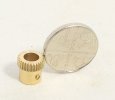
Once again, I would like to sincerely thank all who have contributed to my getting this far.
From identifying the gearboxes that I bought at Stafford, to working out via information provided by fellow members that it was a 29 tooth Mod 0.3 gear that I needed to buy or make and all the helpful advice on both the theory and practical aspects of gear cutting. It really is much appreciated.
I initially test fitted them and ran the motors with the gear rotating on the axle as I didn’t have any small enough grub screws and was pleasantly surprised when they ran freely. Next, I made some tiny grub screws from some lengths of 10ba stud that I had cut off some one inch, 10ba screws. I keep all such things in a plastic Ferrero Rocher box as they do come in from time to time. I was trying to be a bit clever by using a very small slitting saw in the Proxxon pillar drill to cut the slot but the blades that I have, are too thick and it ate away half the thickness of the screw. So I cut the slots by hand with a piercing saw.
After chasing them around the workshop floor and miraculously finding them after dropping one grub twice and the other once, I fitted the first one. It all worked as intended and runs as smooth as the other gears. However when I tried the second one it was a bit lumpy and then I noticed that although it seemed to fit okay between the frames it had splayed them slightly so I popped it back in the lathe and skimmed both ends slightly and on the next try it ran just like the first one. Now I really am a happy bunny.
Just for scale this is one of the gears again a 5p piece. They are very small.
Once again, I would like to sincerely thank all who have contributed to my getting this far.
From identifying the gearboxes that I bought at Stafford, to working out via information provided by fellow members that it was a 29 tooth Mod 0.3 gear that I needed to buy or make and all the helpful advice on both the theory and practical aspects of gear cutting. It really is much appreciated.

Rob Pulham
Western Thunderer
Thanks Dave,
Oh yes, I have certainly enjoyed it and there is such a sense of satisfaction in knowing that you have made it yourself.
Oh yes, I have certainly enjoyed it and there is such a sense of satisfaction in knowing that you have made it yourself.

Susie
Western Thunderer
Rob,
In your picture of the gearboxes it appears that the gearing goes from the initial large-count worm wheel to the layshaft, which is speeded up (large gear driving a smaller) and then an almost equal pair to finish. I must admit to not having read the whole post, but is this what you intended? If so, could you not have used, say, a two start worm and the spur transfer, missing out the second stage?
Here is a picture of my efforts some years ago, these are in 0.4 Mod. and were gears for one of my S Scale locomotives. I now have a Jacobs gear hobber which, of course, only needs a singe hob for all numbers of teeth.

In your picture of the gearboxes it appears that the gearing goes from the initial large-count worm wheel to the layshaft, which is speeded up (large gear driving a smaller) and then an almost equal pair to finish. I must admit to not having read the whole post, but is this what you intended? If so, could you not have used, say, a two start worm and the spur transfer, missing out the second stage?
Here is a picture of my efforts some years ago, these are in 0.4 Mod. and were gears for one of my S Scale locomotives. I now have a Jacobs gear hobber which, of course, only needs a singe hob for all numbers of teeth.
Rob Pulham
Western Thunderer
Hi Susie,Rob,
In your picture of the gearboxes it appears that the gearing goes from the initial large-count worm wheel to the layshaft, which is speeded up (large gear driving a smaller) and then an almost equal pair to finish. I must admit to not having read the whole post, but is this what you intended? If so, could you not have used, say, a two start worm and the spur transfer, missing out the second stage?
Here is a picture of my efforts some years ago, these are in 0.4 Mod. and were gears for one of my S Scale locomotives. I now have a Jacobs gear hobber which, of course, only needs a singe hob for all numbers of teeth.
View attachment 250960
Ordinarily I would say yes, that's the sort of thing that I am striving for longer term. However in this instance I bought the motor/gearboxes as is, and I was aware when I bought them that they were missing their final drive gear. For my initial foray into gear cutting I have just 'replaced' the missing final drive gears to make the proprietary gearboxes usable.
I only paid £25 each for them so I figured if all else failed, the Canon motors and flywheels were worth that.
Rob Pulham
Western Thunderer
Although not strictly speaking specifically gear cutting per, se I had another ‘first’ yesterday. This ‘first’ was single point thread cutting which I have never attempted before. For those that don’t know what single point thread cutting is, it’s the cutting of a thread using a cutting tool in the lathe rather than a traditional threading die (which I used to cut the 0BA worm a few days ago).
The pitch of the thread is determined either by altering gearing via several levers (if your lathe is so equipped) or in the case of many smaller hobby lathes it’s achieved by the use of change gears. Mine is the latter. What the change gears do is alter the rotation of the lead screw so that when the automatic feed is engaged, it moves the carriage a certain distance for each revolution. In my case I needed a 1.5mm pitch so I needed to swap out my standard gear set up for a 30 tooth (A), a 50 tooth(B), a 55 tooth(C), and a 35 tooth(D)
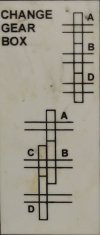
This was the standard gear layout
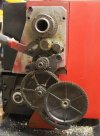
This is the gear layout for a 1.5mm pitch
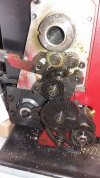
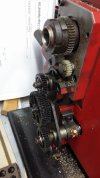
Once I had them setup, I put some layout fluid on a piece of nickel bar and did a scratch pass to make sure that I hadn’t made any mistakes.

Then I had a go at cutting a thread using a proprietary standard* 60 degrees thread cutting tool.
*Threads come in many different flavours depending on whether you are using metric, imperial, BA or many of the other thread types. Below is a thread tool gauge designed to assist when grinding your own cutting tools. As you can see US Imperial and Metric use the same standard which is 60 degrees.
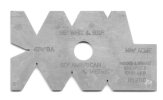
I used this mainly because I had never done it before and I wanted to use a known good set up rather than a tool I had ground myself (which proved a wise choice).
I am happy to report that all went as planned, although I did over shoot the thread gutter a couple times because I hadn’t really made it wide enough to allow the machine to stop at this pitch and I successfully cut a screw thread.

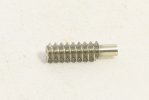
Another good session in the workshop. On the back of this I had another go later in the day, using a piece of steel and the cutter that I had ground. Sadly, as I half suspected, the tip broke off the cutter after about 5 passes. This was due I think, to being ground on a taper, which meant there was nothing under the point to offer any support. Plus being carbide, it was quite brittle.
This actually turned out to be a blessing in disguise as when I started to grind a proper piece of tool steel, I realised that my 20 degrees angle, actually gave me 40 degrees included angle. A mistake that I had also made on the first one.
Thankfully it was a case of taking more off rather than starting again so I just need to finish off grinding it to shape after posting this.
The pitch of the thread is determined either by altering gearing via several levers (if your lathe is so equipped) or in the case of many smaller hobby lathes it’s achieved by the use of change gears. Mine is the latter. What the change gears do is alter the rotation of the lead screw so that when the automatic feed is engaged, it moves the carriage a certain distance for each revolution. In my case I needed a 1.5mm pitch so I needed to swap out my standard gear set up for a 30 tooth (A), a 50 tooth(B), a 55 tooth(C), and a 35 tooth(D)
This was the standard gear layout
This is the gear layout for a 1.5mm pitch
Once I had them setup, I put some layout fluid on a piece of nickel bar and did a scratch pass to make sure that I hadn’t made any mistakes.
Then I had a go at cutting a thread using a proprietary standard* 60 degrees thread cutting tool.
*Threads come in many different flavours depending on whether you are using metric, imperial, BA or many of the other thread types. Below is a thread tool gauge designed to assist when grinding your own cutting tools. As you can see US Imperial and Metric use the same standard which is 60 degrees.
I used this mainly because I had never done it before and I wanted to use a known good set up rather than a tool I had ground myself (which proved a wise choice).
I am happy to report that all went as planned, although I did over shoot the thread gutter a couple times because I hadn’t really made it wide enough to allow the machine to stop at this pitch and I successfully cut a screw thread.
Another good session in the workshop. On the back of this I had another go later in the day, using a piece of steel and the cutter that I had ground. Sadly, as I half suspected, the tip broke off the cutter after about 5 passes. This was due I think, to being ground on a taper, which meant there was nothing under the point to offer any support. Plus being carbide, it was quite brittle.
This actually turned out to be a blessing in disguise as when I started to grind a proper piece of tool steel, I realised that my 20 degrees angle, actually gave me 40 degrees included angle. A mistake that I had also made on the first one.
Thankfully it was a case of taking more off rather than starting again so I just need to finish off grinding it to shape after posting this.
Rob Pulham
Western Thunderer
Nice work Rob. There are plenty of 60 degree cutters around but does anyone make 47.5 deg ones for BA threads?
I have never seen anything other than 60 to buy pre ground or carbide. I rather suspect it's a case of grinding your own.
Rob Pulham
Western Thunderer
This week has been very much about more learning. First of all, although I reground the 20 degrees cutting tool, I had still left too much of an undercut and the point snapped off again after about five passes.
I did manage to make another worm, the best to date but it was still cut with a standard 60 degrees thread tool – more for the practice at single point threading than an expectation of it actually being used as a worm at some point.
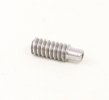
I also made an arbour to hold my gear blanks. I made this primarily because the largest brass bar that I have which is 19mm diameter and is just the right size for a 36-tooth Mod 0.5 gear. I only had approx. 200mm/8 inches, so I wanted as little waste as I could get away with to make best use of it.
The arbor has a short section at 3/16 and then the end is threaded M4 for a locking nut.
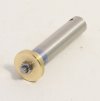
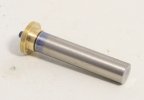
With it made I then cut a 36-tooth gear.
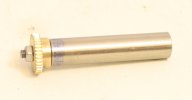
After some off line discussion with Susie (@Susie) and much grinding of my cutting tool, I finally managed to get a 20 degrees tool with sufficient support underneath the point and was able to cut a ‘proper’ worm to suit my mod 0.5 gear. On Susie’s advice I wound the lathe over by hand rather than under power to cut the worm. Now I don’t have any kind of ‘handle’ to allow me to turn the lathe over smoothly (I have seen other machinists who make an expanding arbor for their lathe spindle to allow smooth hand cranking) so my effort using the holes in the collet chuck and a tommy bar were quite laborious but I got it done.
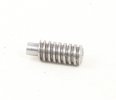

I also had another go at making a gear but with a slight angle to the teeth to better mesh with the worm.
My method of creating an angle on the teeth is very unscientific, I started off by adding a length of 0.7mm nickel rod under the front end of the spin indexer to raise it up and it did work albeit not enough and I also forgot to raise the cutter height so I ended up with slightly lopsided teeth and the angle wasn’t quite enough.
Undeterred, I increased the rod size to 1mm and tried again. It was at this point that my learning experience went into overdrive. According to the charts that I have been using* the cutting depth for Mod 0.5 is 1mm thinking I was being clever I increased that by 0.1mm. As soon as I made the first pass, I realised that something was wrong. The cutter had not only cut the tooth but it had also created a much wider channel in the blank which you can see on the right-hand side of my hacked about blank below.
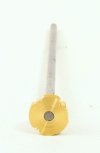
The rest of the teeth on the damaged blank were created by my testing of various cutting depths to determine the point where the cutter cut the tooth without removing any from what would become the adjacent tooth and thus reducing the overall diameter of the gear. After a few test cuts, I determined that for my cutters 0.8mm was the maximum depth before it effectively reduced the height of the adjacent tooth.
*Bob did point out earlier in the discussion that the charts were actually for the cutting of worms rather than gears but we determined that in the absence of any other data that they were near enough for both.
For the Mod 0.3 the data from the chart worked fine and now that I know I can refine my own version based on what I have determined. No doubt that if I do buy a set of Mod 0.4 cutters in the future, I will have to do some tests to refine the Mod 0.4 data to suit the practical application with my set up.
Once I had made that discovery, I cut another gear and although it was successful, it still wasn’t angled enough so I will do further experiments on my duff blank to see how a 1.6mm lift works, before committing to another full gear cut.
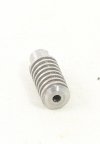
Finally, to round off this war and peace update I also cut another worm with the 20 degrees tool in a piece of free cutting mild steel (the others were cut in recycled printer bars) under power and I think that it’s a much nicer worm albeit that there isn’t much visible difference from the ‘hand powered’ example.

I did manage to make another worm, the best to date but it was still cut with a standard 60 degrees thread tool – more for the practice at single point threading than an expectation of it actually being used as a worm at some point.
I also made an arbour to hold my gear blanks. I made this primarily because the largest brass bar that I have which is 19mm diameter and is just the right size for a 36-tooth Mod 0.5 gear. I only had approx. 200mm/8 inches, so I wanted as little waste as I could get away with to make best use of it.
The arbor has a short section at 3/16 and then the end is threaded M4 for a locking nut.
With it made I then cut a 36-tooth gear.
After some off line discussion with Susie (@Susie) and much grinding of my cutting tool, I finally managed to get a 20 degrees tool with sufficient support underneath the point and was able to cut a ‘proper’ worm to suit my mod 0.5 gear. On Susie’s advice I wound the lathe over by hand rather than under power to cut the worm. Now I don’t have any kind of ‘handle’ to allow me to turn the lathe over smoothly (I have seen other machinists who make an expanding arbor for their lathe spindle to allow smooth hand cranking) so my effort using the holes in the collet chuck and a tommy bar were quite laborious but I got it done.
I also had another go at making a gear but with a slight angle to the teeth to better mesh with the worm.
My method of creating an angle on the teeth is very unscientific, I started off by adding a length of 0.7mm nickel rod under the front end of the spin indexer to raise it up and it did work albeit not enough and I also forgot to raise the cutter height so I ended up with slightly lopsided teeth and the angle wasn’t quite enough.
Undeterred, I increased the rod size to 1mm and tried again. It was at this point that my learning experience went into overdrive. According to the charts that I have been using* the cutting depth for Mod 0.5 is 1mm thinking I was being clever I increased that by 0.1mm. As soon as I made the first pass, I realised that something was wrong. The cutter had not only cut the tooth but it had also created a much wider channel in the blank which you can see on the right-hand side of my hacked about blank below.
The rest of the teeth on the damaged blank were created by my testing of various cutting depths to determine the point where the cutter cut the tooth without removing any from what would become the adjacent tooth and thus reducing the overall diameter of the gear. After a few test cuts, I determined that for my cutters 0.8mm was the maximum depth before it effectively reduced the height of the adjacent tooth.
*Bob did point out earlier in the discussion that the charts were actually for the cutting of worms rather than gears but we determined that in the absence of any other data that they were near enough for both.
For the Mod 0.3 the data from the chart worked fine and now that I know I can refine my own version based on what I have determined. No doubt that if I do buy a set of Mod 0.4 cutters in the future, I will have to do some tests to refine the Mod 0.4 data to suit the practical application with my set up.
Once I had made that discovery, I cut another gear and although it was successful, it still wasn’t angled enough so I will do further experiments on my duff blank to see how a 1.6mm lift works, before committing to another full gear cut.
Finally, to round off this war and peace update I also cut another worm with the 20 degrees tool in a piece of free cutting mild steel (the others were cut in recycled printer bars) under power and I think that it’s a much nicer worm albeit that there isn’t much visible difference from the ‘hand powered’ example.
I think the reason 47.5 degree cutting tools are rare is simply because it applies to only one particular thread form, BA, and that is concerned with small diameters where dies can be used right up to the largest of OBA.
It’s difficult to cut helical gears with disc cutters because of the geometric error involved and would explain why the need arose to undercut to preserve the tooth form in places but it means in others they will not be. They will also not be vertical in relation to the gear axis but slant at an angle. The more severe the helix the worse this becomes. So proper meshing with other gears is compromised. There's no easy answer to this conundrum, hobbing is the only real answer with small scale tooth forms. You'll appreciate I discovered all this for myself and is why I went down the hobbing route.
If you want to mesh worms with straight cut spur gears then overcut them and keep them to no more than 1/3 or a 1/4 of the worm diameter. That should, generally, allow them to sit at 90 degrees to the wormwheel axis. Of course this difference can be used to change the direction of shafting when it's desired. It's mostly direct inline or at right angles but doesn't have to be. For model loco's of course right angle drive is what we generally want.
Bob
It’s difficult to cut helical gears with disc cutters because of the geometric error involved and would explain why the need arose to undercut to preserve the tooth form in places but it means in others they will not be. They will also not be vertical in relation to the gear axis but slant at an angle. The more severe the helix the worse this becomes. So proper meshing with other gears is compromised. There's no easy answer to this conundrum, hobbing is the only real answer with small scale tooth forms. You'll appreciate I discovered all this for myself and is why I went down the hobbing route.
If you want to mesh worms with straight cut spur gears then overcut them and keep them to no more than 1/3 or a 1/4 of the worm diameter. That should, generally, allow them to sit at 90 degrees to the wormwheel axis. Of course this difference can be used to change the direction of shafting when it's desired. It's mostly direct inline or at right angles but doesn't have to be. For model loco's of course right angle drive is what we generally want.
Bob
(I have seen other machinists who make an expanding arbor for their lathe spindle to allow smooth hand cranking
They are very useful for all manner of slow speed work such as die cutting in the lathe. Made mine from steel.
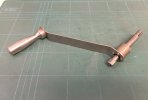
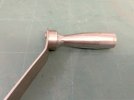


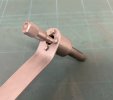

Gets your arm working.........
Bob
Rob Pulham
Western Thunderer
If you want to mesh worms with straight cut spur gears then overcut them and keep them to no more than 1/3 or a 1/4 of the worm diameter. That should, generally, allow them to sit at 90 degrees to the wormwheel axis. Of course this difference can be used to change the direction of shafting when it's desired. It's mostly direct inline or at right angles but doesn't have to be. For model loco's of course right angle drive is what we generally want.
Bob
Thanks again Bob,
I don't think that I will ever need to make enough gears to warrant going down the hobbing route but the whole process has taught me much
I have had some success with tilting the spin indexer to cut the spur gear at an angle (although admittedly I did realise last night that I was in fact tilting it in the wrong direction so I corrected that). I am curious as to what you mean by keeping the diameter to no more than a third or a 1/4 of the worm diameter for straight cut gears? Is that the spur gear diameter or the tooth size? - My 'best' worm to date is 6.4mm or just a touch over a quarter inch.
One other question, for overcutting, would I use the next cutter up or down? - Actually that point is slight moot, because my cutter set only has six of the 8 cutters out of the full set and I am using the no 6 cutter (35-54 teeth) to cut the 36 tooth gear. So in reality I can only go down without buying more cutters.
Rob Pulham
Western Thunderer
They are very useful for all manner of slow speed work such as die cutting in the lathe. Made mine from steel.
View attachment 251507
View attachment 251508
View attachment 251509
View attachment 251510
View attachment 251511
View attachment 251512
Gets your arm working.........
Bob
That looks the business, I can see another little side project on the horizon. Thanks for taking the time to take the photos Bob.