
You are using an out of date browser. It may not display this or other websites correctly.
You should upgrade or use an alternative browser.
You should upgrade or use an alternative browser.
Standard Gauge Baldwin Gas Mechanical
- Thread starter spikey faz
- Start date


spikey faz
Western Thunderer
I think the Unimat would be ideal, but I simply don't have the space to store one. My 'workshop' is a bedroom and home office, so storage is at a premium. Something a little bit smaller than the Unimat would be ideal, but probably would be more of a toy.Go on, Mike, treat yourself. You know it makes sense!
my little Unimat was my second lathe purchase. I paid about £350 some 30 years ago.
It’s paid its way, and it’s probably worth the same, maybe a bit more, now.
Mike

RichardG
Western Thunderer
I keep my lathe on the landing, on top of a folding bed I keep for guests. The lathe doesn't intrude there. It is as portable as the cast-iron sewing machine my Mum had, and I clear off the bench when I want to use it. I found space in the hobby room for a pillar drill, but there isn't room for any more machine tools unless I move the layout to the living room.
spikey faz
Western Thunderer
An initial trip to the paintshop/garden shed/home of many spiders has shown up a few blemishes. Nothing that a bit of filler can't sort out.
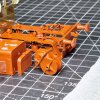


The primer looks a bit glossy in the pictures, but almost matt in reality.
Mike
The primer looks a bit glossy in the pictures, but almost matt in reality.
Mike
spikey faz
Western Thunderer
Filler rubbed down and fresh primer applied. Not sure why I'm trying to get a smooth(ish) finish as there will be a fair bit of weathering to follow once the topcoat has been applied. Topcoat is most likely going to be yellow!

Mike
Mike


spikey faz
Western Thunderer
More paint!
Let's be honest, it's not the best paint finish, but I had in mind from the outset that this would be a well weathered locomotive, so the scruffy look is already half way there.
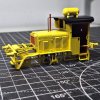
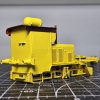
The chassis will revert to black in due course.
Mike
Let's be honest, it's not the best paint finish, but I had in mind from the outset that this would be a well weathered locomotive, so the scruffy look is already half way there.
The chassis will revert to black in due course.
Mike
spikey faz
Western Thunderer
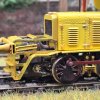
Working chain-drive would have been nice, but realistically I'd struggle to achieve that. So, I took the easy option and acquired a couple of Dapol Sentinel chains as spare parts. Once I'd soldered some brass gears on I was good to go.


The differential was subjected to some unsubtle weathering prior to installation.


Mike
The differential was subjected to some unsubtle weathering prior to installation.
Mike
spikey faz
Western Thunderer
Baldwin transmission I assumed this was a differential, but open to suggestions.That’s lovely!
(I’ll bet a whole pound, of my own money, that it’s not a differential)
cheers
Simon
Mike

simond
Western Thunderer
Hi Mike
I don’t think so for two reasons.
firstly, a railway vehicle doesn’t need a differential gear because the wheel coning does the job. Indeed, if it has cranks and rods, the pairs of cranks must be immovably connected to the same axle, or it’ll tie itself in knots!
secondly, that photo looks very like a marine reversing transmission such as would be fitted to an outboard, or an outdrive. The pinion (which I think is not visible), rotates only in one direction, as driven by the engine. The two crown wheels are in permanent mesh with the pinion and thus rotate in opposite directions. There will be a pair of dogs that are able to slide on the drive (crank) shaft so one or the other can engage with the crown wheels, thus rotating the crank shaft forwards, or backwards.
cheers
Simon
I don’t think so for two reasons.
firstly, a railway vehicle doesn’t need a differential gear because the wheel coning does the job. Indeed, if it has cranks and rods, the pairs of cranks must be immovably connected to the same axle, or it’ll tie itself in knots!
secondly, that photo looks very like a marine reversing transmission such as would be fitted to an outboard, or an outdrive. The pinion (which I think is not visible), rotates only in one direction, as driven by the engine. The two crown wheels are in permanent mesh with the pinion and thus rotate in opposite directions. There will be a pair of dogs that are able to slide on the drive (crank) shaft so one or the other can engage with the crown wheels, thus rotating the crank shaft forwards, or backwards.
cheers
Simon
spikey faz
Western Thunderer
Yes, you're right. I was thinking in car terms, which of course needs the diff, whereas the requirement for a locomotive is much simpler. Anyway, it's a big grimy box full of gears!Hi Mike
I don’t think so for two reasons.
firstly, a railway vehicle doesn’t need a differential gear because the wheel coning does the job. Indeed, if it has cranks and rods, the pairs of cranks must be immovably connected to the same axle, or it’ll tie itself in knots!
secondly, that photo looks very like a marine reversing transmission such as would be fitted to an outboard, or an outdrive. The pinion (which I think is not visible), rotates only in one direction, as driven by the engine. The two crown wheels are in permanent mesh with the pinion and thus rotate in opposite directions. There will be a pair of dogs that are able to slide on the drive (crank) shaft so one or the other can engage with the crown wheels, thus rotating the crank shaft forwards, or backwards.
cheers
Simon

Mike
spikey faz
Western Thunderer
spikey faz
Western Thunderer
The instructions included a scale drawing. Unfortunately I've only recently binned them! However, I don't think from memory there were any actual dimensions anotated to the drawing.It's looking very good.
I have various drawings for the Baldwin but all without dimensions.
Can you say what the wheelbase is?
And maybe some dims of the cab?
Thanks in advance
P
I have still got the CD from which the seller downloaded and printed off the instructions, but I don't have any means of downloading this myself.
Mike