7mm The Old Man's Workbench - tales of a rivet side

Dog Star

Western Thunderer
Last Saturday saw me holding a flat parcel rather carefully as I escorted the test build of a carriage side to the Reading 0 Gauge Trade Show for inspection by David White of Slater's Plastikard. The work so far has been received favourably and so the project gets an amber light.

What am I doing? Photos soon when I make up the parts for the second side. For now, a clue - take two V5s and a sharp knife / saw/ sandpaper to produce a bigger sandwich.

regards, Graham
 

Dog Star

Western Thunderer
Postie called this morning to deliver an iconic white box... not the big white version (the Class 52 was collected from the Reading Trade Show) rather the smaller version which is used for wagons and similar. The label reveals all, an air-braked TTA with long walkways. Peter and I liked the example on the JLTRT stand at the show... unfortunately the kit was sold out so we have had to wait for more to be made.

Anyone any helpful hints / tips for assembly?

The kit provides separate parts for the axleguards, for the roller-bearing axleboxes and for the springs (actually, complete sets for two different styles of bearing springs). All-in-all, this looks promising for including working suspension. Anyone included springing for their model?

regards, Graham
 

richard carr

Western Thunderer
Graham

I'm building my third at the moment, its a really nice kit, the only points I would make are as follows :-

Folding up the walkway requires a folding tool of one kind or another.

The indents on the tank that the walkway fits into don't quite match up with the walkway you will probably need to hack away at a few to get everything to fit perfectly.

You can get the W irons to work, but the wagon is so heavy 690g that you don't need suspension.

The distance between the W irons is very tight for scale 7 you will probably find you need to give the W irons a little push outwards to get the wheels to rotate freely.

Fox do transfer for these wagons, Paul Bartletts site has lots of photos of them but you will find that they were all very subtly different and that the kit makes up only a relative small percentage of wagons that seem to be refered to as TTAs.

Richard
 

Dog Star

Western Thunderer
The indents on the tank that the walkway fits into don't quite match up with the walkway you will probably need to hack away at a few to get everything to fit perfectly.
Thank you for the warning, any idea which part is "correct"?

You can get the W irons to work, but the wagon is so heavy 690g that you don't need suspension.
Not a fan of the thin white-metal axleguards, I get the impression that the axleguards might bend too easily if the wagon took a sideways knock. Replacement axleguards in brass or n/s ought to be easy to make and would make fitting of Slater's brass axleboxes an easy task - biggest concern is getting springs to support the weight of the model (that tank body is obscenely heavy!!!!).

The distance between the W irons is very tight for scale 7 you will probably find you need to give the W irons a little push outwards to get the wheels to rotate freely.
Thank you for this comment - what is binding? (wheel rim on back of axleguard or journal in bearing).

... the kit makes up only a relative small percentage of wagons that seem to be refered to as TTAs.
Here I expose my lack of knowledge of the prototype... as yet I have not found any historical / build information on these wagons so I shall be pleased to read of any relevant references.

regards, Graham
 

AJC

Western Thunderer
This is an example of the unhelpfulness of TOPS codes - all that TTA indicates is a 4-wheeled, airbraked tank wagon. Most modellers seem to regard this as a 44 ton monobloc design and that at least is fair enough. They were built from about 1964/5 and the early versions were vacuum braked. Some were presumably later air-piped and the majority seem to have been leased by oil companies rather than owned outright. ESSO also had some some 35 ton versions (built '63) with a slightly shorter barrel, but I think the same diameter as later versions), different suspension and vacuum brake. I keep meaning to convert a Bachmann one in 4mm to one of these... The basic wagon was for oil, but with detail variations, wagons of similar basic configuration were used for all sorts of things.

http://paulbartlett.zenfolio.com/fueltankwagons

The chief variations were suspension, brake mechanisms and walkways. The suspension systems are at least relatively straightforward and the two main ones are in the box by the sounds of it. The walkways depend on the builder, spec' and date and, to some extent whose traffic they were used on, so the usual rule of consulting dated photographs applies. Paul Bartlett's galleries are obviously the place to start.

The brakegear is the interesting/fun/frustrating bit since this varied between builders, batches and brake type (air, vacuum, etc.), but the variations are mostly concerned with the actuation mechanisms and brake levers. Again, checking photos is the way forward since there are very few published drawings.

Adam
 

richard carr

Western Thunderer
Graham

I have no idea if the walkway is correct or the indents on the tank, as you can't easily change the walkway I have modded the tank.

The journal in the bearing binds or it could be the bearing on the front of the wheel face, the reality is that the white metal W irons are too thick.

Adam

thanks for those details, as you say a few photos are what you need to decide what it is you are going to build.


Richard
 

Dog Star

Western Thunderer
... all that TTA indicates is a 4-wheeled, airbraked tank wagon... They were built from about 1964/5 and the early versions were vacuum braked. Some were presumably later air-piped and the majority seem to have been leased by oil companies rather than owned outright. ESSO also had some 35 ton versions (built '63) with a slightly shorter barrel, but I think the same diameter as later versions), different suspension and vacuum brake.
Thank you Adam for explaining something of the development of this style of tank wagon. Paul Bartlett's web site is necessary reading for building the JLTRT kit... my first look at the tank wagon pages gave me a real headache for I was not aware of the huge variety of 4-wheel tanks for carrying Class A and Class B liquids. I shall persevere with the web-site photos... if anyone knows which prototype is represented by the JLTRT kit then that might help me avoid making a wunder-blunder.

thanks, Graham
 

AJC

Western Thunderer
Hmm, I daresay that, with a bit of work and adaptation, you could make most of the variations. Assuming that the long walkway is as illustrated on the JLTRT website. The application of transfers on that model has been screwed up somewhat, not helped by the fact that the tank was too small initially (per Brian Daniels in the other place). This seems to have been corrected, but how on earth did they make the error in the first place?

The long style of walkway modelled seems to have been relatively unusual, though these Algeco vehicles seem a reasonable match: http://paulbartlett.zenfolio.com/algecob as do these from Shell: http://paulbartlett.zenfolio.com/smbpclassa (obviously Shell Mex BP when built).

The brakegear modelled - based on the JLTRT website - seems to reflect the version Bachmann did in 4mm and *seems* to be the most common variant. Is your's going to be vac' braked or air?

Adam
 

Dog Star

Western Thunderer
As this is the festive season then here is a little light relief...

We are all familiar with the iconic white box and the implicit assumption that the box has a JLTRT kit. Please do not be afraid... there is another source of such boxes! For those of a certain persuasion - and the perseverance to pour over page after page of any of Russell's carriage books - Slater's can be persuaded to supply a kit which otherwise does not appear in their catalogue. This photo says it all... white box, GWR carriage diagram, courtesy of Slaters and provided in time for Christmas (and no, the box did not contain five axlesets...).

xmas puzzle 1.jpg

Model Railway Constructor for June, August and September 1967 contains information and drawings for the GWR Dean Passenger Luggage Vans which includes the diagrams K14, K15 and K16. An exchange of e-mails with David White established the appropriate recipe for the necessary parts... take one C10 kit and remove any parts for the body... take the body parts from a couple of V5 kits... add several handfuls of lost wax castings... and the brake section sides from the D14. Sift into a white box and stir carefully. For simplicity, from here on any reference to plastic mouldings, sides or parts are to items supplied generously by Slater's Plastikard.

xmas puzzle 2.jpg

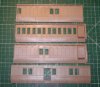
Woah! We need to make some puzzle pieces before stirring gently. Let us start with the sides from the box, so this is what we have on the workbench today.

xmas puzzle 3.jpg

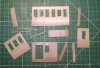
Actually, we have more than just those four ingredients, at this point we have no clear idea as to what is going into the mixing bowl so we shall just see what could be used. After a bit of nifty work with the kitchen knife there is a small pile of left-overs....

xmas puzzle 4.jpg

Now tip the mixture out onto a flat surface and start to put the pieces together into a well-known phrase or saying...

xmas puzzle 5.jpg

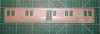
And there we are, one side of a K14/5/6 coach, just needs another side, some ends and an underframe. OK - the end sections for the turnunder are to be added. What we have here is a trial run to convince David White and myself that we can produce a carriage side of sufficient quality that the result can be used to produce a master for a complete resin body.

In case anyone is thinking "plagarism", "copyright" etc., this project started as a "one-off, for personal use" on our future GW&GC Jt layout. As the ideas were being progressed with Slaters David asked the question "why not make a master for the body and we can cast that in resin". So the idea came from Slaters, the master shall belong to Slaters and any reproduction of the master shall be managed by Slaters.

regards, Graham
 
Last edited:

Dog Star

Western Thunderer
... and it also shows how helpful some manufacturers can be.
True, Slaters has been always most helpful in providing parts for hair-brained schemes. I do find that knowing what is wanted does help to sway the day... particularly if able to provide a description and / or part numbers of mouldings from specific kits. The previous time I asked for a "one-off" coach kit the archtypical white box arrived with a note from David, along the lines of "you will need something for the control gear under the ends... these parts from a Midland coach kit will be useful... " - and this was for a GWR clerestory double-ended slip!

regards, Graham
 
Last edited:

Dog Star

Western Thunderer
For those who might wish to read more about the method that I have used - and will describe / illustrate for the second of the sides - then you can find information in these two articles:-

[1] Model Railway Journal issue no.28, 1989... in my opinion one of the most inspirational articles ever :thumbs: ;
[2] Model Railway Journal issue no.94, 1997... an alternative approach to the cut and shut problem.

I am lucky in that I have a draft of Richard de Camin's article which was intended for publication (and has not as far as I can tell). Richard provided details of how to produce a wide range of GWR carriages from the Slater's kits plus some scratchbuilding where there is no suitable side in the Slater's range. Richard did not include a K14 /15 / 16 in his article.

Patrick Reardon (MRJ 28) makes the cuts in the body side adjacent to doors or midway through panelling. Jim Snowdon (MRJ 94) makes the cuts through windows as, in his opinion, such a position simplifies the task of smoothing the joins. As will be seen shortly, I had to find another route because of the lack of windows... and the need to make joins somewhere between the doors of the donor sides.

regards, Graham
 
Last edited:

Dog Star

Western Thunderer
Now that we know where this is going, let us see how we got there, starting with the prototype. Rather than show a drawing of the K14 Passenger Luggage Van and risk copyright problems... here is a drawing of one of the other two diagrams "as built".

k16 a.jpg

Here we have a diagram of the K16 PLV, built with ends capable of being fitted with gangways at a future date - somewhat unusual and not easy to spot a K16 when in a rake of carriages. To recap, there are three diagrams "as built", being:-

* K14, PLV without gangway;
* K15, PLV with gangway;
* K16, PLV with provision for gangway, gangway not fitted when built.

So the drawing shows the basic form of the Dean 40' PLV and the detail of the end which was common to the K15 and K16. GWR carriage lots 919, 1017 and 1033 were built between 1899 and 1903. Rather than keep refering to the different variants of the 40' PLV then from here on I shall refer to just a K15 (which is what I want) unless there is a need to be more specific in regard to carriage diagram. Whilst there appears to be a fair number of photos of the K14 variant - which may explain why that is the diagram used for a 4mm kit (Keyser) and for a 7mm kit (Metalmodels) - I am aware of no photo of a K16 and only two photos of a K15 (being in the MRC article cited previously and on the Warwickshire Railways web site).

The first stage in building one side is to decide (a) which sides to use and (b) where to cut each side to form one or more parts of the re-assembled side. Initial thinking decided that using just the sides from the V5 (four wheel PLV) would give the best "fit" for the K15 (40' PLV) because:-

* using sides from one mould minimises problems from variation in moulding thickness;
* the K15 needs four sets of double doors per side... and a V5 has two pairs of the same doors per side... so a K15 side equates (roughly) to two V5 sides.

(if I had started with D14 sides then I would have need four D14 sides for each K15 side, somewhat wasteful).

I made several photocopies of the V5 sides because I cut "pieces" from the photocopies in a trial and error puzzle to determine the best fit of V5 parts to K15 side. OK - Slaters provided quite a few sides for the project, no sense in making mistakes when cutting slices from a plastic moulding. Here is what happened next:-

k16 b.jpg

k16 c.jpg

Not too pretty, good enough to establish where to make the cuts in the V5 sides. Each K15 side is made from seven slices of V5... slices 1, 2, and 3 come from V5 side "A" and slices 4, 5, 6 and 7 come from V5 side "B". In the photo slices from side "A" have a green line drawn on the bottom edge of the V5 photocopy and slices from side "B" have a black line... this is important because the slices from side "A" are of different widths to the slices from side "B".

Equally important is to remember which double door from a V5 side goes where in the K15 make-up. I have numbered the droplights on the V5 photocopy with 1 to the left and 5 to the right, so the photo shows that the K15 doors came from the V5 sides as:-

* K15 door 1 came from V5 side "A" LH door;
* K15 door 2 came from V5 side "A" RH door;
* K15 door 3 came from V5 side "B" (the Guard's door);
* K15 door 4 came from V5 side "B" RH door;
* K15 door 5 came from V5 side "B" LH door.

And here is photo of the photocopy "slices" for comparison with the (almost) completed side.

k16 d.jpg

xmas puzzle 5.jpg

Next step is to cut another pair of V5 sides to produce the slices for the second K15 side.

regards, Graham
 
Last edited:

28ten

Guv'nor
I tried that once, i think the bits are still in a box somewhere gathering dust with my "jenkinson' attempts, hats off if you can make it work :thumbs:
 

richard carr

Western Thunderer
Graham here are some TTA pictures so you can see how things go together.

Richard


DSCN0573.JPG

The first one I built

DSCN0574.JPG

I'm not really sure if any ever carried ESSO livery like this, plenty of TTAs did I'm just not sure that this particular style of TTA did.

Heres the under frame of the one I'm building now.

DSCN0576.JPG

DSCN0578.JPG
 

Dog Star

Western Thunderer
And on to cutting sides...

I use a razor saw to cut the slices from each moulding, slowly... so as to avoid melting the plastic. Holding a side and getting a right angle cut is not easy so a helping hand is desirable, as here:-

k15 a.jpg

The multitude of saw cuts is a consequence of not getting the slots at right angles across the jig and right angles to the base. The coffee stirrers? Ah, the sides are not flat on the back face and the stirrers support the side during cutting, see below:-

k15 b.jpg


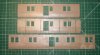
Several slow cuts later and the first of the V5 donor sides is in pieces, this V5 side providing just the left hand end and the two doors to the left of the Guard's compartment of the K15. The photograph below shows an original V5 side above a sliced V5 side above a (95%) complate K15 side:-

k15 c.jpg

The photo shows the slices as cut, the raw edges need to be cleaned up and the slices adjusted to an appropriate length.

regards, Graham
 

Dog Star

Western Thunderer
The indents on the tank that the walkway fits into don't quite match up with the walkway ....

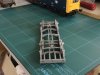
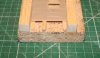
Placing the walkway etch against the tank barrel provides a clear indication of the problem that is described by Richard in his earlier post. When the etch is placed relative to the barrel such that an endmost "leg" is over a cutout in the barrel then one can see that the distance between "legs" is longer than the distance between cutouts... hence the "legs" get increasingly further out of alignment with the barrel. Sorting this is going to be fun.

I shall search Paul Bartlett's photos for a close-up of the walkway... in the meantime, does anyone have a photo or a drawing which illustrates how the walkway is attached to the barrel? Or a photo / drawing which shows the shape of the legs? (might the leg on the outside of a walkway be joined to the leg on the inside of that walkway... rather like an upside-down "U"?).

regards, Graham
 
Last edited:
Top