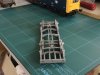
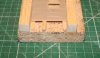
Now that we know where this is going, let us see how we got there, starting with the prototype. Rather than show a drawing of the K14 Passenger Luggage Van and risk copyright problems... here is a drawing of one of the other two diagrams "as built".

Here we have a diagram of the K16 PLV, built with ends capable of being fitted with gangways at a future date - somewhat unusual and not easy to spot a K16 when in a rake of carriages. To recap, there are three diagrams "as built", being:-
* K14, PLV without gangway;
* K15, PLV with gangway;
* K16, PLV with provision for gangway, gangway not fitted when built.
So the drawing shows the basic form of the Dean 40' PLV and the detail of the end which was common to the K15 and K16. GWR carriage lots 919, 1017 and 1033 were built between 1899 and 1903. Rather than keep refering to the different variants of the 40' PLV then from here on I shall refer to just a K15 (which is what I want) unless there is a need to be more specific in regard to carriage diagram. Whilst there appears to be a fair number of photos of the K14 variant - which may explain why that is the diagram used for a 4mm kit (Keyser) and for a 7mm kit (Metalmodels) - I am aware of no photo of a K16 and only two photos of a K15 (being in the MRC article cited previously and on the
Warwickshire Railways web site).
The first stage in building one side is to decide (a) which sides to use and (b) where to cut each side to form one or more parts of the re-assembled side. Initial thinking decided that using just the sides from the V5 (four wheel PLV) would give the best "fit" for the K15 (40' PLV) because:-
* using sides from one mould minimises problems from variation in moulding thickness;
* the K15 needs four sets of double doors per side... and a V5 has two pairs of the same doors per side... so a K15 side equates (roughly) to two V5 sides.
(if I had started with D14 sides then I would have need four D14 sides for each K15 side, somewhat wasteful).
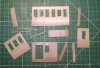
I made several photocopies of the V5 sides because I cut "pieces" from the photocopies in a trial and error puzzle to determine the best fit of V5 parts to K15 side. OK - Slaters provided quite a few sides for the project, no sense in making mistakes when cutting slices from a plastic moulding. Here is what happened next:-


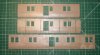
Not too pretty, good enough to establish where to make the cuts in the V5 sides. Each K15 side is made from seven slices of V5... slices 1, 2, and 3 come from V5 side "A" and slices 4, 5, 6 and 7 come from V5 side "B". In the photo slices from side "A" have a green line drawn on the bottom edge of the V5 photocopy and slices from side "B" have a black line... this is important because the slices from side "A" are of different widths to the slices from side "B".
Equally important is to remember which double door from a V5 side goes where in the K15 make-up. I have numbered the droplights on the V5 photocopy with 1 to the left and 5 to the right, so the photo shows that the K15 doors came from the V5 sides as:-
* K15 door 1 came from V5 side "A" LH door;
* K15 door 2 came from V5 side "A" RH door;
* K15 door 3 came from V5 side "B" (the Guard's door);
* K15 door 4 came from V5 side "B" RH door;
* K15 door 5 came from V5 side "B" LH door.
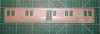
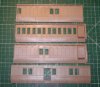
And here is photo of the photocopy "slices" for comparison with the (almost) completed side.

Next step is to cut another pair of V5 sides to produce the slices for the second K15 side.
regards, Graham





 ;
;