7mm The Old Man's Workbench - tales of a rivet side

ZiderHead

Western Thunderer
Thats going to require some careful setting up so the motors arent fighting each other, as its effectively permanent double-heading using 2 decoders. I helped a friend set up double-headed locos using Zimo chips and it took quite a while to get the speed curves right ...
 

Steph Dale

Western Thunderer
Thats going to require some careful setting up so the motors arent fighting each other, as its effectively permanent double-heading using 2 decoders. I helped a friend set up double-headed locos using Zimo chips and it took quite a while to get the speed curves right ...
Yep, it can be fun!
My approach these days is to drop the same settings for min, max, med speed onto each decoder (assuming the drive/loco is the same in each case). The trick is then to dial out the back-emf response until the decoders stop fighting. This latter stage is probably easier to do by programming on the main.
Graham will be helped a little in this as he's using coreless motors so his feedback response values will be pretty low anyway.

Steph
 

TheSnapper

Western Thunderer
...........On ESU there's also the automatic set up routine, although I haven't tried this yet...Steph

Steph

Presumably, you mean the "CV54 trick"? I've tried it several times on v4 chips, and it does work.

At Aylesbury, I also tried consisting Tony's 23 Class 20's. That worked a treat too, but I appreciate you need closely matched locos, chips, CV settings etc., and there was a bit of a procedure in getting them both started.....but they did look & sound good!

Tim
 

TheSnapper

Western Thunderer
What are you describing here?


The CV54 trick applies to ESU Loksound V4 chips only, as far as I know.

Set CV54 to 0, put the loco on the track with plenty of room in front and behind, then turn on F1. It will shoot off for about six feet whilst the chip checks out the motor response and adjusts itself accordingly, then stop. After that the motor should run smoothly.


I wish I had seen twenty three Class 20s running around Heyside...;) .

Whoops...so do I...., but what a racket!!

Tim
 

Dog Star

Western Thunderer
Thank you Tim, an interesting programming method - might that trick work for a model which has two instances of a motor/decoder combination?
 

TheSnapper

Western Thunderer
.............might that trick work for a model which has two instances of a motor/decoder combination?........

I don't know, is the short answer!

Presumably both chips will have the same address?

Personally I wouldn't use 2 chips. With Maxxon motors, one will be sufficient, and will be less hassle to set up.

Tim
 

Steph Dale

Western Thunderer
Thank you Tim, an interesting programming method - might that trick work for a model which has two instances of a motor/decoder combination?

Graham,

I suspect that's the simplest way to get some starting values into the decoders, the only potential problem is that you'll need a lengthy run (or circuit) of track. I'm still in agreement with Tim about the use of one decoder...

Steph
 

richard carr

Western Thunderer
Graham

I have to agree with Tim and Steph, one decoder should br fine, it is for all my Heljan models.
I also wouldn't have thought that 2 abc motor bogies are necessary 1 should be sufficient with a little added weight.


Richard
 

Dog Star

Western Thunderer
We shall see just what happens then... on both counts...

* as for two ABC bogies, seemed to us that having power at each end ought to give a more realistic appearance to the motion and provide a surfeit of power for hauling JLTRT Mk.1s around. If one is enough then that is a good reason to obtain a second Cl.37;
* I did write earlier that I asked Brian Clapperton for his advice about ESU / SWD decoders for use with the model (and at the time of that discussion the model was fitted with two ABC motor bogies). Brian was quite clear that the model would run better with one decoder for each motor. I shall ask Brian to explain his reasoning when I see him during the summer.

regards, Graham
 

Dikitriki

Flying Squad
Hi

I would always go for 2 powered bogies. Our experience of one powered bogie in DJH diesels (= weigh a ton) is that traction was very much better with the powered bogie trailing than it was leading.

Richard
 

Caggers

Western Thunderer
Richard,

I'm a little confused (not difficult) with your post, if running was better with one powered trailing bogie, why would two be better??? Or is this just from trial and error you found two motor bogies to be better?

Cheers, Simon
 

Dikitriki

Flying Squad
The loco was unbalanced with only one bogie powered, even with the weight of it, and the traction was affected materially depending which way you placed it on the track.

If the loco was placed with the powered bogie next to the train (powered bogie trailing), traction was fine. If the loco was turned round so that the unpowered bogie was next to the train (powered bogie leading), the pulling power was much less.

It wasn't that traction was bad, just that it was noticeably different. We just felt it was better balanced with 2 powered bogies, and we didn't want to have to remember which way round to put the loco.

Richard
 

Caggers

Western Thunderer
are you confused with Richard's post or is confusion a consequence of living near to the Tyne?

The Tyne does not confuse me, its black and white on my side and red and white on the other...
T'was Richards post on two bogies, and then one and the back, rather than the front. What was going through my mind was why you would want to introduce the second bogie (at the front) if it was better at the back...:cool:

Cheers, Simon
 

40126

Western Thunderer
...are you confused with Richard's post or is confusion a consequence of living near to the Tyne?.....
regards, Graham

Doggers, your up to your old tricks again :))

The Tyne does not confuse me, its black and white on my side and red and white on the other...

Cheers, Simon

Doggers, Do not bring football rivalry onto here. Its bad enough on facebook, people get upset. I'm white & Black & detest (bit polite for me) them down the road in red :rant::headbang::)):)):))

Steve :cool:
 

Dog Star

Western Thunderer
Apart from the friendly banter, long may that continue, life goes on and the DC / DCC saga continues, I never thought this topic would be so controversial :) . A minor milestone has been passed today, the engine has run on 12V DC with the motors co-operating, so here is a pikkie.

The veroboard is retained with blobs of blue stuff at the moment, eventually some form of mechanical fixing is going to be used. The copper strips on the veroboard are on the underside so, unfortunately, you cannot see how the tracks are used. At this time, the pick-ups on each bogie are connected together so operation of this model is not going to be disrupted by short track sections without electrical feed, in effect there is an internal power bus (+/- or A/B dependent upon mode of operation) running the length of the underframe. At each end of the board there is a movable link which, for 12V DC operation, connects the motors to the internal power bus - this movable link is going to connect to the decoders for DCC working. One of the motor bogies had the wiring, as supplied, reversed so that the pick-up wiring on a side is the same colour.
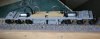
cl37wiring-5.jpg

regards, Graham
 
Top