Rob P's Journey Into Miniature Gear Cutting

Rob Pulham

Western Thunderer
Rob,

Back in my 4mm days I made worm and wheel gears using an M6 tap. For the gear I mounted the brass blank on an arbour held in the tool post and just plunged it into the rotating tap. Must have been luck as the setup worked and turned out a gear with all the teeth intact. The worms were made from commercial steel M6 screw rod. Because the tooth form was concave the mesh had to be held in a gear box with no sideplay but they worked well and may still do as I sold the models on some time ago.

Ian.
Hi Ian,

That's pretty much what I planned to do myself, how did you work out the diameter of the brass blank or was that just potluck?
 

Bob Essex

Western Thunderer
Would you mind taking a few more shots of how your attachment drives off the lathe carriage bed gearing please - I am quite fascinated by all such things

I'm awfully sorry Rob but I can't set it up at present. However I have taken a few shots to show how it all goes together away from the lathe and I hope this is okay. It is of course all fairly crude and simple so you'll have to accept that. Just stock metal machined as easily as possible. It did take quite a while to produce, mostly with trying to work out how to make it rather than the actual making.

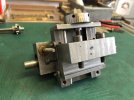
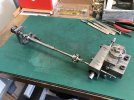
This is the adapter plate which bolts into place to allow the last changewheel (normally on the powerfeed shaft) to drive the unit. It moves to cope with the different sizes of wheels used.
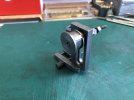
WT 02.jpg

WT 01.jpg

The drive shaft is telescopic to allow for distance changes.
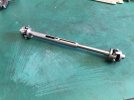
WT 03.jpg

The main unit bolts onto the end of the compound slide and can move up/down to accomodate the size of gear being cut. The arbour section is reversable to allow more room for larger gears since the vertical adjustment is limited by the lathe carriage design.
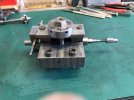
WT 04.jpg


WT 05.jpg


WT 06.jpg


WT 07.jpg


WT 08.jpg

There is a worm gear set in the end of the arbour section to turn the drive through 90 degrees. A very large tooth one, 20-1 ISTR, and meant to be used in 7mm locos.... Two sizes of removable arbour are screwed into the end for 1/8" and 3/16" bore gears.

None of this would have been possible without a milling machine, the Hobbymat BFE65 (which is a fair old size & weight), or the bits that go with it. It was mostly made on it as well as the lathe.

My gearing notebook suggests that I could cut gears with 12/16/18/21/24/27/30/32/33/36/39/40/42/44/45/48/52/54/56/60/63/66 teeth with this setup and the available changewheels.

Bob
 

John Baker

Western Thunderer
Maybe a bit bit beyond the scope of this thread, but there's a chap who's made his own gear hobbing attachment for his mill. I'm sure it's not beyond the realms of the more engineering-minded folk to make one! He provides the code for free (or a small charge?) for anyone wanting to have a go themselves. Even if you don't want to build your own, the playlist below is well worth a watch.
https://youtube.com/playlist?list=PL7T9LOrvm0qLMHvxnMJsi_gqrfyUoaeCp&si=Vis-urGy_rL0iKDg
 

Rob Pulham

Western Thunderer
Thanks Bob,

I rather think that I will need to study the photos a few times for it to sink in but I much appreciate you taking the time to take the photos.
 

Rob Pulham

Western Thunderer
Maybe a bit bit beyond the scope of this thread, but there's a chap who's made his own gear hobbing attachment for his mill. I'm sure it's not beyond the realms of the more engineering-minded folk to make one! He provides the code for free (or a small charge?) for anyone wanting to have a go themselves. Even if you don't want to build your own, the playlist below is well worth a watch.
GEARS
Thanks John,

I had seen the video entitled "cut any gear with a slitting saw" but I hadn't seen the others.
 

Ian@StEnochs

Western Thunderer
Hi Ian,

That's pretty much what I planned to do myself, how did you work out the diameter of the brass blank or was that just potluck?
Rob,

It's a long time ago but if I am sure I worked out the circumference based on the screw pitch. M6 is 1mm so I think I went for a ratio of 40-1 and a circumferance of 40mm. Divide by 2pie or 6.28 approx to get the radius of the blank. The thread depth isn’t that much but the worm has quite a decent engagement due to the concave shape of the teeth. One thing that is critical is getting the wheel and worm in accurate mesh with no sideplay in the wheel so a proper gearbox is essential.

Ian.
 

Brian McKenzie

Western Thunderer
A suggestion for Rob, for when he gets everything going, is to cut just four or five teeth on a test blank - to check if its diameter when used for a finished gear, will be sized appropriately to suit his gearbox shaft spacings.

It would be a shame to cut a full gear, then find its theoretical P.C.D. (Pitch Circle Diameter) was either a whisker too small, or too large to mesh perfectly.

There's also the added benefit of giving the new cutter some preliminary work to get its freshly ground teeth smoothed off of any burrs etc - to avoid any uneveness in a first cut gear.

-Brian McK.
 

Rob Pulham

Western Thunderer
Rob,

It's a long time ago but if I am sure I worked out the circumference based on the screw pitch. M6 is 1mm so I think I went for a ratio of 40-1 and a circumferance of 40mm. Divide by 2pie or 6.28 approx to get the radius of the blank. The thread depth isn’t that much but the worm has quite a decent engagement due to the concave shape of the teeth. One thing that is critical is getting the wheel and worm in accurate mesh with no sideplay in the wheel so a proper gearbox is essential.

Ian.
Thanks Ian,

That confirms my thinking, its good to know that I am heading in the right direction.

A suggestion for Rob, for when he gets everything going, is to cut just four or five teeth on a test blank - to check if its diameter when used for a finished gear, will be sized appropriately to suit his gearbox shaft spacings.

It would be a shame to cut a full gear, then find its theoretical P.C.D. (Pitch Circle Diameter) was either a whisker too small, or too large to mesh perfectly.

There's also the added benefit of giving the new cutter some preliminary work to get its freshly ground teeth smoothed off of any burrs etc - to avoid any uneveness in a first cut gear.

-Brian McK.
Thanks Brian,

That's a really good idea, not only for the gearboxes which are already made up but for all my attempts.
 

Bob Essex

Western Thunderer
If your really interested in gearing then getting hold of a copy of Machinery's Handbook might be worthwhile if you can find/afford one. This is often referred to as the 'toolmakers bible' and at a couple of thousand pages is a hefty tome. It's been printed since 1914 and my copy is dated 1956. It's still produced today by the industrial press and the latest edition is 32. The gearing section is over 200 pages so shows how important it is in enginering.

A few basic facts to note are that worm gears are normally produced with the 20 degree pressure angle to prevent undercutting of worms, and that even with low helix angle worm gears efficiency rises with rotational speed as the coeficient of friction falls. There's lots of tables and facts to absorb.

Bob
 

Rob Pulham

Western Thunderer
Thanks Bob another one to add to the shopping list.

I was idly looking through my box of motors last night and I saw that I had a couple of the Roxey Mouldings fold up gearboxes with worm and wheel gear sets. Following from my discussion with Ian on making basic worm and wheels from proprietary threaded stock, I ran a thread gauge over the worm and a metric 1.25mm thread gauge fits perfectly.

However the diameter of the stock seems to be 1/4 inch, so my guess is that it is in fact 20tpi. I can't check for certain because I don't have any imperial thread gauges.

Taking note of Bob's 20 degree pressure angle comment above, I wonder if they have been done with a 60 degree angle for convenience in production.
 

Bob Essex

Western Thunderer
The advantage of the involute gear tooth profile is that the tooth depth is greater than with screw threads because of the different pressure angles. This is of course a great advantage for us modellers in respect of meshing. As they get shallower so the depth reduces. BA threads with their 47.5 degree angle are a decent compromise. I’ve often cut substitute BA worms ( using a die) to go with the 38 tooth 100dp wormwheels Alan Gibson used to produce.

Bob
 

Rob Pulham

Western Thunderer
The advantage of the involute gear tooth profile is that the tooth depth is greater than with screw threads because of the different pressure angles. This is of course a great advantage for us modellers in respect of meshing. As they get shallower so the depth reduces. BA threads with their 47.5 degree angle are a decent compromise. I’ve often cut substitute BA worms ( using a die) to go with the 38 tooth 100dp wormwheels Alan Gibson used to produce.

Bob
Thanks Bob,

That's another avenue to explore, I have BA taps and dies up to 0BA Lot's to try when my good lady is back on her feet. After I make the final drive gears for the two gearboxes that I have of course.
 

Big Train James

Western Thunderer
I went to the link to the AndysMachines Youtube page, and watched some videos. One was the video on identifying unknown gears. In that video, the guy says that DP or Mod can be ascertained by taking the outside diameter and dividing it by the number of teeth plus 2. This raises a question for me that is only tangentially related to Rob's endeavors, but perhaps somebody here will have the answer.

It's my understanding that DP and Mod are both functions of the size of the tooth at the pitch diameter, which is not the same as the outside diameter of the gear. Do I have that correct? If so, than using the outside diameter instead would yield an incorrect result. Is it one of those things where the difference doesn't matter. I looked around in the descriptions and comments for the video looking for some disclaimer about the the perceived discrepancy, that this method was a close enough approximation, etc, etc, and found nothing. I also saw the same method touted in the other google search results. I'm curious if my instincts are right or wrong on this topic.

Jim
 

Brian McKenzie

Western Thunderer
I went to the link to the AndysMachines Youtube page, and watched some videos. One was the video on identifying unknown gears. In that video, the guy says that DP or Mod can be ascertained by taking the outside diameter and dividing it by the number of teeth plus 2. This raises a question for me that is only tangentially related to Rob's endeavors, but perhaps somebody here will have the answer.

It's my understanding that DP and Mod are both functions of the size of the tooth at the pitch diameter, which is not the same as the outside diameter of the gear. Do I have that correct? If so, than using the outside diameter instead would yield an incorrect result. Is it one of those things where the difference doesn't matter. I looked around in the descriptions and comments for the video looking for some disclaimer about the the perceived discrepancy, that this method was a close enough approximation, etc, etc, and found nothing. I also saw the same method touted in the other google search results. I'm curious if my instincts are right or wrong on this topic.

Jim

There's no discrepancy caused by using the "number of teeth + two" formula for gears that have full height teeth.
An interesting task for Jim, would be drawing up a gear in CAD, then dimensioning it to see how it all compares!

-Brian McK.
 
Last edited:

Ian@StEnochs

Western Thunderer
Proper gearboxes are what started me down the route of making my own a year or so ago. Besides lack of rigidity etched ones seem to increase the noise level or perhaps that's just my perception.
Absolutely correct. Etched gear frames, they are not really gear boxes, need to be beefed up to make them truly rigid and hold the gears in true alignment without vibration and thus noisy. Stiffening the folds with angle or etch waste and beefing up the sides with similar helps to keep the noise levels down.
 

Brian McKenzie

Western Thunderer
Have just viewed a 10year old video, where the clever presenter has further refined his use of printed paper patterns for indexing gear teeth, by setting up a USB connected microscope, to read the individual line spacings on a computer screen.

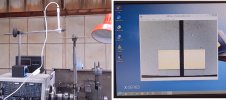
Here's his original setup with the gear being cut, mounted on a shaft supported vertically. The paper pattern is on the disc at top - where markings are aligned to the scriber tip.

Simple indexing for gear cutting_by Xynudu.jpg

The scriber was then replaced with a USB microscope, for viewing the lines on a computer screen. Two 'Sticky Notes' on the screen are used as 'goal posts' to capture the lines when rotating the indexing disc.

Simple indexing via USB microscope for gear cutting_by Xynudu.jpg


-Brian McK.
 

Rob Pulham

Western Thunderer
Thanks Brian, I am constantly amazed by people's ingenuity.
I am actually subscribed to Xynudu on YouTube but I missed that one.
 

Rob Pulham

Western Thunderer
The advantage of the involute gear tooth profile is that the tooth depth is greater than with screw threads because of the different pressure angles. This is of course a great advantage for us modellers in respect of meshing. As they get shallower so the depth reduces. BA threads with their 47.5 degree angle are a decent compromise. I’ve often cut substitute BA worms ( using a die) to go with the 38 tooth 100dp wormwheels Alan Gibson used to produce.

Bob

Having just checked my BA thread chart, I was mildly surprised to find that 0BA is 6mm diameter with a 1mm pitch but as discussed a different thread profile.

I have a number of 6mm steel rods, retrieved from old printers and toner cartridges so I can practice with them to my heart's content.
 

Bob Essex

Western Thunderer
Having just checked my BA thread chart, I was mildly surprised to find that 0BA is 6mm diameter with a 1mm pitch but as discussed a different thread profile.

I have a number of 6mm steel rods, retrieved from old printers and toner cartridges so I can practice with them to my heart's content.

Yes, BA threads are geometric based. Specifically designed for small sized scientific applications and such like which is why they are so useful for model making.

Bob
 
Top